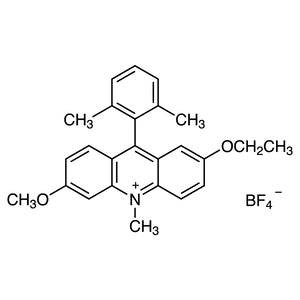
TCI D5983 9-(2,6-Dimethylphenyl)-2-ethoxy-6-methoxy-10-methylacridinium Tetrafluoroborate is an organic photocatalyst of the acridinium class, developed specifically for metal-free photoredox reactions. Its molecule consists of a positively charged acridinium core bearing an ethoxy group and a methoxy group on the aromatic rings, a methyl group on the nitrogen atom, and a 2,6-dimethylphenyl ring attached at the nine position; the positive charge is balanced by a tetrafluoroborate anion. In the laboratory, this compound absorbs visible light and converts into an excited species capable of removing an electron from a substrate, thereby generating radical cations that serve as the starting point for a wide range of organic transformations.
Several structural features explain why this catalyst is chosen over alternatives. In the excited state, acridinium salts rank among the strongest organic oxidants available, allowing them to oxidize substrates that lie beyond the reach of conventional metal-based photocatalysts. The 2,6-dimethylphenyl ring is twisted perpendicular to the plane of the acridinium core, which blocks nucleophilic attack at the nine position — the principal decomposition pathway of simpler acridinium salts — so the catalyst remains substantially more robust over the course of a reaction. The combination of strong excited-state oxidizing power and structural durability makes it a dependable choice for demanding photoredox work.
In Indonesian laboratories, this photocatalyst is typically used in university research groups, synthetic organic chemistry laboratories, and institutional research facilities that carry out visible-light-driven reactions. It suits settings where researchers wish to avoid precious-metal photocatalysts, whether for cost reasons, ease of product purification, or the desire to keep residual metals out of the final compound. The material is handled in ordinary photoreactor setups illuminated with visible-light sources, and it fits readily into method development and reaction screening workflows.
Advantages (TCI brochure)
- Maximum absorption occurs around 450 nm.
- More active than the conventional acridinium photoredox catalysts.
- Applicable to decarboxylations and halogenations via the photoredox reaction.
- Used in SNAr type substitutions and C-H activation reactions.
TCI brochures (PDF)
- Highly Active Visible Light Photoredox Organocatalyst Acr-450 2026-08-07 · p. 1
- Visible Light Photoredox Catalysts 2026-04-28 · p. 4
- Organic Photoreaction Reagents 2025-02-13 · p. 4
Related TCI products
- TCI B2897 2743539-91-3 9-(2-Biphenylyl)-10-methylacridinium Perchlorate
- TCI M1787 26456-05-3 10-Methylacridinium Perchlorate
- TCI M1774 674783-97-2 9-Mesityl-10-methylacridinium Perchlorate
- TCI M2072 1216909-33-9 9-Mesityl-2,7,10-trimethylacridinium Perchlorate
- TCI T3968 448-61-3 2,4,6-Triphenylpyrylium Tetrafluoroborate
- TCI D6218 1810004-87-5 3,6-Di-tert-butyl-9-mesityl-10-phenylacridinium Tetrafluoroborate
- Metal-free photoredox catalysis: serves as the light-absorbing oxidant in reactions where researchers deliberately avoid precious-metal complexes, simplifying purification and removing concerns over residual metal contamination in the isolated product.
- Radical cation generation from organic substrates: the excited acridinium species removes an electron from the substrate, producing radical cations that open reaction pathways unavailable through conventional two-electron polar chemistry.
- Oxidation of difficult substrates: because excited acridinium salts are among the strongest organic oxidants available, they reach substrates whose oxidation potentials lie outside the working range of common metal-based photocatalysts.
- Visible-light-driven synthetic methodology: the compound absorbs visible light directly, so reactions can be run with ordinary visible-light sources rather than equipment demanding specialized ultraviolet irradiation and associated protective measures.
- Extended-duration photoreactions: the perpendicular 2,6-dimethylphenyl ring shields the nine position against nucleophilic attack, so catalyst decomposition is slowed and performance is sustained across longer reaction times.
From the TCI brochure
- Decarboxylation of photoredox reaction: 98% conversion
- SNAr type substitution of photoredox reaction: 51% NMR yield
| Brand | TCI |
|---|---|
| CAS number | 2771238-32-3 |
| Molecular formula | — |
| Purity | — |
| Category | Chemistry > Catalysis and Inorganic Chemistry > Photocatalysts [Catalysis] |
| Pack sizes | available in standard catalogue pack sizes; please confirm the currently offered size when ordering |
| Physical form | — |
| Storage | store according to the conditions stated on the manufacturer's label and safety data sheet |
- Product code: D5983
Data from the TCI brochure
| Maximum absorption | around 450 nm |
|---|---|
| Conversion (decarboxylation) | 98% conversion (D5983 1 mol%, imidazole 1 eq., 4-isopropylbenzenethiol 0.7 eq., CH2Cl2 / CH3OH, LED (447 nm), 1 h) |
| Yield (SNAr type substitution) | 51% NMR yield (D5983 5 mol%, BzOH 3 eq., NaHCO3 2 eq., 2,2,2-trifluoroethanol, LED (447 nm), 20 h) |
Source: TCI brochure RR168 (2026-08-07)
Store the material in its original tightly closed container, following the storage conditions specified on the manufacturer's label and safety data sheet. As a photocatalyst, it should be protected from unnecessary light exposure and kept in a cool, dry place away from moisture and incompatible substances. Handle in a well-ventilated area or fume hood using appropriate personal protective equipment, including gloves, safety glasses, and a laboratory coat. Use clean, dry spatulas when weighing to avoid contaminating the stock, reseal the container promptly after use, and consult the safety data sheet before handling, disposal, or spill cleanup.
—
Produk Terkait
-
9-(2-Biphenylyl)-10-methylacridiniumPerchlorate TCI B2897
Regular price Rp 4.240.950,00Regular price -
10-MethylacridiniumPerchlorate TCI M1787
Regular price From Rp 1.326.150,00Regular price -
9-Mesityl-10-methylacridiniumPerchlorate TCI M1774
Regular price Rp 3.817.800,00Regular price -
9-Mesityl-2,7,10-trimethylacridiniumPerchlorate TCI M2072
Regular price Rp 9.063.600,00Regular price -
2,4,6-TriphenylpyryliumTetrafluoroborate TCI T3968
Regular price Rp 1.829.100,00Regular price -
3,6-Di-tert-butyl-9-mesityl-10-phenylacridiniumTetrafluoroborate TCI D6218
Regular price Rp 4.771.200,00Regular price -
10-Methyl-9-phenylacridiniumPerchlorate TCI M1775
Regular price From Rp 2.704.800,00Regular price -
AcriflavineHydrochloride(mixtureof3,6-Diamino-10-methylacridiniumChlorideHydrochlorideand3,6-DiaminoacridineHydrochloride) TCI A0677
Regular price From Rp 1.803.900,00Regular price