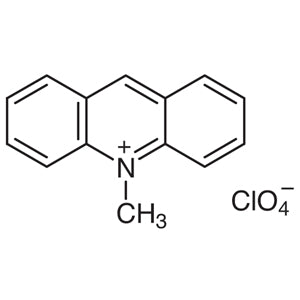
10-Methylacridinium Perchlorate is a simple acridinium salt composed of an acridinium cation methylated at the nitrogen atom, carrying no substituent at the 9-position, paired with a perchlorate anion. It is widely known in the laboratory as a hydride acceptor and an electron acceptor, and equally as a chemical model for studying hydride transfer reactions that resemble the action of the coenzyme NAD⁺ in biological systems. Its role on the researcher's bench is to provide a well-defined organic oxidant whose reactions can be followed easily through colour change or through spectroscopic measurement.
The property that makes it the preferred choice is the pronounced electron deficiency of the positively charged acridinium framework, which renders the C-9 position strongly electrophilic and ready to accept a hydride to form neutral 10-methylacridan. This acridinium/acridan pair forms a reversible redox system that is extremely useful for mechanistic study. In addition, its fused aromatic system absorbs visible light and fluoresces, so electron transfer reactions can be monitored through fluorescence quenching. As an organocatalyst it operates without transition metals, so products remain free of metal residues.
In Indonesian laboratories this compound is typically used in university and institutional research groups working on photoredox chemistry, organocatalysis, and reaction mechanism studies. It suits work where a clean, metal-free oxidant is needed and where the progress of a reaction must be tracked by UV-visible or fluorescence spectroscopy. Because it is supplied as a defined reagent from TCI, it is also convenient for teaching-level advanced practical work and for method development prior to scale-up.
TCI brochures (PDF)
- Visible Light Photoredox Catalysts 2026-04-28 · p. 4
- Organic Photoreaction Reagents 2025-02-13 · p. 7
- Oxidizing Agents 2025-06-11 · p. 9
Related TCI products
- TCI B2897 2743539-91-3 9-(2-Biphenylyl)-10-methylacridinium Perchlorate
- TCI M1774 674783-97-2 9-Mesityl-10-methylacridinium Perchlorate
- TCI M2072 1216909-33-9 9-Mesityl-2,7,10-trimethylacridinium Perchlorate
- TCI M1775 36519-61-6 10-Methyl-9-phenylacridinium Perchlorate
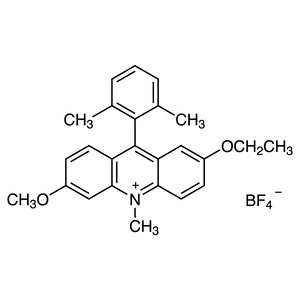
- TCI D5983 2771238-32-3 9-(2,6-Dimethylphenyl)-2-ethoxy-6-methoxy-10-methylacridinium Tetrafluoroborate
- TCI D6218 1810004-87-5 3,6-Di-tert-butyl-9-mesityl-10-phenylacridinium Tetrafluoroborate
- Hydride transfer mechanism studies: the electrophilic C-9 position accepts hydride cleanly to give 10-methylacridan, providing a well-behaved and reproducible model reaction for kinetic and mechanistic investigation.
- NAD⁺ coenzyme modelling: the acridinium cation mimics the hydride-accepting behaviour of the biological coenzyme, letting researchers examine biomimetic redox chemistry without handling sensitive enzymatic systems.
- Photoredox and electron transfer research: the fused aromatic system absorbs visible light and fluoresces, so single-electron transfer events can be followed directly through fluorescence quenching experiments.
- Metal-free organocatalysis: because the compound catalyses without any transition metal centre, reaction products remain free of metal residues that would otherwise require additional purification steps.
- Reversible redox system investigation: the acridinium/acridan couple cycles between oxidised and reduced forms, making it a practical reference system for studying reversible organic redox behaviour and electrode processes.
| Brand | TCI (Tokyo Chemical Industry) |
|---|---|
| CAS number | 26456-05-3 |
| Molecular formula | — |
| Purity | — |
| Category | Chemistry > Catalysis and Inorganic Chemistry > Organocatalysts [Catalysis] |
| Pack sizes | available in standard laboratory research pack sizes; please confirm the currently offered size when ordering |
| Physical form | — |
| Storage | keep in a tightly closed container in a cool, dry, well-ventilated place away from light |
- Catalogue number: M1787
Store the container tightly closed in a cool, dry and well-ventilated area, protected from direct sunlight and from sources of heat, ignition, or friction. Keep the material in its original supplier container or in a chemically compatible, clearly labelled amber glass container, and avoid contact with reducing agents and combustible or organic materials. Handle only in a fume hood using safety goggles, chemical-resistant gloves, and a laboratory coat. Weigh with clean, dry spatulas to prevent contamination and moisture uptake, close the container immediately after use, and dispose of residues and contaminated materials through the authorised chemical waste route in accordance with the supplier safety data sheet and local institutional regulations.
—
Product Categories
Produk Terkait
-
9-(2-Biphenylyl)-10-methylacridiniumPerchlorate TCI B2897
Regular price Rp 4.240.950,00Regular price -
9-Mesityl-10-methylacridiniumPerchlorate TCI M1774
Regular price Rp 3.817.800,00Regular price -
9-Mesityl-2,7,10-trimethylacridiniumPerchlorate TCI M2072
Regular price Rp 9.063.600,00Regular price -
10-Methyl-9-phenylacridiniumPerchlorate TCI M1775
Regular price From Rp 2.704.800,00Regular price -
9-(2,6-Dimethylphenyl)-2-ethoxy-6-methoxy-10-methylacridiniumTetrafluoroborate TCI D5983
Regular price From Rp 3.367.350,00Regular price -
3,6-Di-tert-butyl-9-mesityl-10-phenylacridiniumTetrafluoroborate TCI D6218
Regular price Rp 4.771.200,00Regular price -
AcriflavineHydrochloride(mixtureof3,6-Diamino-10-methylacridiniumChlorideHydrochlorideand3,6-DiaminoacridineHydrochloride) TCI A0677
Regular price From Rp 1.803.900,00Regular price -
Acriflavine(mixtureof3,6-Diamino-10-methylacridiniumChlorideand3,6-Diaminoacridine) TCI A0134
Regular price Rp 2.121.000,00Regular price