


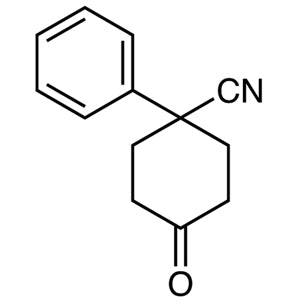
1-Phenylcyclohexanecarbonitrile is an organic compound widely used as a foundational building block in the synthesis of complex chemical structures. Its molecular structure consists of a cyclohexanecarbonitrile group attached to a phenyl ring, making it a versatile intermediate in various chemical reactions. This compound plays a crucial role in organic chemistry laboratories, where it is employed to construct more intricate molecular frameworks. Its ability to participate in both nucleophilic and electrophilic reactions makes it a valuable tool for chemists seeking to develop new compounds with specific functional properties.
The compound is prized for its chemical stability and compatibility with a wide range of synthetic methodologies. Its predictable reactivity allows researchers to tailor its behavior in different reaction conditions, enhancing its utility in both academic and industrial settings. The solid form of this material ensures ease of handling and storage, while its consistent quality supports reproducibility in experimental outcomes. These characteristics make it a reliable choice for laboratories aiming to achieve precise and controlled chemical transformations.
In Indonesian laboratories, 1-Phenylcyclohexanecarbonitrile is commonly used in research related to pharmacology, chemical materials, and organic synthesis. Local researchers frequently incorporate this compound into the development of new substances with potential applications in medicine and industry. Its availability and ease of use make it a preferred option for both small-scale experiments and larger research projects.
Related TCI products
- TCI O0470 25115-74-6 4-Oxo-1-phenylcyclohexanecarbonitrile
- TCI A3039 103646-82-8 5-Amino-1-(p-tolyl)pyrazole-4-carbonitrile
- TCI P2252 14377-68-5 1-Phenylcyclobutanecarbonitrile
- TCI P2146 77-57-6 1-Phenylcyclopentanecarbonitrile
- TCI C4103 24973-49-7 [1,1'-Biphenyl]-2-carbonitrile
- TCI B6956 690260-67-4 2'-Bromo-[1,1'-biphenyl]-3-carbonitrile
- Synthesis of heterocyclic compounds for the development of new pharmaceuticals, as it provides a stable and reactive core for ring formation.
- Production of specialized polymers, where its carbonitrile group can be functionalized to create unique material properties.
- Research on the reactivity of aromatic compounds, due to its phenyl group’s ability to participate in electrophilic substitution reactions.
- Development of novel chemical intermediates for industrial applications, leveraging its structural versatility and synthetic potential.
- Exploration of catalytic processes in organic chemistry, as it can serve as a substrate for various reaction mechanisms.
| Brand | TCI |
|---|---|
| CAS number | 2201-23-2 |
| Molecular formula | — |
| Purity | — |
| Category | Chemistry > Building Blocks > Non-Heterocyclic Building Blocks |
| Pack sizes | Available in standard laboratory quantities |
| Physical form | Solid |
| Storage | Store in a cool, dry place away from moisture and direct sunlight |
This compound should be stored in a cool, dry environment to maintain its chemical stability. It is recommended to keep it in a sealed container to prevent exposure to moisture and air, which could affect its integrity. Due to its solid form, it is suitable for storage in glass or polyethylene containers that are resistant to chemical degradation. In laboratory settings, it should be handled with standard safety precautions, including the use of personal protective equipment. While it does not require special handling beyond general chemical safety protocols, it is important to ensure that it is stored separately from incompatible substances to avoid any potential chemical interactions.
—
Produk Terkait
-
4-Oxo-1-phenylcyclohexanecarbonitrile TCI O0470
Regular price Rp 2.174.550,00Regular price -
5-Amino-1-(p-tolyl)pyrazole-4-carbonitrile TCI A3039
Regular price Rp 3.312.750,00Regular price -
1-Phenylcyclobutanecarbonitrile TCI P2252
Regular price From Rp 1.378.650,00Regular price -
1-Phenylcyclopentanecarbonitrile TCI P2146
Regular price From Rp 2.625.000,00Regular price -
[1,1'-Biphenyl]-2-carbonitrile TCI C4103
Regular price From Rp 2.094.750,00Regular price -
2'-Bromo-[1,1'-biphenyl]-3-carbonitrile TCI B6956
Regular price From Rp 2.757.300,00Regular price -
3'-Bromo[1,1'-biphenyl]-4-carbonitrile TCI B5965
Regular price From Rp 2.359.350,00Regular price -
3'-Bromo[1,1'-biphenyl]-3-carbonitrile TCI B5964
Regular price From Rp 2.094.750,00Regular price


![[1,1'-Biphenyl]-2-carbonitrile (CAS 24973-49-7) - TCI C4103 - AMI Scientific](http://amiscientific.com/cdn/shop/files/TCI2510C4103.jpg?v=1769180472&width=533)
![2'-Bromo-[1,1'-biphenyl]-3-carbonitrile (CAS 690260-67-4) - TCI B6956 - AMI Scientific](http://amiscientific.com/cdn/shop/files/TCI2510B6956.jpg?v=1771058291&width=533)
![3'-Bromo[1,1'-biphenyl]-4-carbonitrile (CAS 160521-46-0) - TCI B5965 - AMI Scientific](http://amiscientific.com/cdn/shop/files/TCI2510B5965.jpg?v=1769180247&width=533)
![3'-Bromo[1,1'-biphenyl]-3-carbonitrile (CAS 1040141-34-1) - TCI B5964 - AMI Scientific](http://amiscientific.com/cdn/shop/files/TCI2510B5964.jpg?v=1769144661&width=533)