![1258780-50-5 9-Phenyl-3,6-bis[4-(1-phenylbenzimidazol-2-yl)phenyl]carbazole - AMI Scientific](http://amiscientific.com/cdn/shop/files/TCI2510P2330.jpg?v=1768819379&width=1946)
![1258780-50-5 9-Phenyl-3,6-bis[4-(1-phenylbenzimidazol-2-yl)phenyl]carbazole - AMI Scientific](http://amiscientific.com/cdn/shop/files/TCI2510P2330.jpg?v=1768819379&width=1445)
9-Phenyl-3,6-bis[4-(1-phenylbenzimidazol-2-yl)phenyl]carbazole is a large conjugated organic molecule. Its core is a carbazole unit with a phenyl group on the nitrogen atom. The 3 and 6 positions of the carbazole each carry a phenyl arm, and each arm is linked to a 1-phenylbenzimidazole unit. TCI classifies this compound as an Organic Light-Emitting Diode (OLED) material. Laboratories use it in research on organic electronic devices, especially to study host layers, charge-transport layers, or emissive layers in OLED devices.
The structure of this compound brings together two types of units with different electronic character. Carbazole is known as a unit that supports hole transport, while benzimidazole is often used as a unit that supports electron transport. Researchers call this kind of design bipolar. Bipolar molecules are widely studied as host materials because they help balance charge flow within the emissive layer. OLED research also commonly links a large molecular size and a rigid aromatic framework with good thermal stability and good thin-film morphology. Together, these features make the compound useful for studying how molecular design relates to device performance.
In Indonesia, organic optoelectronics research is carried out in physics, materials engineering, and chemistry study programs. In these settings, this compound can serve as a reference or working material for fabricating and characterizing experimental OLED devices. It also fits final-year projects, theses, and research groups that compare host materials or examine charge balance in multilayer device stacks. Researchers who want to understand how bipolar molecular design affects efficiency and stability in organic light-emitting devices will also find it relevant.
TCI brochures (PDF)
- Organic Light-Emitting Diode (OLED) Materials 2026-08-18 · p. 3
- Carbazoles 2025-06-27 · p. 5
Related TCI products
- TCI D4919 1338446-77-7 9-[3-(Dibenzofuran-2-yl)phenyl]-9H-carbazole
- TCI C4038 1392506-99-8 9-[3-(9H-Carbazol-9-yl)phenyl]-9H-carbazole-3-carbonitrile
- TCI D6033 175606-05-0 5,10,15,20-Tetraphenylbenzo[5,6]indeno[1,2,3-cd]benzo[5,6]indeno[1,2,3-lm]perylene
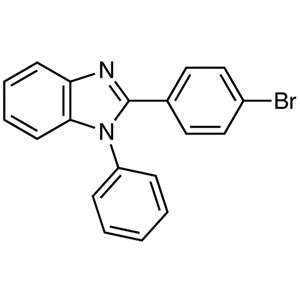
- TCI B4479 2620-76-0 2-(4-Bromophenyl)-1-phenylbenzimidazole
- TCI P3214 1527-91-9 N-Phenylbenzimidamide
- TCI P1105 716-79-0 2-Phenylbenzimidazole
- OLED host material research: the bipolar carbazole and benzimidazole design makes this compound suitable for studying how a host balances hole and electron flow in the emissive layer.
- Charge-transport layer studies: because it combines a hole-supporting carbazole core with electron-supporting benzimidazole arms, it suits experiments that compare charge-transport behaviour in multilayer devices.
- Emissive layer investigations: its large conjugated aromatic framework makes it a relevant candidate when researchers evaluate how molecular structure affects light emission in experimental OLED device stacks.
- Thin-film morphology research: the rigid aromatic structure, commonly associated with good film morphology, makes it useful for studying film formation and its effect on device performance.
- Structure–property teaching and research: the molecule clearly combines units with different electronic roles, which makes it a useful example for academic work on molecular design in organic electronics.
| Brand | TCI (product code P2330) |
|---|---|
| CAS number | 1258780-50-5 |
| Molecular formula | — |
| Purity | — |
| Category | Materials Science > Electronic Materials > Organic Light-Emitting Diode (OLED) Materials |
| Pack sizes | available in the pack sizes offered by TCI; please confirm the available options when ordering |
| Physical form | — |
| Storage | follow the storage conditions stated on the TCI label and Safety Data Sheet (SDS) |
Store this compound in its original tightly closed container in a cool, dry, well-ventilated place. Keep it away from direct light, moisture, and incompatible substances, and always follow the specific storage conditions on the TCI label and Safety Data Sheet. For sensitive OLED experiments, many laboratories handle such materials under inert or controlled conditions to limit contamination. Wear suitable personal protective equipment, such as gloves, safety glasses, and a lab coat. Avoid creating or inhaling dust, and work in a fume hood or well-ventilated area. Label every transferred portion clearly, and dispose of waste according to institutional and local regulations.
—
Produk Terkait
-
9-[3-(Dibenzofuran-2-yl)phenyl]-9H-carbazole TCI D4919
Regular price From Rp 3.127.950,00Regular price -
9-[3-(9H-Carbazol-9-yl)phenyl]-9H-carbazole-3-carbonitrile TCI C4038
Regular price From Rp 2.359.350,00Regular price -
5,10,15,20-Tetraphenylbenzo[5,6]indeno[1,2,3-cd]benzo[5,6]indeno[1,2,3-lm]perylene TCI D6033
Regular price Rp 7.924.350,00Regular price -
2-(4-Bromophenyl)-1-phenylbenzimidazole TCI B4479
Regular price Rp 1.298.850,00Regular price -
N-Phenylbenzimidamide TCI P3214
Regular price From Rp 1.035.300,00Regular price -
2-Phenylbenzimidazole TCI P1105
Regular price Rp 848.400,00Regular price -
2-(4-Iodophenyl)-1-phenylbenzimidazole TCI I0983
Regular price From Rp 1.908.900,00Regular price -
2,3-Dihydro-1,3-dimethyl-2-phenylbenzimidazole TCI D4470
Regular price From Rp 4.056.150,00Regular price
![9-[3-(Dibenzofuran-2-yl)phenyl]-9H-carbazole (CAS 1338446-77-7) - TCI D4919 - AMI Scientific](http://amiscientific.com/cdn/shop/files/TCI2510D4919.jpg?v=1769180683&width=533)
![9-[3-(9H-Carbazol-9-yl)phenyl]-9H-carbazole-3-carbonitrile (CAS 1392506-99-8) - TCI C4038 - AMI Scientific](http://amiscientific.com/cdn/shop/files/TCI2510C4038.jpg?v=1768817181&width=533)
![5,10,15,20-Tetraphenylbenzo[5,6]indeno[1,2,3-cd]benzo[5,6]indeno[1,2,3-lm]perylene (CAS 175606-05-0) - TCI D6033 - AMI Scientific](http://amiscientific.com/cdn/shop/files/TCI2510D6033.jpg?v=1771058235&width=533)