(5-Phenylisoxazol-3-yl)methanol from TCI is a heterocyclic building block. It consists of an isoxazole ring with a phenyl substituent at position 5 and a hydroxymethyl group at position 3. Isoxazole is a five-membered heterocycle in which a nitrogen atom and an oxygen atom sit next to each other, and the ring appears often in drug molecules and agrochemicals. In the laboratory, this compound is a starting point for building more complex isoxazole derivatives, especially in medicinal chemistry research and organic synthesis.
Chemists choose this compound because its primary alcohol group is easy to modify. The group can be oxidized to an aldehyde or a carboxylic acid, converted to a halide or mesylate for nucleophilic substitution, or used in etherification and esterification. This lets one starting material give many analogues. The isoxazole ring is relatively stable under many reaction conditions and is often used as a bioisostere for ester or amide groups. The phenyl group adds a lipophilic aromatic part that helps the molecule interact with protein binding pockets.
In Indonesia, this material is useful for pharmaceutical chemistry, medicinal chemistry, and organic synthesis laboratories at universities and research institutions that develop new heterocyclic compounds. Research groups making analogue libraries for structure-activity relationship studies can use it as a dependable scaffold. It also suits teaching and thesis work on heterocyclic chemistry, where students practise functional group transformations on a well-defined aromatic heterocycle and learn how small structural changes affect biological or physical behaviour.
Related TCI products
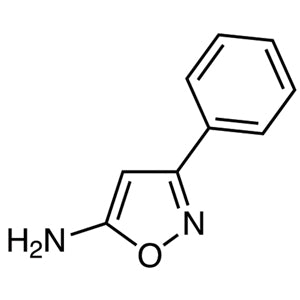
- TCI A2437 4369-55-5 5-Amino-3-phenylisoxazole
- TCI P2390 14442-12-7 3-Phenylisoxazole-5-carboxylic Acid
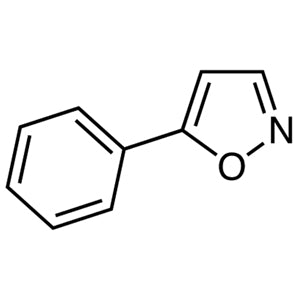
- TCI P2309 1006-67-3 5-Phenylisoxazole
- TCI P2020 14441-90-8 5-Phenylisoxazole-3-carboxylic Acid
- TCI M2996 16883-16-2 5-Methyl-3-phenylisoxazole-4-carbonyl Chloride
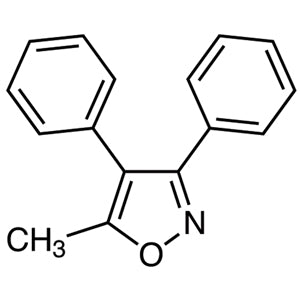
- TCI M2830 37928-17-9 5-Methyl-3,4-diphenylisoxazole
- Medicinal chemistry analogue synthesis: the modifiable hydroxymethyl group lets researchers build a series of isoxazole derivatives from one starting material for structure-activity relationship studies.
- Oxidation to aldehydes and carboxylic acids: the primary alcohol can be oxidized to give isoxazole aldehydes or acids, which serve as intermediates for further coupling and condensation reactions.
- Nucleophilic substitution routes: converting the alcohol to a halide or mesylate gives a reactive electrophile, so amines, thiols, and other nucleophiles can be attached to the isoxazole scaffold.
- Ether and ester formation: etherification and esterification of the hydroxyl group give quick access to derivatives with different lipophilicity and steric properties for screening programs.
- Bioisostere design in drug discovery: the isoxazole ring often replaces ester or amide groups, so this building block helps researchers study more stable alternatives to those functional groups.
| Brand | TCI (product code P2386) |
|---|---|
| CAS number | 1619-37-0 |
| Molecular formula | — |
| Purity | — |
| Category | Chemistry > Building Blocks > Heterocyclic Building Blocks |
| Pack sizes | available in TCI's standard pack sizes; please check the product listing for current options |
| Physical form | refer to the TCI product label and Safety Data Sheet |
| Storage | follow the storage conditions stated on the TCI label and Safety Data Sheet |
Store this compound in its original, tightly closed container in a cool, dry, well-ventilated place, away from direct sunlight, heat sources, and strong oxidizing agents. Follow the storage temperature on the TCI label. Reseal the container right after use to limit exposure to moisture and air. Handle the material in a fume hood or well-ventilated area, and wear safety glasses, chemical-resistant gloves, and a lab coat. Avoid breathing dust or vapour and avoid contact with skin and eyes. Read the Safety Data Sheet before use, and dispose of waste according to institutional and local regulations.
—
Produk Terkait
-
5-Amino-3-phenylisoxazole TCI A2437
Regular price Rp 2.359.350,00Regular priceRp 1.665.300,00Sale price Rp 2.359.350,00 -
3-Phenylisoxazole-5-carboxylicAcid TCI P2390
Regular price From Rp 2.384.550,00Regular priceRp 1.683.150,00Sale price From Rp 2.384.550,00 -
5-Phenylisoxazole TCI P2309
Regular price From Rp 1.618.050,00Regular priceRp 1.146.600,00Sale price From Rp 1.618.050,00 -
5-Phenylisoxazole-3-carboxylicAcid TCI P2020
Regular price From Rp 2.068.500,00Regular priceRp 1.461.600,00Sale price From Rp 2.068.500,00 -
5-Methyl-3-phenylisoxazole-4-carbonylChloride TCI M2996
Regular price From Rp 822.150,00Regular priceRp 590.100,00Sale price From Rp 822.150,00 -
5-Methyl-3,4-diphenylisoxazole TCI M2830
Regular price From Rp 900.900,00Regular priceRp 645.750,00Sale price From Rp 900.900,00 -
(1H-1,2,4-Triazol-1-yl)methanol TCI T3797
Regular price Rp 3.790.500,00Regular priceRp 2.665.950,00Sale price Rp 3.790.500,00