

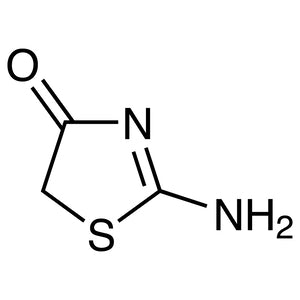
Pseudothiohydantoin from TCI, also known as 2-imino-4-thiazolidinone, is a five-membered heterocyclic compound. Its ring contains both a sulfur and a nitrogen atom, and its framework carries a carbonyl group as well as an imino/amino group. In the laboratory, it is a widely used heterocyclic building block for preparing thiazolidinone and thiazole derivatives. These compound classes get wide attention in medicinal chemistry because of the many biological activities reported for their derivatives. This makes Pseudothiohydantoin a useful starting material for synthetic and exploratory research programs.
Chemists choose this compound mainly for the active methylene group at position 5 of the ring, which sits between the carbonyl group and the sulfur atom. This methylene group readily undergoes Knoevenagel condensation with aromatic aldehydes to give 5-arylidene derivatives, a popular scaffold in research on bioactive compounds. The imino/amino group at position 2 can also be derivatized further, which opens a second route to structural variation. The compound can also exist in several tautomeric forms, which makes it of interest for spectroscopic and structural studies. Because this small molecule has several reactive sites, researchers can use it to build a series of analogs efficiently.
In Indonesia, Pseudothiohydantoin is especially relevant to synthesis research in university chemistry and pharmacy departments, research institutes, and laboratories working on medicinal chemistry. Research groups that design and screen new heterocyclic compounds can use it as a dependable core for building small libraries of thiazolidinone and thiazole derivatives. It also suits graduate and undergraduate research projects on condensation chemistry, heterocycle derivatization, and structure characterization. Supplying it under the TCI brand helps Indonesian laboratories keep their starting materials consistent from one experiment to the next.
Related TCI products
- TCI P0756 4333-22-6 Phenylthiohydantoin-norleucine
- TCI P0731 182153-75-9 Phenylthiohydantoin-arginine Hydrochloride
- TCI P0729 4333-21-5 Phenylthiohydantoin-proline
- TCI P0625 29635-94-7 Phenylthiohydantoin-(Nepsilon-phenylthiocarbamyl)-lysine
- TCI P0379 4333-20-4 Phenylthiohydantoin-valine
- TCI P0378 5789-24-2 Phenylthiohydantoin-tryptophan
- Synthesis of thiazolidinone derivatives: the five-membered ring already contains sulfur, nitrogen, and a carbonyl group, so it serves directly as the core for building substituted thiazolidinone analogs.
- Knoevenagel condensation with aromatic aldehydes: the active methylene group at position 5, between the carbonyl and sulfur, reacts readily with aldehydes to form 5-arylidene derivatives for further study.
- Preparation of thiazole-based compounds: as a heterocyclic building block, it provides a convenient entry point for synthetic routes that lead to thiazole derivatives used in medicinal chemistry research.
- Derivatization at the 2-position: the imino/amino group at position 2 can be modified further, so researchers can add more structural diversity when preparing a series of analogs.
- Spectroscopic and structural studies: because the compound can exist in several tautomeric forms, it is a useful model substance for spectroscopic investigation and structural analysis in research and teaching laboratories.
| Brand | TCI (product code P2911) |
|---|---|
| CAS number | 556-90-1 |
| Molecular formula | — |
| Purity | — |
| Category | Chemistry > Building Blocks > Heterocyclic Building Blocks |
| Pack sizes | please contact AMI Scientific for the pack sizes currently available |
| Physical form | — |
| Storage | follow the conditions given on the TCI label and Safety Data Sheet |
- Synonym: 2-Imino-4-thiazolidinone
Store Pseudothiohydantoin in its original, tightly closed container, as recommended on the TCI label and in the Safety Data Sheet. Keep it in a cool, dry, well-ventilated place, away from direct sunlight, moisture, and incompatible substances. Reseal the container promptly after each use to protect the material from humidity and contamination. Handle the compound according to good laboratory practice, wearing gloves, safety glasses, and a lab coat. Work in a fume hood or well-ventilated area and avoid breathing in dust or letting it touch skin and eyes. Before use, read the Safety Data Sheet for complete hazard, first-aid, and disposal information. Dispose of waste in line with local regulations.
—
Produk Terkait
-
Phenylthiohydantoin-norleucine TCI P0756
Regular price Rp 689.850,00Regular price -
Phenylthiohydantoin-arginineHydrochloride TCI P0731
Regular price Rp 1.273.650,00Regular price -
Phenylthiohydantoin-proline TCI P0729
Regular price Rp 584.850,00Regular price -
Phenylthiohydantoin-(Nepsilon-phenylthiocarbamyl)-lysine TCI P0625
Regular price From Rp 743.400,00Regular price -
Phenylthiohydantoin-valine TCI P0379
Regular price Rp 637.350,00Regular price -
Phenylthiohydantoin-tryptophan TCI P0378
Regular price From Rp 1.140.300,00Regular price -
Phenylthiohydantoin-glycine TCI P0376
Regular price Rp 1.115.100,00Regular price -
Phenylthiohydantoin-tyrosine TCI P0368
Regular price From Rp 505.050,00Regular price


