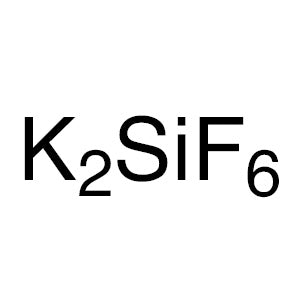
Potassium Hexafluorosilicate (TCI P2922), also known as potassium fluorosilicate, has the formula K₂SiF₆. It is an inorganic salt made up of one hexafluorosilicate anion and two potassium cations. In the laboratory it serves as a stable source of silicon and fluoride, a starting material for synthesizing inorganic materials, and a study compound in main-group element chemistry. It is best known as the host matrix for the red phosphor K₂SiF₆:Mn⁴⁺ (KSF). That phosphor is widely studied for white LEDs with high color rendering, so this compound is relevant to both fundamental inorganic chemistry and applied materials research.
Researchers choose this compound because the SiF₆²⁻ anion is fairly stable in solid form. It is also easier to handle than more reactive fluoride sources. Its solubility in water is relatively low, and precipitation and crystallization methods use this property to produce materials with controlled morphology. The octahedral crystal structure provides suitable sites for Mn⁴⁺ dopant ions, which makes it the basis of narrow-band red phosphors. Under acidic conditions the compound can release fluoride, so it can also act as a fluorinating agent in certain syntheses. These properties make it a versatile reagent for both synthesis and materials work.
In Indonesia, this material is relevant to inorganic chemistry, materials physics, and materials engineering laboratories that research phosphors and luminescent materials. University research groups working on LED phosphor development, crystal growth, and doped inorganic hosts can use it as a well-defined starting compound. Teaching laboratories covering main-group chemistry may also use it to show the behavior of hexafluoro complex anions. Supplied under the TCI brand, it gives Indonesian researchers a consistent reagent for reproducible experimental work.
TCI brochures (PDF)
- Red phosphor synthesis: Researchers use it as the host matrix for K₂SiF₆:Mn⁴⁺ (KSF) because its octahedral sites accept Mn⁴⁺ dopants, which produce narrow-band red emission for white LEDs.
- Precipitation and crystallization studies: Its relatively low water solubility lets researchers control precipitation and crystal growth, which helps them produce inorganic materials with controlled particle morphology.
- Silicon and fluoride source: The fairly stable solid SiF₆²⁻ anion supplies both silicon and fluoride in a form that is easier to handle than more reactive fluoride reagents.
- Fluorination reactions: Under acidic conditions the compound releases fluoride, so it can serve as a fluorinating agent in selected synthetic routes that need controlled fluoride delivery.
- Main-group element chemistry research: As a well-defined hexafluoro complex of silicon, it is a useful model compound for studying the structure, bonding, and reactivity of main-group elements.
| Brand | TCI (product code P2922) |
|---|---|
| CAS number | 16871-90-2 |
| Molecular formula | — |
| Purity | — |
| Category | Chemistry > Catalysis and Inorganic Chemistry > Main-group Elements |
| Pack sizes | Available in TCI standard pack sizes; please refer to the product listing for current options |
| Physical form | Crystalline solid |
| Storage | Keep tightly closed in a cool, dry place, away from acids |
Store Potassium Hexafluorosilicate in its original, tightly sealed container in a cool, dry, well-ventilated area, protected from moisture. Keep it well away from acids, because acidic conditions can release fluoride species. Use chemically compatible containers and label them clearly. Handle the material in a fume hood or another well-ventilated area, and avoid creating or breathing in dust. Wear suitable protective equipment, including gloves, safety glasses, and a lab coat. Wash your hands thoroughly after handling. Always consult the TCI Safety Data Sheet for full hazard, first-aid, and disposal information before use, and follow institutional and local regulations for fluoride-containing waste.
—
Produk Terkait
-
PotassiumPhosphateHydrate TCI T3998
Regular price From Rp 530.250,00Regular priceRp 386.400,00Sale price From Rp 530.250,00 -
PotassiumSulfamate TCI S0164
Regular price Rp 2.782.500,00Regular priceRp 1.945.650,00Sale price Rp 2.782.500,00 -
PotassiumBromide TCI P1747
Regular price Rp 477.750,00Regular priceRp 333.900,00Sale price Rp 477.750,00 -
PotassiumIodide TCI P1721
Regular price From Rp 425.250,00Regular priceRp 775.950,00Sale price From Rp 425.250,00Sale -
PotassiumHexafluorophosphate TCI P1023
Regular price From Rp 689.850,00Regular priceRp 481.950,00Sale price From Rp 689.850,00 -
PotassiumPyrophosphate TCI P3418
Regular price Rp 1.087.800,00Regular priceRp 775.950,00Sale price Rp 1.087.800,00 -
PotassiumSilver(I)Cyanide TCI P3370
Regular price Rp 848.400,00Regular priceRp 593.250,00Sale price Rp 848.400,00 -
PotassiumHexafluorotitanate(IV) TCI P2923
Regular price From Rp 505.050,00Regular priceRp 352.800,00Sale price From Rp 505.050,00