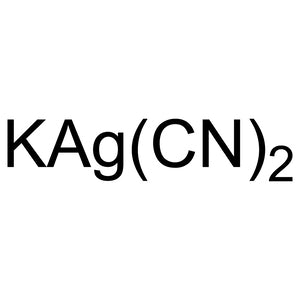
TCI P3370 Potassium Silver(I) Cyanide, also known as potassium dicyanoargentate (KAg(CN)2), is an inorganic complex salt in which a silver(I) ion is coordinated by two cyanide ligands. It is widely known as a silver source in electroplating and as an inorganic reagent for coordination chemistry research. In the laboratory, KAg(CN)2 is used when a water-soluble silver source in the form of a stable complex is needed. Note that this compound is HIGHLY TOXIC because it contains cyanide.
The dicyanoargentate complex is chosen because the cyanide ligands bind the silver ion strongly. As a result, the concentration of free silver ions in solution stays low and controlled, so silver deposited during electroplating tends to be fine-grained and even. The linear [Ag(CN)2]⁻ anion is also of interest in coordination chemistry and materials chemistry, for example as a building unit for coordination polymers or metal–cyanide frameworks. It offers researchers a well-defined, stable silver complex instead of a simple silver salt.
The 5g pack suits research and small-scale laboratory testing. In Indonesia, this material is relevant to electrochemistry, inorganic chemistry, and materials engineering laboratories at universities, and to the metal-plating industry. University research groups can use it to study coordination compounds and frameworks, while industrial laboratories can use it to evaluate silver plating baths. Because it is highly toxic, its use must follow strict cyanide-handling procedures, with trained personnel and proper safety facilities in place.
TCI brochures (PDF)
- Metallic Salts 2025-11-06 · p. 11
Related TCI products
- Silver electroplating studies: the strongly bound dicyanoargentate complex keeps free silver ion concentration low and controlled, which helps produce fine, even silver deposits.
- Coordination chemistry research: the linear [Ag(CN)2]⁻ anion is a well-defined complex, making it a useful model for studying silver(I)–cyanide coordination behaviour in the laboratory.
- Coordination polymer synthesis: the linear dicyanoargentate unit can act as a building block for coordination polymers, letting researchers assemble extended structures from a stable precursor.
- Metal–cyanide framework research: in materials chemistry, [Ag(CN)2]⁻ is of interest as a component of metal–cyanide frameworks studied for their structure and properties.
- Water-soluble silver source: when an experiment needs silver delivered in solution as a stable complex rather than a simple salt, KAg(CN)2 provides that controlled form.
| Brand | TCI (product code P3370) |
|---|---|
| CAS number | 506-61-6 |
| Molecular formula | — |
| Purity | — |
| Category | Chemistry > Catalysis and Inorganic Chemistry > Main-group Elements |
| Pack sizes | 5g |
| Physical form | — |
| Storage | keep tightly closed and away from acids; follow the manufacturer's SDS |
- Chemical identity: Potassium dicyanoargentate, KAg(CN)2; check the physical form on the supplier documentation
Store Potassium Silver(I) Cyanide in its original tightly closed container in a cool, dry, well-ventilated area. Keep it in a locked, clearly labelled storage location for toxic substances. Keep it well away from acids and acidic vapours, since cyanide compounds can release highly toxic hydrogen cyanide gas on contact with acid. Handle it only in a fume hood while wearing chemical-resistant gloves, safety goggles, and a lab coat. Avoid creating dust, and never eat, drink, or work alone while handling it. Have a cyanide emergency procedure ready, and collect all waste separately for disposal as hazardous cyanide waste under local regulations. Always read the manufacturer's Safety Data Sheet before use.
—
Product Categories
- Catalysis and Inorganic ChemistryMain-group Elements [Catalysis and Inorganic Chemistry]Potassium [Catalysis and Inorganic Chemistry]
- Catalysis and Inorganic ChemistryTransition Elements [Catalysis and Inorganic Chemistry]Silver [Catalysis and Inorganic Chemistry]
- Catalysis and Inorganic ChemistryMetallic Salts [Catalysis and Inorganic Chemistry]Cyanide Salts [Metallic Salts]
Produk Terkait
-
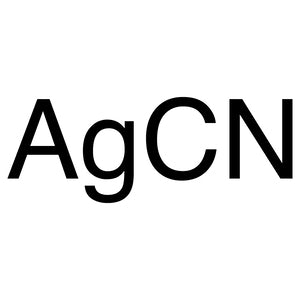
Silver(I)Cyanide TCI I1243
Regular price From Rp 823.200,00Regular priceRp 575.400,00Sale price From Rp 823.200,00 -
SilverHexafluorophosphate TCI S0981
Regular price From Rp 1.829.100,00Regular priceRp 1.278.900,00Sale price From Rp 1.829.100,00 -
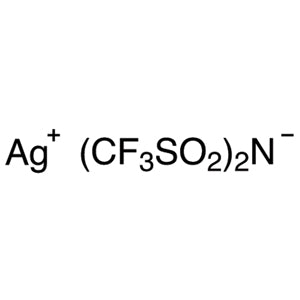
SilverBis(trifluoromethanesulfonyl)imide TCI S0898
Regular price From Rp 5.485.200,00Regular priceRp 3.835.650,00Sale price From Rp 5.485.200,00 -
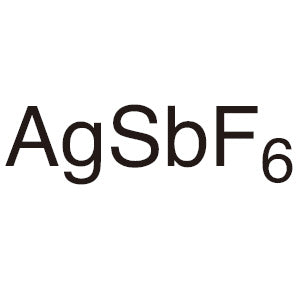
SilverHexafluoroantimonate(V) TCI S0463
Regular price Rp 3.155.250,00Regular priceRp 2.206.050,00Sale price Rp 3.155.250,00 -
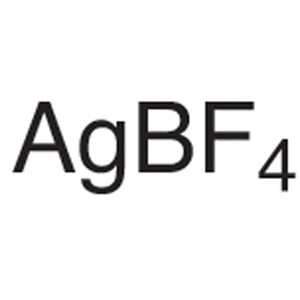
SilverTetrafluoroborate TCI S0446
Regular price From Rp 2.650.200,00Regular priceRp 1.853.250,00Sale price From Rp 2.650.200,00 -
Silver(I)Phosphate TCI I1259
Regular price From Rp 1.670.550,00Regular priceRp 1.167.600,00Sale price From Rp 1.670.550,00 -
Silver(I)Bromide TCI I1258
Regular price From Rp 1.644.300,00Regular priceRp 1.149.750,00Sale price From Rp 1.644.300,00 -
Silver(I)Nitrate TCI I1245
Regular price From Rp 795.900,00Regular priceRp 556.500,00Sale price From Rp 795.900,00