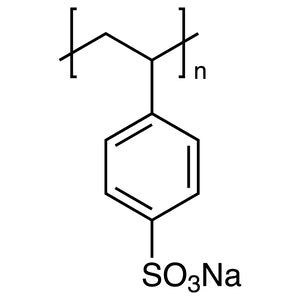
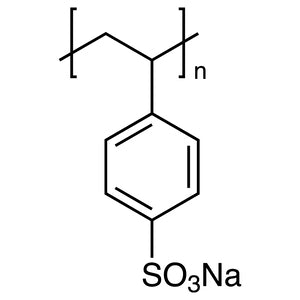
Poly(sodium 4-styrenesulfonate) is an anionic polymer widely used in chemical and material experiments due to its unique properties and versatility. This material is a 20% aqueous solution with a viscosity range of 200-500 cP, making it ideal for applications requiring precise control over flow and consistency. In laboratory settings, it serves as a key reagent for studying polymer behavior, including its response to environmental changes and interactions with other ions. Its high viscosity also aids in processes such as film formation and controlled mixing, which are essential in both fundamental and applied research.
The polymer’s high water solubility, chemical stability, and ability to form complexes with metal ions make it a preferred choice for a wide range of experiments. These properties allow it to be used in studies involving ion exchange, electrostatic interactions, and polymer self-assembly. Its compatibility with various laboratory techniques, such as rheology testing and thin film deposition, further enhances its utility. The material’s consistent performance under different conditions ensures reliable results, making it a staple in both academic and industrial research environments.
In Indonesian laboratories, Poly(sodium 4-styrenesulfonate) is commonly used in chemical, material science, and environmental research. It supports experiments related to polymer characterization, viscoelastic behavior, and environmental remediation. Many research institutions and universities in Indonesia rely on this material for its reliability and adaptability in diverse experimental setups. Its role in advancing scientific understanding and innovation in these fields is significant.
TCI brochures (PDF)
- Biomaterials Research Reagents 2025-02-19 · p. 5
Related TCI products
- TCI P2966 25704-18-1 Poly(sodium 4-styrenesulfonate) (viscosity 800-1600) (20wt% in Water)
- TCI P2964 25704-18-1 Poly(sodium 4-styrenesulfonate) (viscosity 20-50) (20wt% in Water)
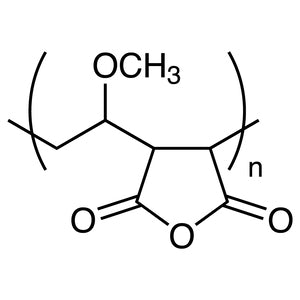
- TCI P3007 9011-16-9 Poly(methyl vinyl ether-alt-maleic anhydride) (specific viscosity 27-39)
- TCI P3006 9011-16-9 Poly(methyl vinyl ether-alt-maleic anhydride) (specific viscosity 10-15)
- TCI P2884 9011-16-9 Poly(methyl vinyl ether-alt-maleic anhydride) (specific viscosity 01-05)
- TCI A0140 9003-05-8 Acrylamide Polymer (containing small amounts of formalin as fungicide) (10% in Water)
- Polymer characterization studies benefit from its consistent viscosity and solubility, allowing accurate measurement of rheological properties.
- Environmental research utilizes its ion exchange capabilities to study contaminant removal and water treatment processes.
- Thin film formation experiments leverage its high viscosity to control film thickness and structural integrity.
- Electrostatic interaction studies use its anionic charge to investigate interactions with cationic species and surfaces.
- Rheology testing applications take advantage of its controlled flow behavior to analyze material response under varying stress conditions.
| Brand | TCI |
|---|---|
| CAS number | 25704-18-1 |
| Molecular formula | — |
| Purity | — |
| Category | Materials Science > Polymer/Macromolecule Reagents > Polymers |
| Pack sizes | 20wt% in Water |
| Physical form | Aqueous solution |
| Storage | Store at room temperature, away from direct sunlight and moisture |
This material should be stored in a cool, dry place, away from direct sunlight and sources of heat. It is recommended to use airtight containers to prevent evaporation and contamination. As an aqueous solution, it should be kept in a sealed container to maintain its viscosity and prevent microbial growth. Regular inspection of the container is advised to ensure no leaks or degradation occur. Handling should be done with appropriate gloves and protective eyewear to avoid skin contact or splashes. It is not flammable and does not pose a significant hazard under normal storage conditions.
—
Produk Terkait
-
Poly(sodium4-styrenesulfonate)(viscosity800-1600)(20wt%inWater) TCI P2966
Regular price From Rp 689.850,00Regular priceRp 481.950,00Sale price From Rp 689.850,00 -
Poly(sodium4-styrenesulfonate)(viscosity20-50)(20wt%inWater) TCI P2964
Regular price From Rp 689.850,00Regular priceRp 481.950,00Sale price From Rp 689.850,00 -
Poly(methylvinylether-alt-maleicanhydride)(specificviscosity27-39) TCI P3007
Regular price From Rp 2.174.550,00Regular priceRp 1.520.400,00Sale price From Rp 2.174.550,00 -
Poly(methylvinylether-alt-maleicanhydride)(specificviscosity10-15) TCI P3006
Regular price From Rp 2.174.550,00Regular priceRp 1.520.400,00Sale price From Rp 2.174.550,00 -
Poly(methylvinylether-alt-maleicanhydride)(specificviscosity01-05) TCI P2884
Regular price From Rp 1.565.550,00Regular priceRp 1.094.100,00Sale price From Rp 1.565.550,00 -
AcrylamidePolymer(containingsmallamountsofformalinasfungicide)(10%inWater) TCI A0140
Regular price Rp 3.075.450,00Regular priceRp 2.150.400,00Sale price Rp 3.075.450,00 -
Polyethyleneimine(ca.30%inWater) TCI P0381
Regular price From Rp 477.750,00Regular priceRp 333.900,00Sale price From Rp 477.750,00 -
CarboxymethylCelluloseSodiumSalt(Ultrahighviscosity) TCI C4143
Regular price From Rp 1.115.100,00Regular priceRp 779.100,00Sale price From Rp 1.115.100,00