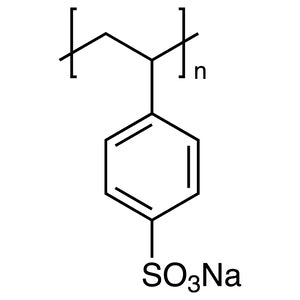
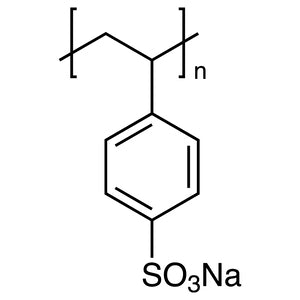
Poly(sodium 4-styrenesulfonate) is an anionic polymer widely used in chemical and material science experiments. It is a versatile reagent that plays a crucial role in various laboratory applications, including polymer synthesis, solution preparation, and viscosity studies. This material is particularly valuable for its ability to interact with cations, making it an essential component in polymer research and chemical reactions. Its stable properties and consistent performance make it a reliable choice for scientific investigations requiring controlled conditions and reproducible results.
The key properties that make this polymer a preferred choice include its high solubility in water, stable chemical structure, and consistent viscosity range of 800–1600 mPa·s. These characteristics ensure that it maintains its integrity under various experimental conditions, providing researchers with dependable results. Additionally, its 20% concentration in water allows for precise control over solution viscosity, which is critical in many analytical and industrial applications. The non-toxic nature of the material also enhances its safety profile, making it suitable for use in a wide range of laboratory settings.
In Indonesian laboratories, this polymer is commonly used in material science, chemical engineering, and polymer research. It is a staple in academic and research institutions, where it supports studies on polymer behavior, surface modification, and chemical reaction mechanisms. Its availability and cost-effectiveness make it a popular choice for both educational and industrial applications, contributing to the advancement of scientific research in the region.
TCI brochures (PDF)
- Biomaterials Research Reagents 2025-02-19 · p. 5
Related TCI products
- TCI P2965 25704-18-1 Poly(sodium 4-styrenesulfonate) (viscosity 200-500) (20wt% in Water)
- TCI P2964 25704-18-1 Poly(sodium 4-styrenesulfonate) (viscosity 20-50) (20wt% in Water)
- TCI P3007 9011-16-9 Poly(methyl vinyl ether-alt-maleic anhydride) (specific viscosity 27-39)
- TCI P3006 9011-16-9 Poly(methyl vinyl ether-alt-maleic anhydride) (specific viscosity 10-15)
- TCI P2884 9011-16-9 Poly(methyl vinyl ether-alt-maleic anhydride) (specific viscosity 01-05)
- TCI A0140 9003-05-8 Acrylamide Polymer (containing small amounts of formalin as fungicide) (10% in Water)
- Polymer synthesis and solution preparation due to its high solubility and stable viscosity properties.
- Viscosity studies and rheological analysis because of its consistent and measurable flow characteristics.
- Surface modification and coating applications due to its ability to interact with cations and form stable films.
- Chemical reaction experiments where anionic polymer interactions are required for catalytic or structural purposes.
- Educational and research purposes in material science and chemical engineering laboratories for teaching and experimentation.
| Brand | TCI |
|---|---|
| CAS number | 25704-18-1 |
| Molecular formula | — |
| Purity | — |
| Category | Materials Science > Polymer/Macromolecule Reagents > Polymers |
| Pack sizes | 20% in water (exact packaging details may vary) |
| Physical form | Liquid solution |
| Storage | Store in a cool, dry place away from direct sunlight |
This material should be stored in a cool, dry environment, away from direct sunlight and sources of heat. It is recommended to use airtight containers to prevent contamination and maintain its chemical stability. Since it is a water-based solution, it should be kept in a container that is resistant to chemical degradation. Proper labeling is essential to ensure safe handling and prevent accidental misuse. Due to its non-toxic nature, it is generally safe to handle, but standard laboratory safety protocols should still be followed. Avoid prolonged exposure to high temperatures or mechanical stress to maintain its integrity and performance.
—
Produk Terkait
-
Poly(sodium4-styrenesulfonate)(viscosity200-500)(20wt%inWater) TCI P2965
Regular price Rp 664.650,00Regular priceRp 464.100,00Sale price Rp 664.650,00 -
Poly(sodium4-styrenesulfonate)(viscosity20-50)(20wt%inWater) TCI P2964
Regular price From Rp 689.850,00Regular priceRp 481.950,00Sale price From Rp 689.850,00 -
Poly(methylvinylether-alt-maleicanhydride)(specificviscosity27-39) TCI P3007
Regular price From Rp 2.174.550,00Regular priceRp 1.520.400,00Sale price From Rp 2.174.550,00 -
Poly(methylvinylether-alt-maleicanhydride)(specificviscosity10-15) TCI P3006
Regular price From Rp 2.174.550,00Regular priceRp 1.520.400,00Sale price From Rp 2.174.550,00 -
Poly(methylvinylether-alt-maleicanhydride)(specificviscosity01-05) TCI P2884
Regular price From Rp 1.565.550,00Regular priceRp 1.094.100,00Sale price From Rp 1.565.550,00 -
AcrylamidePolymer(containingsmallamountsofformalinasfungicide)(10%inWater) TCI A0140
Regular price Rp 3.075.450,00Regular priceRp 2.150.400,00Sale price Rp 3.075.450,00 -
Polyethyleneimine(ca.30%inWater) TCI P0381
Regular price From Rp 477.750,00Regular priceRp 333.900,00Sale price From Rp 477.750,00 -
CarboxymethylCelluloseSodiumSalt(Ultrahighviscosity) TCI C4143
Regular price From Rp 1.115.100,00Regular priceRp 779.100,00Sale price From Rp 1.115.100,00