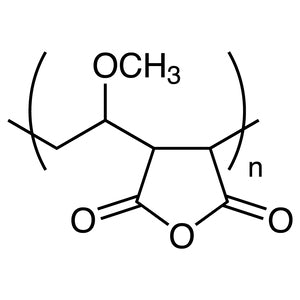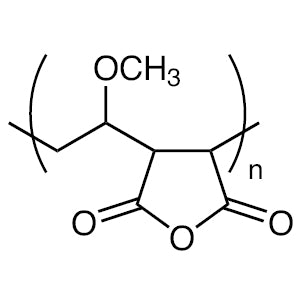
Poly(methyl vinyl ether-alt-maleic anhydride) is a polymer-based chemical compound widely used in scientific and industrial applications. It is a versatile reagent that plays a critical role in laboratories, particularly in polymer chemistry and material science. This compound is valued for its unique molecular structure, which combines vinyl ether and maleic anhydride units, allowing it to participate in various chemical reactions. Its reactivity and structural flexibility make it an essential component in the synthesis of complex compounds and polymer modifications. Due to its adaptability, it is frequently used in research settings to develop new materials and chemical products.
The compound’s controlled specific viscosity, ranging from 0.01 to 0.05, ensures ease of measurement and handling in different experimental scales. This property is crucial for maintaining consistency in laboratory procedures. Additionally, its reactivity enables it to be used in polymerization, grafting, and chemical modification processes. The compound’s stability under certain conditions further enhances its usability, allowing for extended storage and reliable performance in various applications. These characteristics make it a preferred choice for researchers working on advanced material development and organic chemistry projects.
In Indonesian laboratories, Poly(methyl vinyl ether-alt-maleic anhydride) is commonly used in material science, organic chemistry, and pharmaceutical research. It supports the development of new polymers, drug delivery systems, and functional materials. Many research institutions and universities in Indonesia rely on this compound for experimental work, contributing to advancements in both academic and industrial sectors. Its reliability and versatility make it a key reagent in the scientific community.
TCI brochures (PDF)
- Biomaterials Research Reagents 2025-02-19 · p. 5
Related TCI products
- TCI P3007 9011-16-9 Poly(methyl vinyl ether-alt-maleic anhydride) (specific viscosity 27-39)
- TCI P3006 9011-16-9 Poly(methyl vinyl ether-alt-maleic anhydride) (specific viscosity 10-15)
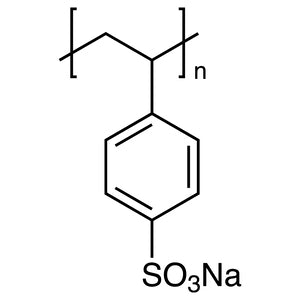
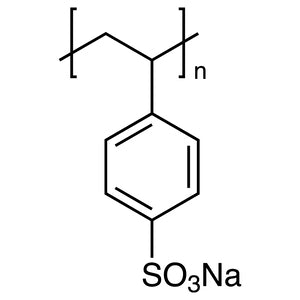
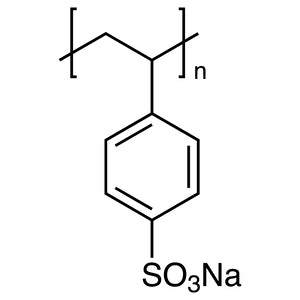
- TCI P2966 25704-18-1 Poly(sodium 4-styrenesulfonate) (viscosity 800-1600) (20wt% in Water)
- TCI P2965 25704-18-1 Poly(sodium 4-styrenesulfonate) (viscosity 200-500) (20wt% in Water)
- TCI P2964 25704-18-1 Poly(sodium 4-styrenesulfonate) (viscosity 20-50) (20wt% in Water)
- TCI P0804 9002-89-5 Poly(vinyl Alcohol) (n=approx. 2000) (degree of saponification ca. 80mol%)
- Polymer synthesis and modification due to its reactivity and structural versatility for creating new materials.
- Organic chemistry research as a building block for complex compound synthesis and functional group introduction.
- Material science applications in developing advanced polymers and composite materials with tailored properties.
- Pharmaceutical research for drug delivery systems and polymer-based formulations requiring controlled reactivity.
- Industrial applications in chemical manufacturing where polymerization and grafting reactions are essential processes.
| Brand | TCI |
|---|---|
| CAS number | 9011-16-9 |
| Molecular formula | — |
| Purity | — |
| Category | Materials Science > Polymer/Macromolecule Reagents > Polymers |
| Pack sizes | As listed on product page |
| Physical form | Solid or liquid, depending on formulation |
| Storage | Store in a cool, dry place away from moisture and direct sunlight |
This compound should be stored in a cool, dry environment to maintain its stability and prevent degradation. It is recommended to use airtight containers to minimize exposure to moisture and air, which can affect its chemical properties. Due to its reactivity, it should be handled in a well-ventilated area, and appropriate personal protective equipment, such as gloves and safety goggles, should be worn. Avoid contact with incompatible substances to ensure safe handling. Proper storage and handling practices help preserve the compound's integrity and ensure its effectiveness in laboratory applications.
—
Produk Terkait
-
Poly(methylvinylether-alt-maleicanhydride)(specificviscosity27-39) TCI P3007
Regular price From Rp 2.174.550,00Regular price -
Poly(methylvinylether-alt-maleicanhydride)(specificviscosity10-15) TCI P3006
Regular price From Rp 2.174.550,00Regular price -
Poly(sodium4-styrenesulfonate)(viscosity800-1600)(20wt%inWater) TCI P2966
Regular price From Rp 689.850,00Regular price -
Poly(sodium4-styrenesulfonate)(viscosity200-500)(20wt%inWater) TCI P2965
Regular price Rp 664.650,00Regular price -
Poly(sodium4-styrenesulfonate)(viscosity20-50)(20wt%inWater) TCI P2964
Regular price From Rp 689.850,00Regular price -
Poly(vinylAlcohol)(n=approx.2000)(degreeofsaponificationca.80mol%) TCI P0804
Regular price From Rp 477.750,00Regular price -
Poly(vinylAlcohol)(n=approx.1700) TCI P0469
Regular price From Rp 477.750,00Regular price -
Poly(1-vinylpyrrolidone-co-VinylAcetate)(Copolymer,3:7)(50%inEthanol) TCI P0385
Regular price From Rp 557.550,00Regular price