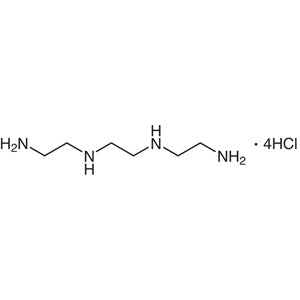
Spermine from TCI (product code P3251, CAS number 71-44-3) is a naturally occurring aliphatic polyamine with four nitrogen atoms: two primary amine groups at the ends of the chain and two secondary amines in the middle. It is found in nearly all eukaryotic cells, where it takes part in several biological processes, including stabilising nucleic acids, regulating cell growth and modulating ion channels. In the laboratory, spermine serves two roles. It is a biochemical reagent for molecular biology research, and it is a synthetic building block for polyamine conjugates and gene carriers.
Researchers choose spermine for its high positive charge at physiological pH. This charge lets it interact strongly with negatively charged molecules such as DNA and RNA, which makes it effective for condensing and precipitating nucleic acids and for stabilising their structure. The four amine groups also give the molecule many reactive sites that can be chemically modified, for example by acylation or by conjugation with lipids. This versatility makes spermine useful in both biological studies and synthetic chemistry. Note that free polyamines tend to absorb carbon dioxide and moisture from the air, so handling them takes extra care.
In Indonesia, spermine is useful to laboratories working in molecular biology, biochemistry and synthetic organic chemistry, including university research groups, research institutes and pharmaceutical development facilities. Molecular biology groups can use it in nucleic acid work, where its ability to bind and condense DNA and RNA is valuable. Synthetic chemistry teams can use it as a polyamine scaffold for building conjugates and gene delivery carriers. Because the material is sensitive to air and moisture, laboratories in Indonesia's warm and humid climate should take particular care with storage and handling.
TCI brochures (PDF)
- Polyamines 2025-10-21 · p. 2
Related TCI products
- TCI S0069 58298-97-8 Spermine Phosphate Hexahydrate
- TCI P2950 306-67-2 Spermine Tetrahydrochloride [for Protein Research]
- TCI X0080 89690-11-9 Xylemin Dihydrochloride
- TCI T1212 4961-40-4 Triethylenetetramine Tetrahydrochloride
- TCI B1952 10563-26-5 N,N'-Bis(3-aminopropyl)ethylenediamine
- TCI B1445 4741-99-5 N,N'-Bis(2-aminoethyl)-1,3-propanediamine
- Nucleic acid condensation: spermine's high positive charge at physiological pH lets it bind strongly to negatively charged DNA and RNA, which condenses them into compact structures for further study.
- Nucleic acid precipitation: its strong electrostatic interaction with DNA and RNA makes it effective for precipitating nucleic acids from solution during molecular biology sample preparation.
- Nucleic acid stabilisation studies: spermine plays a natural role in stabilising nucleic acids in eukaryotic cells, so it is a relevant reagent for research on DNA and RNA structure and stability.
- Synthesis of polyamine conjugates: the four amine groups provide several reactive sites that can be chemically modified, for example by acylation, which makes spermine a versatile building block for polyamine derivatives.
- Development of gene carriers: spermine can be conjugated with lipids through its amine groups, and its affinity for nucleic acids makes it a suitable scaffold for designing gene delivery carriers.
| Brand | TCI (product code P3251) |
|---|---|
| CAS number | 71-44-3 |
| Molecular formula | — |
| Purity | — |
| Category | Chemistry > Building Blocks > Non-Heterocyclic Building Blocks |
| Pack sizes | available pack sizes are listed on the product page or available on request |
| Physical form | refer to the TCI product documentation and certificate of analysis |
| Storage | protect from air (carbon dioxide) and moisture; keep the container tightly closed |
Free polyamines such as spermine tend to absorb carbon dioxide and moisture from the air, so store the material in a tightly sealed container, ideally under an inert gas such as nitrogen or argon. Keep it in a cool, dry place away from direct sunlight and away from acids and oxidising agents. Use well-sealed glass or chemically compatible containers, and reseal them promptly after each use to limit exposure to the atmosphere. In humid environments, a desiccator gives extra protection. As general laboratory practice, handle the material in a well-ventilated area or fume hood and wear gloves, safety glasses and a lab coat. Avoid skin and eye contact and avoid breathing dust or vapour. Always check the Safety Data Sheet (SDS) supplied by TCI for the specific hazard information and the recommended storage temperature.
—
Produk Terkait
-
SperminePhosphateHexahydrate TCI S0069
Regular price From Rp 2.174.550,00Regular price -
SpermineTetrahydrochloride[forProteinResearch] TCI P2950
Regular price Rp 1.936.200,00Regular price -
XyleminDihydrochloride TCI X0080
Regular price From Rp 2.518.950,00Regular price -
TriethylenetetramineTetrahydrochloride TCI T1212
Regular price Rp 1.988.700,00Regular price -
N,N'-Bis(3-aminopropyl)ethylenediamine TCI B1952
Regular price From Rp 610.050,00Regular price -
N,N'-Bis(2-aminoethyl)-1,3-propanediamine TCI B1445
Regular price Rp 1.378.650,00Regular price -
Spermidine TCI P3255
Regular price From Rp 1.458.450,00Regular price -
1,4-Diaminobutane TCI D0239
Regular price From Rp 505.050,00Regular price

![306-67-2 Spermine Tetrahydrochloride [for Protein Research] - AMI Scientific](http://amiscientific.com/cdn/shop/files/TCI2510P2950.jpg?v=1767136881&width=533)