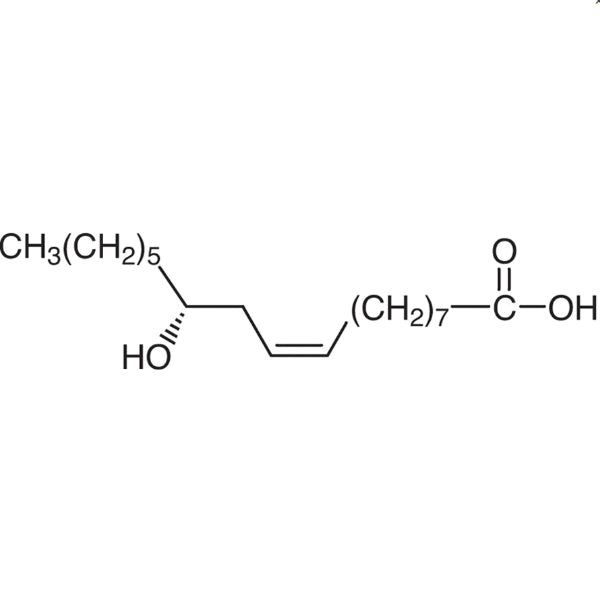
Ricinoleic Acid TCI R0027 is a chemical compound widely used in scientific research, particularly in the fields of materials science and technology. As an unsaturated fatty acid, it possesses a unique molecular structure and highly interesting chemical properties that make it valuable for various laboratory applications. This compound is commonly used as a raw material for the synthesis of composite materials, electrode materials, and research materials related to quantum dots. Its versatility and reactivity make it a preferred choice for innovative research projects.
The properties of Ricinoleic Acid that make it a preferred choice include its relatively low melting point, which facilitates heating and processing in laboratory settings. Additionally, its high polarity allows it to dissolve easily in organic solvents such as ethanol or ether, making it suitable for a wide range of chemical reactions and material synthesis processes. These characteristics enable researchers to work with greater efficiency and accuracy, supporting high-quality scientific outcomes.
In Indonesian laboratories, Ricinoleic Acid is used in diverse research contexts, including the development of advanced materials and the study of nanotechnology. Its availability and reliability make it a popular choice for both academic and industrial research. The compound’s consistent quality and purity ensure that it meets the standards required for rigorous scientific experimentation.
TCI brochures (PDF)
- Colloidal Quantum Dot (QD) Research Reagents 2026-05-21 · p. 5
- Lipids 2025-12-17 · p. 5
- Quantum Dot Research: Ricinoleic Acid is used in colloidal quantum dot synthesis due to its ability to stabilize nanoparticles and enhance optical properties.
- Composite Material Development: It serves as a functional additive in polymer composites to improve mechanical and thermal properties.
- Electrode Material Fabrication: Its chemical reactivity makes it suitable for creating conductive and electroactive electrode surfaces.
- Surface Modification Studies: The compound’s polarity allows it to be used in modifying surface properties of materials for enhanced performance.
- Organic Synthesis Reactions: Ricinoleic Acid is a valuable reagent in organic synthesis due to its reactivity and solubility in organic solvents.
| Brand | TCI |
|---|---|
| CAS number | 141-22-0 |
| Molecular formula | — |
| Purity | — |
| Category | Materials Science > Electronic Materials > Colloidal Quantum Dot (QD) Research Reagents |
| Pack sizes | Available in various quantities as per standard laboratory supply |
| Physical form | Solid at room temperature |
| Storage | Store in a cool, dry place away from direct sunlight and moisture |
Ricinoleic Acid should be stored in a cool, dry place, away from direct sunlight and moisture to maintain its chemical integrity. It is recommended to use airtight containers to prevent exposure to air and humidity, which can affect its stability. As a reactive compound, it should be handled with care in a well-ventilated laboratory environment. Proper personal protective equipment, such as gloves and safety goggles, should be worn during handling. Avoid contact with skin and eyes, and ensure that spillage is cleaned up promptly to prevent any potential hazards. The compound’s high polarity and solubility in organic solvents require careful storage to prevent unintended reactions or contamination.
—
Produk Terkait
-
ValericAcid TCI V0003
Regular price From Rp 610.050,00Regular priceRp 426.300,00Sale price From Rp 610.050,00 -
2-UndecenoicAcid TCI U0032
Regular price Rp 2.571.450,00Regular priceRp 1.813.350,00Sale price Rp 2.571.450,00 -
10-UndecenoicAcid TCI U0007
Regular price From Rp 557.550,00Regular priceRp 405.300,00Sale price From Rp 557.550,00 -
UndecanoicAcid TCI U0004
Regular price From Rp 1.008.000,00Regular priceRp 720.300,00Sale price From Rp 1.008.000,00 -
cis-15-TetracosenoicAcid TCI T1642
Regular price Rp 6.784.050,00Regular priceRp 4.759.650,00Sale price Rp 6.784.050,00 -
BehenicAcid TCI B1747
Regular price Rp 4.028.850,00Regular priceRp 2.832.900,00Sale price Rp 4.028.850,00 -
BehenicAcid TCI B1248
Regular price From Rp 848.400,00Regular priceRp 609.000,00Sale price From Rp 848.400,00 -
ButyricAcid TCI B0754
Regular price From Rp 477.750,00Regular priceRp 333.900,00Sale price From Rp 477.750,00