

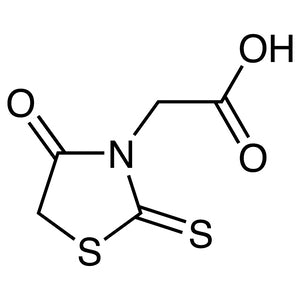
Rhodanine-3-acetic Acid is a chemical compound widely used as a building block in the synthesis of heterocyclic compounds. It plays a crucial role in the development of complex molecular structures that exhibit specific biological activities. This compound is essential in various chemical applications, including pharmaceutical research, industrial chemistry, and scientific experimentation. Its unique chemical structure enables it to participate in a wide range of synthetic reactions, making it a versatile tool for chemists and researchers.
Rhodanine-3-acetic Acid is valued for its chemical stability and reactivity. It maintains its integrity under certain conditions, which simplifies handling and storage. Its ability to undergo diverse chemical transformations makes it a preferred choice for synthetic chemists. The compound's flexibility in reacting with different functional groups allows for the creation of a broad spectrum of derivatives, enhancing its utility in laboratory settings. These properties contribute to its widespread use in both academic and industrial research.
In Indonesian laboratories, Rhodanine-3-acetic Acid is commonly used in chemical and pharmaceutical research. It is favored for its availability and reliability in various synthetic reactions. Researchers in educational and research institutions rely on this compound for experiments and the development of new chemical compounds. Its consistent performance and chemical properties make it an essential component in the toolkit of many scientists working in Indonesia.
- Pharmaceutical research for the synthesis of bioactive heterocyclic compounds due to its structural versatility and reactivity.
- Industrial chemical synthesis where stable and reactive building blocks are required for the production of specialty chemicals.
- Academic research in organic chemistry for the development of new synthetic methodologies and molecular structures.
- Drug discovery programs that require reliable and consistent chemical intermediates for compound development.
- Analytical chemistry applications where precise and stable reagents are needed for reaction testing and compound characterization.
| Brand | TCI |
|---|---|
| CAS number | 5718-83-2 |
| Molecular formula | — |
| Purity | — |
| Category | Chemistry > Building Blocks > Heterocyclic Building Blocks |
| Pack sizes | Available in various quantities as per standard chemical supply practices |
| Physical form | Solid (as per typical chemical compound presentation) |
| Storage | Store in a cool, dry place away from direct sunlight and moisture |
Rhodanine-3-acetic Acid should be stored in a cool, dry environment to maintain its chemical stability. It is recommended to keep the compound in a sealed container to prevent exposure to moisture and air. Proper labeling of storage containers is essential for safe handling and identification. Laboratory personnel should wear appropriate personal protective equipment when handling this compound. Avoid contact with skin and eyes, and ensure good ventilation in the workspace. Regular monitoring of storage conditions helps maintain the integrity of the compound for long-term use.
—
Produk Terkait
-
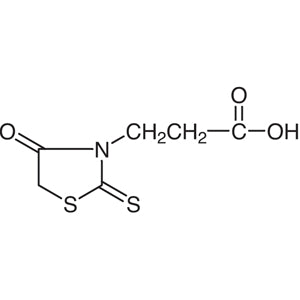
Rhodanine-3-propionicAcid TCI R0060
Regular price Rp 1.618.050,00Regular price -
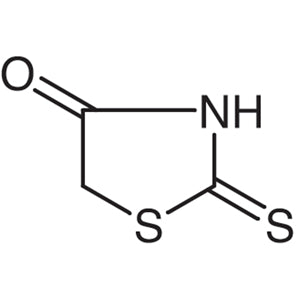
Rhodanine TCI R0017
Regular price From Rp 1.749.300,00Regular price -
5-[4-(Diethylamino)benzylidene]rhodanine TCI D0464
Regular price From Rp 769.650,00Regular price -
Theophylline-7-aceticAcid TCI T2941
Regular price Rp 1.035.300,00Regular price -
1H-Tetrazole-5-aceticAcid TCI T2737
Regular price From Rp 5.619.600,00Regular price -
1,2-Benzisoxazole-3-aceticAcid TCI B2912
Regular price Rp 2.782.500,00Regular price -
(2-Benzothiazolylthio)aceticAcid TCI B1941
Regular price From Rp 1.008.000,00Regular price -
(Z)-2-(2-Amino-4-thiazolyl)-2-(methoxyimino)aceticAcid TCI A2478
Regular price From Rp 689.850,00Regular price
![5-[4-(Diethylamino)benzylidene]rhodanine (CAS 35778-58-6) - TCI D0464 - AMI Scientific](http://amiscientific.com/cdn/shop/files/TCI2510D0464.jpg?v=1767101333&width=533)


