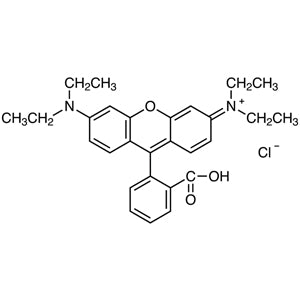
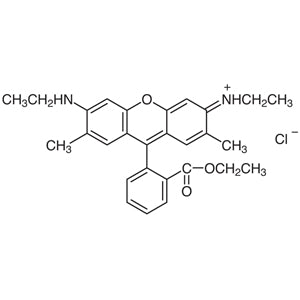
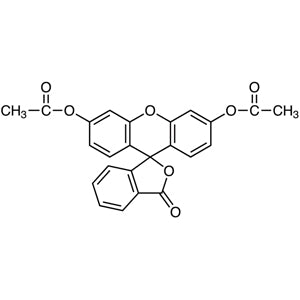
Rhodamine B Hydrazide is a fluorescent chemical compound widely used in laboratory research across biology and chemistry. It serves as a fluorescent probe and labeling agent, enabling the visualization of biological structures and molecules under microscopic examination. This compound is particularly valuable for its ability to bind to specific proteins or biomolecules, making it a key tool in molecular detection and labeling processes. Its fluorescent properties allow researchers to track molecular movements and interactions within complex biological systems with high sensitivity and accuracy.
Rhodamine B Hydrazide is favored for its strong fluorescence and excellent chemical stability, which ensure consistent performance across various experimental conditions. Its high binding affinity for multiple substrates makes it ideal for conjugation reactions and biochemical assays. The compound’s versatility supports a wide range of applications, including biomolecule labeling, enzyme activity testing, and protein structure analysis. These properties make it a reliable and efficient choice for researchers seeking precise and reproducible results.
In Indonesian laboratories, Rhodamine B Hydrazide is commonly used in biochemistry and cell biology research. It is frequently employed in fluorescence microscopy, immunostaining, and molecular imaging techniques. Its availability in various packaging options facilitates its use in both small-scale and large-scale experiments. Researchers rely on its consistent performance to obtain accurate data in their studies, making it an essential reagent in modern laboratory settings.
TCI brochures (PDF)
- Fluorescent Labeling: Rhodamine B Hydrazide is ideal for labeling biomolecules due to its strong fluorescence and high binding affinity, allowing for clear visualization under a microscope.
- Enzyme Activity Assays: Its fluorescent properties enable the detection of enzyme activity by monitoring changes in fluorescence intensity during biochemical reactions.
- Protein Structure Analysis: The compound is used in structural studies to track protein interactions and conformational changes through fluorescence spectroscopy.
- Microscopy Imaging: Its ability to bind to specific targets makes it suitable for fluorescent imaging of cellular structures and molecular processes.
- Bioconjugation Reactions: Rhodamine B Hydrazide is widely used in conjugation processes to attach fluorescent tags to proteins, antibodies, or other biomolecules.
| Brand | TCI |
|---|---|
| CAS number | 74317-53-6 |
| Molecular formula | — |
| Purity | — |
| Category | Life Science > Biochemicals and Reagents > Fluorescent Probes, Fluorescent Labels, Fluorescent Stains |
| Pack sizes | Available in various sizes to suit different experimental needs |
| Physical form | Solid powder |
| Storage | Store in a cool, dry place away from light |
Rhodamine B Hydrazide should be stored in a cool, dry place away from direct light to maintain its stability and fluorescent properties. It is recommended to use airtight containers to prevent moisture absorption and contamination. Due to its chemical nature, it should be handled with care, using appropriate personal protective equipment such as gloves and safety goggles. Avoid exposure to high temperatures or prolonged light exposure, as these can degrade the compound’s effectiveness. In laboratory settings, it should be stored separately from incompatible substances to ensure safety. Proper storage conditions help preserve the compound’s integrity and ensure reliable results in experiments.
—
Product Categories
Produk Terkait
-
RhodamineB TCI R0040
Regular price From Rp 1.167.600,00Regular priceRp 815.850,00Sale price From Rp 1.167.600,00 -
OctadecylRhodamineBChloride TCI O0512
Regular price From Rp 5.167.050,00Regular priceRp 3.628.800,00Sale price From Rp 5.167.050,00 -
RhodamineB[Ionassociationreagentforphotometricandfluorimetricanalysis] TCI A5102
Regular price Rp 1.115.100,00Regular priceRp 779.100,00Sale price Rp 1.115.100,00 -
Rhodamine6G TCI R0039
Regular price Rp 1.298.850,00Regular priceRp 908.250,00Sale price Rp 1.298.850,00 -
JC-1 TCI T4300
Regular price Rp 7.473.900,00Regular priceRp 5.241.600,00Sale price Rp 7.473.900,00 -
FluoresceinDiacetate TCI F0240
Regular price Rp 1.538.250,00Regular priceRp 1.090.950,00Sale price Rp 1.538.250,00 -
Uranine TCI F0096
Regular price From Rp 637.350,00Regular priceRp 445.200,00Sale price From Rp 637.350,00 -
Fluorescein TCI F0095
Regular price Rp 875.700,00Regular priceRp 612.150,00Sale price Rp 875.700,00