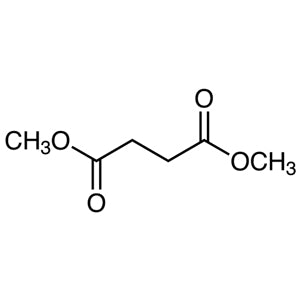
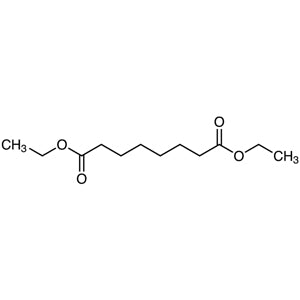
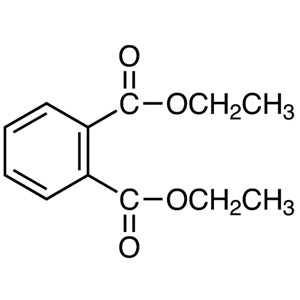
Diethyl Succinate from TCI is the diethyl ester of succinic acid. It is a liquid that TCI classifies as a polymer additive within its materials science range. The compound serves several purposes in the laboratory. It can act as a plasticizer in materials research, as a solvent with a relatively high boiling point, and as an important intermediate in organic synthesis. One classic use is as a substrate for the Stobbe condensation and related reactions, where chemists use it to build more complex carbon frameworks from simple starting materials.
Researchers choose this material because its ethyl ester groups are reactive enough for synthetic transformations yet remain stable when stored under proper conditions. Because it is a liquid, it is easy to measure and mixes readily with common organic solvents, which simplifies routine work at the bench. As a plasticizer, its small molecular size allows good interaction with polymer chains, which is useful when studying flexibility and processing behaviour in polymer formulations. Diethyl succinate is also known for its mild odor and is used in aroma compound research, so it is useful across many laboratory fields.
In Indonesia, Diethyl Succinate is relevant to synthetic organic chemistry laboratories, polymer and materials laboratories, and food and flavor analysis laboratories. University students and researchers can use it in synthesis coursework, final-year projects, and graduate research on condensation reactions or polymer modification. Industrial research and development teams may also use it when evaluating additives or studying aroma compounds. Because it fits several disciplines, a single stock of this reagent can support a range of experiments within one institution.
TCI brochures (PDF)
- Polymer Additives 2026-04-16 · p. 3
- Stobbe condensation and related reactions: the succinate ester framework is a classic substrate for building more complex carbon skeletons in synthetic organic chemistry research and teaching.
- Organic synthesis intermediate: its ethyl ester groups are reactive enough for synthetic transformations while staying stable in storage, which makes it a dependable building block for multistep synthesis.
- Plasticizer studies in materials research: its small molecular size allows good interaction with polymer chains, so it suits experiments on polymer flexibility and additive performance.
- High-boiling solvent applications: as a liquid with a relatively high boiling point, it can serve as a reaction or formulation medium where a less volatile solvent is preferred.
- Aroma and flavor compound research: diethyl succinate is known for its mild odor, so it is relevant to laboratories that study aroma compounds and analyze food and flavor samples.
| Brand | TCI |
|---|---|
| CAS number | 123-25-1 |
| Molecular formula | — |
| Purity | — |
| Category | Materials Science > Polymer/Macromolecule Reagents > Polymer Additives |
| Pack sizes | please check the product listing or confirm available pack sizes with AMI Scientific |
| Physical form | liquid |
| Storage | keep tightly closed in a cool, dry, well-ventilated place and follow the TCI label and Safety Data Sheet |
Store Diethyl Succinate in its original, tightly sealed container in a cool, dry, well-ventilated area, away from heat sources, open flames, and strong oxidizing agents. Glass or other chemically compatible containers with secure closures are suitable if the material has to be transferred. Handle it in a fume hood or a well-ventilated workspace, and wear standard personal protective equipment, including safety glasses, chemical-resistant gloves, and a lab coat. Avoid contact with skin and eyes, and do not inhale vapors. Clean up spills promptly with absorbent material and dispose of waste according to local regulations. Always check the TCI Safety Data Sheet for detailed hazard and handling information before use.
—
Produk Terkait
-
DimethylSuccinate TCI S0104
Regular price From Rp 530.250,00Regular priceRp 386.400,00Sale price From Rp 530.250,00 -
DibutylSuccinate TCI S0102
Regular price Rp 1.087.800,00Regular priceRp 775.950,00Sale price Rp 1.087.800,00 -
DiethylAdipate TCI A0162
Regular price From Rp 452.550,00Regular priceRp 316.050,00Sale price From Rp 452.550,00 -
DiethylSuberate TCI S0449
Regular price Rp 2.730.000,00Regular priceRp 1.924.650,00Sale price Rp 2.730.000,00 -
DiethylSebacate TCI S0024
Regular price From Rp 557.550,00Regular priceRp 405.300,00Sale price From Rp 557.550,00 -
DiethylPhthalate TCI P0296
Regular price From Rp 477.750,00Regular priceRp 333.900,00Sale price From Rp 477.750,00 -
DiethylMaleate TCI M0010
Regular price From Rp 557.550,00Regular priceRp 405.300,00Sale price From Rp 557.550,00 -
DiethylDodecanedioate TCI D2486
Regular price Rp 1.405.950,00Regular priceRp 998.550,00Sale price Rp 1.405.950,00