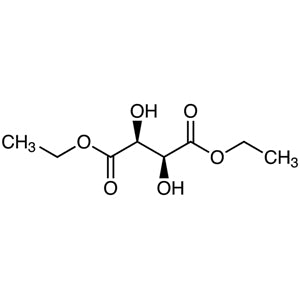
Diethyl L-(+)-Tartrate is a chiral compound widely used in asymmetric synthesis to construct molecules with specific biological activities. It plays a crucial role in chemical and pharmaceutical laboratories, particularly in research focused on drug development and active compound synthesis. As a chiral building block, it enables the creation of molecules with distinct spatial configurations, which can significantly influence their biological activity. This compound is essential for scientists aiming to design and synthesize enantiomerically pure compounds, which are vital in pharmaceutical applications.
The compound is valued for its chemical stability and reactivity under controlled conditions, making it suitable for a variety of chemical reactions. Its well-defined molecular structure and physical characteristics facilitate separation and identification processes in analytical procedures. Additionally, its chiral nature allows for precise control over the stereochemistry of synthesized compounds, which is critical in the development of pharmaceuticals with high therapeutic efficacy. These properties make it a preferred choice for researchers working in organic chemistry and medicinal chemistry.
In Indonesian laboratories, Diethyl L-(+)-Tartrate is commonly used in research and development projects related to pharmaceuticals and organic chemistry. It is a key component in the synthesis of active pharmaceutical ingredients and is often employed in academic and industrial settings where chiral compounds are required. Its reliability and versatility make it an essential material for scientists conducting advanced chemical research in Indonesia.
TCI brochures (PDF)
- Oxidizing Agents 2025-06-11 · p. 4
- Chiral Auxiliaries and Optical Resolving Agents 2025-06-17 · p. 7
- Asymmetric Synthesis 2026-03-18 · p. 6
- Chiral Building Blocks 2025-04-14 · p. 11
- Asymmetric synthesis in pharmaceutical research due to its chiral structure and ability to control stereochemistry.
- Organic chemistry experiments requiring chiral building blocks for the synthesis of enantiomerically pure compounds.
- Drug development projects where precise molecular configuration is essential for biological activity.
- Analytical chemistry applications for the separation and identification of chiral compounds.
- Research in medicinal chemistry focused on the design of therapeutically active molecules.
From the TCI brochure
- Chiral ligand in Sharpless-Katsuki asymmetric epoxidation scheme
| Brand | TCI |
|---|---|
| CAS number | 87-91-2 |
| Molecular formula | — |
| Purity | — |
| Category | Chemistry > Asymmetric Synthesis > Chiral Building Blocks |
| Pack sizes | Available in standard laboratory quantities |
| Physical form | Solid powder |
| Storage | Store in a cool, dry place away from light |
Diethyl L-(+)-Tartrate should be stored in a cool, dry environment to maintain its chemical stability. It is recommended to keep it in a sealed container to prevent moisture absorption and contamination. Due to its chiral nature, it should be handled with care to avoid any unintended racemization. The compound is generally non-hazardous but should be stored away from incompatible substances. Proper labeling and storage conditions are essential to ensure its integrity and usability in laboratory settings. Always follow standard laboratory safety protocols when handling and storing this compound.
—
Product Categories
- Asymmetric SynthesisChiral Building BlocksChiral Non-Heterocyclic Building Blocks
- Asymmetric SynthesisChiral Catalysts, Chiral Ligands, Chiral ReagentsEpoxidation [Asymmetric Synthesis]
- Asymmetric SynthesisChiral Resolution ReagentsChiral Resolving Reagents
- Building BlocksChiral Building BlocksChiral Non-Heterocyclic Building Blocks
Produk Terkait
-
DiethylD-(-)-Tartrate TCI T1195
Regular price From Rp 1.115.100,00Regular priceRp 779.100,00Sale price From Rp 1.115.100,00 -
DimethylD-(-)-Tartrate TCI T1659
Regular price From Rp 584.850,00Regular priceRp 408.450,00Sale price From Rp 584.850,00 -
DiisopropylD-(-)-Tartrate TCI T1387
Regular price From Rp 1.881.600,00Regular priceRp 1.315.650,00Sale price From Rp 1.881.600,00 -
DiisopropylL-(+)-Tartrate TCI T0621
Regular price From Rp 1.326.150,00Regular priceRp 927.150,00Sale price From Rp 1.326.150,00 -
DimethylL-(+)-Tartrate TCI T0006
Regular price Rp 980.700,00Regular priceRp 685.650,00Sale price Rp 980.700,00 -
DibenzylL-Tartrate TCI T1671
Regular price From Rp 1.298.850,00Regular priceRp 908.250,00Sale price From Rp 1.298.850,00 -
Di-tert-butylL-(+)-Tartrate TCI D3898
Regular price Rp 5.194.350,00Regular priceRp 3.631.950,00Sale price Rp 5.194.350,00 -
DibutylL-(+)-Tartrate TCI T0005
Regular price From Rp 1.220.100,00Regular priceRp 852.600,00Sale price From Rp 1.220.100,00