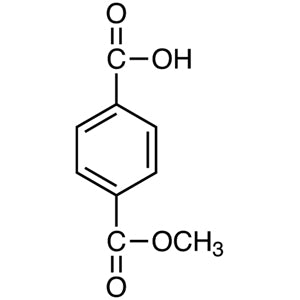
Monomethyl Terephthalate (MMT), with the CAS number 1679-64-7, is a chemical compound widely used as a building block in organic synthesis. It is a key reagent in laboratory settings, particularly in the preparation of esters and the development of polymer materials. Its molecular structure features a terephthalate group linked to a single methyl group, making it versatile for various chemical transformations. MMT is valued for its stability and controlled reactivity, allowing chemists to perform complex reactions with predictable outcomes. Its role in both academic and industrial research makes it an essential component in modern chemical laboratories.
MMT is known for its chemical stability under normal conditions, which ensures it remains effective throughout experimental procedures. It dissolves well in organic solvents such as ethyl acetate and chloroform, facilitating its use in a wide range of reactions. Its non-corrosive nature and low reactivity with common laboratory materials make it a safe and reliable choice for chemists. These properties contribute to its widespread use in both routine and specialized chemical applications. The compound’s predictable behavior and compatibility with various solvents further enhance its utility in laboratory environments.
In Indonesian laboratories, MMT is commonly used in applied chemical research, particularly in the synthesis of organic compounds and the development of new chemical materials. It plays a vital role in polymer research and the creation of compounds with specific functional properties. Its presence in research programs focused on material science and chemical innovation underscores its importance in advancing scientific knowledge and technological applications in the region.
Related TCI products
- Organic synthesis reactions benefit from MMT's stability and controlled reactivity, making it ideal for esterification processes.
- Polymer development relies on MMT as a building block for creating materials with tailored properties and structural integrity.
- Applied chemical research utilizes MMT to design new compounds with specific functional characteristics for industrial applications.
- Material science studies incorporate MMT to explore the synthesis of advanced polymers and specialty chemicals.
- Research programs in Indonesia use MMT to support the development of sustainable and high-performance chemical materials.
| Brand | TCI |
|---|---|
| CAS number | 1679-64-7 |
| Molecular formula | — |
| Purity | — |
| Category | Chemistry > Building Blocks > Non-Heterocyclic Building Blocks |
| Pack sizes | Available in various quantities as per supplier specifications |
| Physical form | Solid, crystalline powder |
| Storage | Store in a cool, dry place away from direct sunlight and moisture |
Monomethyl Terephthalate should be stored in a cool, dry environment to maintain its chemical stability. It is recommended to keep it in a sealed container to prevent exposure to moisture and air, which could affect its performance. Due to its non-corrosive nature, it is compatible with most standard laboratory containers, including glass and polyethylene. When handling MMT, it is advisable to use appropriate personal protective equipment, such as gloves and safety goggles, to ensure safe laboratory practices. Its low reactivity with common laboratory materials makes it a safe choice for routine use, provided standard safety protocols are followed.
—
Produk Terkait
-
PotassiumMonomethylTerephthalate TCI T1083
Regular price From Rp 875.700,00Regular priceRp 612.150,00Sale price From Rp 875.700,00 -
2-HydroxyethylMethylTerephthalate TCI T1679
Regular price From Rp 1.803.900,00Regular priceRp 1.261.050,00Sale price From Rp 1.803.900,00 -
Bis(2-hydroxyethyl)Terephthalate TCI B3429
Regular price From Rp 928.200,00Regular priceRp 648.900,00Sale price From Rp 928.200,00 -
MonomethylAdipate TCI A1738
Regular price From Rp 1.485.750,00Regular priceRp 1.038.450,00Sale price From Rp 1.485.750,00 -
MonomethylAzelate TCI A1312
Regular price From Rp 1.167.600,00Regular priceRp 831.600,00Sale price From Rp 1.167.600,00 -
DisodiumTerephthalate TCI T1097
Regular price From Rp 1.510.950,00Regular priceRp 1.056.300,00Sale price From Rp 1.510.950,00 -
DimethylTerephthalate TCI T0015
Regular price From Rp 505.050,00Regular priceRp 352.800,00Sale price From Rp 505.050,00 -
DiethylTerephthalate TCI T0014
Regular price From Rp 1.881.600,00Regular priceRp 1.315.650,00Sale price From Rp 1.881.600,00