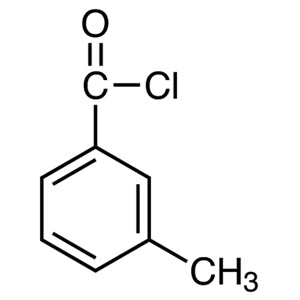
m-Toluoyl Chloride (CAS 1711-06-4) is a versatile organic compound widely used in laboratory settings for its reactivity and utility in synthetic chemistry. It serves as a key building block in the synthesis of aromatic and heterocyclic compounds, making it an essential reagent in organic chemistry research. Its ability to participate in electrophilic substitution and coupling reactions makes it a valuable tool for chemists working on complex molecule synthesis. This compound is commonly found in academic and industrial laboratories where organic synthesis is a core activity.
The chemical and physical properties of m-Toluoyl Chloride make it a preferred choice for specific synthetic applications. It is a stable molecular structure but highly sensitive to moisture and air, requiring careful handling. It appears as a white solid and dissolves readily in organic solvents such as ethyl acetate and chloroform. These solubility characteristics make it ideal for reactions that require anhydrous conditions. Its reactivity and solubility profile enable it to be used in a variety of synthetic pathways, enhancing its applicability in laboratory research.
In Indonesian laboratories, m-Toluoyl Chloride is extensively used in organic chemistry research, particularly in educational institutions and research centers. Its role in the synthesis of pharmaceuticals, materials, and specialty chemicals makes it a critical component in both academic and industrial research. It is commonly used in projects involving the development of new compounds and the study of reaction mechanisms. Its availability and reliability make it a trusted reagent in the Indonesian scientific community.
- Organic Synthesis: m-Toluoyl Chloride is widely used in the synthesis of aromatic and heterocyclic compounds due to its reactivity in electrophilic substitution reactions.
- Pharmaceutical Research: It plays a key role in the development of new drug compounds, particularly in the synthesis of aromatic derivatives and functionalized molecules.
- Material Science: The compound is utilized in the creation of advanced materials, including polymers and specialty chemicals, due to its structural versatility.
- Analytical Chemistry: It serves as a reagent in various analytical techniques, aiding in the identification and quantification of organic compounds.
- Teaching and Education: It is commonly used in academic laboratories to demonstrate fundamental organic reactions and synthetic methodologies to students.
| Brand | TCI |
|---|---|
| CAS number | 1711-06-4 |
| Molecular formula | — |
| Purity | — |
| Category | Chemistry > Building Blocks > Non-Heterocyclic Building Blocks |
| Pack sizes | Available in various quantities as per standard laboratory supply |
| Physical form | White solid |
| Storage | Should be stored in a dry, cool, and airtight container away from moisture and light |
m-Toluoyl Chloride should be stored in a dry, cool, and airtight container to prevent moisture absorption and degradation. It is sensitive to both humidity and air, so it is essential to use suitable containers such as glass or sealed plastic vessels. In laboratory settings, it should be handled with care, using appropriate personal protective equipment such as gloves and goggles. Due to its reactivity, it is recommended to store it in a well-ventilated area away from incompatible substances. Regular monitoring of storage conditions ensures the compound remains stable and effective for use in chemical reactions. Proper handling and storage protocols are crucial to maintaining its integrity and ensuring safe laboratory practices.
—
Produk Terkait
-
p-ToluoylChloride TCI T0311
Regular price From Rp 610.050,00Regular priceRp 442.050,00Sale price From Rp 610.050,00 -
o-ToluoylChloride TCI T0310
Regular price From Rp 900.900,00Regular priceRp 645.750,00Sale price From Rp 900.900,00 -
N-(o-Toluoyl)glycine TCI T0719
Regular price From Rp 2.730.000,00Regular priceRp 1.924.650,00Sale price From Rp 2.730.000,00 -
N-(p-Toluoyl)glycine TCI T0313
Regular price From Rp 1.590.750,00Regular priceRp 1.127.700,00Sale price From Rp 1.590.750,00 -
N-(m-Toluoyl)glycine TCI T0312
Regular price From Rp 1.326.150,00Regular priceRp 942.900,00Sale price From Rp 1.326.150,00 -
2-(p-Toluoyl)benzoicAcid TCI T0308
Regular price From Rp 1.008.000,00Regular priceRp 720.300,00Sale price From Rp 1.008.000,00 -
Anthraquinone-2-carbonylChloride TCI A0503
Regular price From Rp 3.232.950,00Regular priceRp 2.276.400,00Sale price From Rp 3.232.950,00 -
AdipoylChloride TCI A0169
Regular price From Rp 1.272.600,00Regular priceRp 905.100,00Sale price From Rp 1.272.600,00