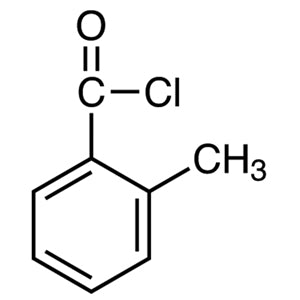
O-Toluoyl Chloride (TCI T0310), with CAS number 933-88-0, is a chemical compound widely used in laboratory settings as a building block in organic synthesis. It serves as a versatile reagent in various chemical reactions, particularly in the synthesis of aromatic compounds and their derivatives. Its unique molecular structure, featuring a toluoyl group attached to a chloride, makes it a valuable component in functional group transformations. This compound is commonly employed in substitution and coupling reactions, enabling the formation of complex molecules with specific chemical properties.
The chemical properties of O-Toluoyl Chloride make it a preferred choice in laboratory research. It exhibits stability under controlled conditions but remains highly reactive towards strong bases and water. This reactivity allows it to participate effectively in a wide range of synthetic pathways, making it a go-to reagent for chemists. Its ability to engage in multiple reaction types enhances its utility in both academic and industrial research environments. The compound’s reactivity and structural versatility contribute to its popularity in organic chemistry applications.
In Indonesian laboratories, O-Toluoyl Chloride is frequently used in organic chemistry research, especially in pharmaceutical, material science, and analytical chemistry fields. It plays a crucial role in the development of new compounds and the study of chemical structures. Its presence in various industrial applications further underscores its importance as a key reagent in chemical synthesis and research. The compound’s reliability and effectiveness make it a staple in many laboratory workflows across Indonesia.
- Organic synthesis applications benefit from O-Toluoyl Chloride due to its role in substitution and coupling reactions, enabling the formation of complex aromatic compounds.
- Pharmaceutical research utilizes this compound for the development of new drugs, as it facilitates the synthesis of aromatic derivatives essential in drug design.
- Material science applications rely on O-Toluoyl Chloride for creating advanced materials with specific chemical properties, such as polymers and coatings.
- Analytical chemistry uses this reagent for the characterization of organic compounds, aiding in the identification and structural analysis of complex molecules.
- Industrial chemical processes incorporate O-Toluoyl Chloride to produce high-reactivity aromatic compounds used in various manufacturing sectors.
| Brand | TCI |
|---|---|
| CAS number | 933-88-0 |
| Molecular formula | — |
| Purity | — |
| Category | Chemistry > Building Blocks > Non-Heterocyclic Building Blocks |
| Pack sizes | Available in various quantities as per standard laboratory supply |
| Physical form | Liquid |
| Storage | Store in a cool, dry place away from moisture and strong bases |
O-Toluoyl Chloride should be stored in a cool, dry environment to maintain its chemical stability. It is recommended to keep the compound in a tightly sealed container to prevent exposure to moisture and air. Due to its reactivity with strong bases and water, it should be handled in a fume hood to minimize direct contact and inhalation risks. Appropriate personal protective equipment, including gloves and safety goggles, should be worn during handling. The compound should be stored away from incompatible materials such as strong bases and oxidizing agents. Regular inspection of storage conditions ensures the compound remains safe and effective for laboratory use.
—
Produk Terkait
-
p-ToluoylChloride TCI T0311
Regular price From Rp 610.050,00Regular priceRp 442.050,00Sale price From Rp 610.050,00 -
m-ToluoylChloride TCI T0309
Regular price Rp 1.008.000,00Regular priceRp 720.300,00Sale price Rp 1.008.000,00 -
N-(o-Toluoyl)glycine TCI T0719
Regular price From Rp 2.730.000,00Regular priceRp 1.924.650,00Sale price From Rp 2.730.000,00 -
N-(p-Toluoyl)glycine TCI T0313
Regular price From Rp 1.590.750,00Regular priceRp 1.127.700,00Sale price From Rp 1.590.750,00 -
N-(m-Toluoyl)glycine TCI T0312
Regular price From Rp 1.326.150,00Regular priceRp 942.900,00Sale price From Rp 1.326.150,00 -
2-(p-Toluoyl)benzoicAcid TCI T0308
Regular price From Rp 1.008.000,00Regular priceRp 720.300,00Sale price From Rp 1.008.000,00 -
Anthraquinone-2-carbonylChloride TCI A0503
Regular price From Rp 3.232.950,00Regular priceRp 2.276.400,00Sale price From Rp 3.232.950,00 -
AdipoylChloride TCI A0169
Regular price From Rp 1.272.600,00Regular priceRp 905.100,00Sale price From Rp 1.272.600,00