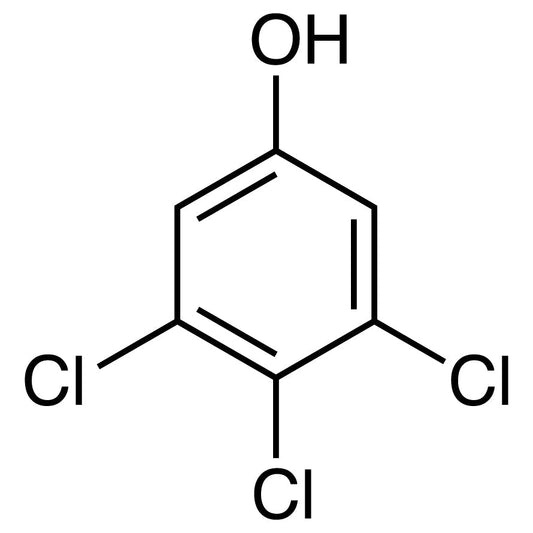
2,4,6-Trichlorophenol is a chemical compound widely used in laboratory settings for the synthesis of complex organic compounds. It serves as a fundamental building block in chemical reactions, particularly in organic chemistry applications. This compound is commonly found in chemistry laboratories as a starting material or reagent due to its phenolic structure with three chlorine substituents. Its role in various chemical processes makes it an essential component for researchers seeking to develop new compounds or conduct analytical studies.
The chemical properties of 2,4,6-Trichlorophenol make it a preferred choice for laboratory use. It possesses a weak phenolic acid group, contributing to its reactivity in substitution and oxidation reactions. The presence of three chlorine atoms enhances its stability and provides controlled reactivity, making it suitable for a wide range of chemical transformations. Additionally, its solubility in organic solvents such as ethyl acetate and chloroform allows for ease of handling and integration into experimental protocols. These characteristics ensure minimal degradation during chemical reactions, maintaining the integrity of experimental results.
In Indonesian laboratories, 2,4,6-Trichlorophenol is frequently utilized in both pure and applied chemical research. It plays a significant role in pharmaceutical and organic chemistry studies, supporting the development of new drugs and materials. Its availability and chemical versatility make it a valuable resource for academic and industrial research, contributing to advancements in various scientific fields.
- Organic synthesis applications benefit from 2,4,6-Trichlorophenol due to its reactivity in substitution and oxidation reactions, making it ideal for creating complex organic molecules.
- Pharmaceutical research utilizes this compound as a building block for developing new drug compounds, leveraging its phenolic structure and reactivity.
- Analytical chemistry experiments often incorporate 2,4,6-Trichlorophenol for its solubility in organic solvents, allowing for accurate and reliable sample preparation.
- Environmental studies may use this compound to investigate its behavior in various chemical environments, assessing its stability and reactivity under different conditions.
- Industrial chemical processes rely on 2,4,6-Trichlorophenol for its controlled reactivity and stability, making it suitable for large-scale chemical manufacturing.
| Brand | TCI |
|---|---|
| CAS number | 88-06-2 |
| Molecular formula | — |
| Purity | — |
| Category | Chemistry > Building Blocks > Non-Heterocyclic Building Blocks |
| Pack sizes | Available in various quantities as per standard laboratory supply |
| Physical form | Solid, typically in crystalline or powder form |
| Storage | Store in a cool, dry place away from direct sunlight and moisture |
2,4,6-Trichlorophenol should be stored in a cool, dry environment to maintain its chemical stability and prevent degradation. It is recommended to use airtight containers made of glass or polyethylene to avoid contamination and ensure long-term preservation. Due to its chemical nature, it should be handled with appropriate personal protective equipment, including gloves and safety goggles, to minimize exposure. In laboratory settings, it is important to store this compound away from incompatible materials such as strong bases or oxidizing agents. Proper labeling and storage practices are essential to ensure safe handling and prevent accidental use.
—
Produk Terkait
-
3,4,5-Trichlorophenol TCI T1115
Regular price Rp 3.949.050,00Regular priceRp 2.761.500,00Sale price Rp 3.949.050,00 -
2,3,6-Trichlorophenol TCI T1114
Regular price From Rp 1.724.100,00Regular priceRp 1.205.400,00Sale price From Rp 1.724.100,00 -
2,4,6-TrichlorophenolSodiumSalt TCI T0392
Regular price Rp 1.829.100,00Regular priceRp 1.278.900,00Sale price Rp 1.829.100,00 -
2,4,5-TrichlorophenolSodiumSalt TCI T0391
Regular price Rp 1.035.300,00Regular priceRp 723.450,00Sale price Rp 1.035.300,00 -
2,4,5-Trichlorophenol TCI T0389
Regular price From Rp 1.167.600,00Regular priceRp 815.850,00Sale price From Rp 1.167.600,00