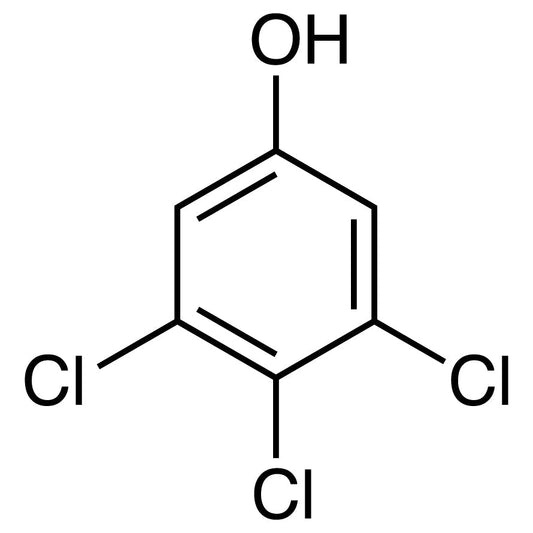
2,4,5-Trichlorophenol is a chemical compound widely used in laboratory settings for the synthesis of complex organic compounds. As a chlorinated aromatic compound, it serves as a fundamental building block in chemical reactions, offering versatility in both research and industrial applications. Its molecular structure, consisting of a phenol core with three chlorine atoms at positions 2, 4, and 5, provides a stable yet reactive platform for further chemical modifications. This compound is commonly found in chemical laboratories as a key reagent or intermediate in various synthetic pathways.
The chemical properties of 2,4,5-Trichlorophenol make it a preferred choice for researchers. It exhibits controlled reactivity, allowing for precise manipulation in synthetic processes. Its ability to react with a variety of reagents, including acids, bases, and metals, enhances its utility in diverse chemical transformations. Additionally, its well-defined melting and boiling points facilitate purification and analysis techniques such as distillation and crystallization. These characteristics make it a reliable and efficient material for laboratory use.
In Indonesian laboratories, 2,4,5-Trichlorophenol is integral to chemical research and development. It is frequently used in the synthesis of new chemical compounds, quality testing of existing materials, and analytical studies. Its presence in both academic and industrial research settings underscores its importance in advancing chemical knowledge and innovation within the region.
TCI brochures (PDF)
- Condensing Agents 2025-11-18 · p. 5
- Organic synthesis applications benefit from 2,4,5-Trichlorophenol’s ability to act as a versatile intermediate in the creation of complex organic molecules.
- It is suitable for reactivity testing in chemical research due to its predictable and controllable chemical behavior under various reaction conditions.
- Quality control processes in chemical laboratories often utilize this compound for the analysis and standardization of other chemical substances.
- Its use in analytical chemistry supports the identification and characterization of unknown compounds through chromatographic and spectroscopic methods.
- In the development of new chemical products, 2,4,5-Trichlorophenol serves as a foundational building block for synthesizing novel compounds with desired properties.
| Brand | TCI |
|---|---|
| CAS number | 95-95-4 |
| Molecular formula | — |
| Purity | — |
| Category | Chemistry > Building Blocks > Non-Heterocyclic Building Blocks |
| Pack sizes | Available in standard laboratory quantities |
| Physical form | Solid |
| Storage | Store in a cool, dry place away from direct sunlight |
2,4,5-Trichlorophenol should be stored in a cool, dry environment to maintain its chemical stability and prevent degradation. It is recommended to keep it in airtight containers to minimize exposure to moisture and air, which can affect its purity and reactivity. Due to its chemical nature, it should be handled with appropriate personal protective equipment, such as gloves and safety goggles, to ensure laboratory safety. Avoid storing near incompatible materials like strong bases or oxidizers. Regular inspection of storage conditions is essential to maintain the integrity of the compound and ensure safe handling in laboratory settings.
—
Produk Terkait
-
3,4,5-Trichlorophenol TCI T1115
Regular price Rp 3.949.050,00Regular priceRp 2.761.500,00Sale price Rp 3.949.050,00 -
2,3,6-Trichlorophenol TCI T1114
Regular price From Rp 1.724.100,00Regular priceRp 1.205.400,00Sale price From Rp 1.724.100,00 -
2,4,6-TrichlorophenolSodiumSalt TCI T0392
Regular price Rp 1.829.100,00Regular priceRp 1.278.900,00Sale price Rp 1.829.100,00 -
2,4,5-TrichlorophenolSodiumSalt TCI T0391
Regular price Rp 1.035.300,00Regular priceRp 723.450,00Sale price Rp 1.035.300,00 -
2,4,6-Trichlorophenol TCI T0390
Regular price From Rp 689.850,00Regular priceRp 481.950,00Sale price From Rp 689.850,00 -
4-Nitrophenol TCI N0220
Regular price From Rp 505.050,00Regular priceRp 352.800,00Sale price From Rp 505.050,00 -
2,4,6-TrichlorobenzoylChloride TCI T1413
Regular price From Rp 2.518.950,00Regular priceRp 1.776.600,00Sale price From Rp 2.518.950,00 -
2,4,6-TriisopropylbenzenesulfonylChloride TCI T0459
Regular price From Rp 2.227.050,00Regular priceRp 1.557.150,00Sale price From Rp 2.227.050,00