


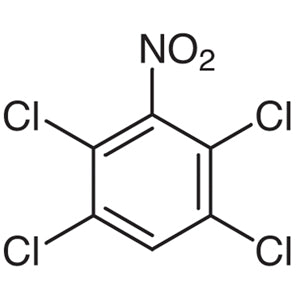
2,3,5,6-Tetrachloronitrobenzene is a chemical compound widely used in laboratory settings as a building block for various synthetic reactions. It plays a crucial role in the synthesis of aromatic and heterocyclic compounds, serving as a versatile precursor for the creation of complex molecules. This compound is commonly found in chemical laboratories due to its reactivity and utility in organic synthesis. Its ability to participate in electrophilic substitution reactions makes it an essential reagent for chemists working on a wide range of projects.
The compound's stability and reactivity make it a preferred choice for researchers. Its molecular structure allows for interactions with various reagents, enabling a range of chemical transformations. The presence of multiple chlorine atoms and a nitro group enhances its reactivity, making it suitable for substitution, oxidation, and reduction reactions. These properties make it an ideal candidate for use in both academic and industrial research environments.
In Indonesian laboratories, 2,3,5,6-Tetrachloronitrobenzene is frequently used in organic chemistry research. It is a key component in the development of new compounds and the modification of molecular structures. Its application is also seen in polymer research and the study of organic compounds. Due to its chemical versatility, it remains a valuable tool for scientists conducting chemical experiments and investigations.
TCI brochures (PDF)
- Agrochemical Ingredients for Research and Experimental Use 2026-01-08 · p. 5
- Plant Research Reagents 2026-02-24 · p. 11
- Reagents for Biological Research 2025-03-11 · p. 56
- Organic synthesis where electrophilic substitution reactions are required due to its reactivity and functional group versatility.
- Polymer research for the development of new materials through chemical modifications and cross-linking processes.
- Heterocyclic compound synthesis as a precursor for the formation of complex ring structures in medicinal chemistry.
- Oxidation and reduction reactions due to its ability to participate in redox processes under controlled conditions.
- Chemical modification of molecular structures for the creation of novel compounds in synthetic chemistry projects.
| Brand | TCI |
|---|---|
| CAS number | 117-18-0 |
| Molecular formula | — |
| Purity | — |
| Category | Chemistry > Building Blocks > Non-Heterocyclic Building Blocks |
| Pack sizes | Available in standard laboratory quantities as per supplier specifications |
| Physical form | Solid, crystalline appearance |
| Storage | Store in a cool, dry place away from light and incompatible substances |
This compound should be stored in a cool, dry environment, away from direct sunlight and sources of heat. It is recommended to use airtight containers to prevent moisture absorption and contamination. Due to its reactivity, it should be kept away from incompatible materials such as strong reducing agents. Proper labeling and safe handling procedures are essential to ensure laboratory safety. Always use appropriate personal protective equipment when handling this material to minimize exposure risks. Regular monitoring of storage conditions is advised to maintain the integrity and stability of the compound.
—
Product Categories
- Cell BiologyNutrition ResearchAgrochemical Research Reagents (for Experimental Use)
- Molecular BiologyPlant BiotechnologyAgrochemical Research Reagents (for Experimental Use)
- Pharmaceutical Development and Drug Discovery ResearchBuilding Blocks for Pharmaceutical Ingredients (for Research and Experimental Use)
Produk Terkait
-
2,3,4,5-Tetrachloronitrobenzene TCI T1128
Regular price Rp 1.298.850,00Regular priceRp 908.250,00Sale price Rp 1.298.850,00 -
3-Bromo-4-chloronitrobenzene TCI B1624
Regular price From Rp 769.650,00Regular priceRp 537.600,00Sale price From Rp 769.650,00 -
4-Chloronitrobenzene TCI C0222
Regular price From Rp 848.400,00Regular priceRp 593.250,00Sale price From Rp 848.400,00 -
2-Chloronitrobenzene TCI C0220
Regular price From Rp 452.550,00Regular priceRp 316.050,00Sale price From Rp 452.550,00 -
3,4,5-Trichloronitrobenzene TCI T1580
Regular price From Rp 743.400,00Regular priceRp 519.750,00Sale price From Rp 743.400,00 -
2,3,4-Trichloronitrobenzene TCI T1197
Regular price Rp 1.353.450,00Regular priceRp 946.050,00Sale price Rp 1.353.450,00 -
2,4,6-Trichloronitrobenzene TCI T0388
Regular price From Rp 1.035.300,00Regular priceRp 723.450,00Sale price From Rp 1.035.300,00 -
2,4,5-Trichloronitrobenzene TCI T0387
Regular price Rp 769.650,00Regular priceRp 537.600,00Sale price Rp 769.650,00


