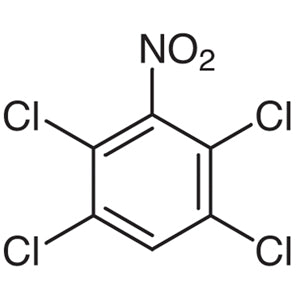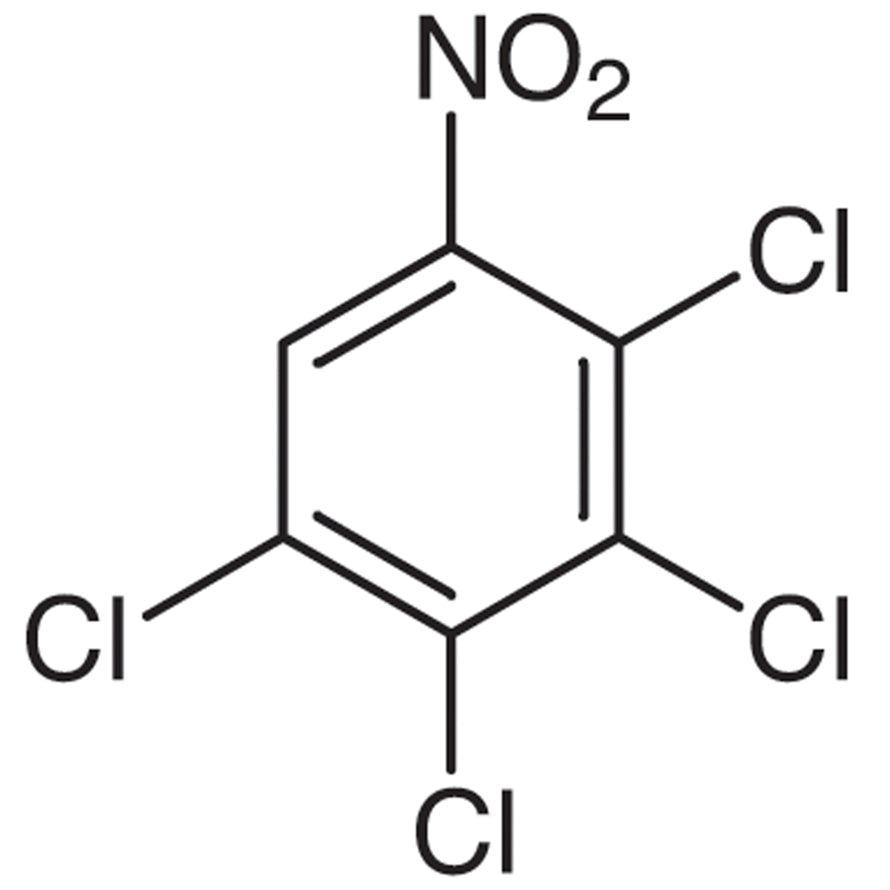
TCI T1128 2,3,4,5-Tetrachloronitrobenzene (CAS 879-39-0) is an aromatic compound that carries one nitro group and four chlorine atoms on a benzene ring. Within the category of non-heterocyclic building blocks, it serves as a starting material for constructing functionalized aromatic molecules. For a synthetic chemistry laboratory, it offers a compact, multi-functional core from which more elaborate structures can be assembled step by step.
The combination of a nitro group and several chlorine substituents opens more than one transformation pathway. The nitro group is a strong electron-withdrawing group, and together with the chlorine atoms it leaves the ring highly electron-poor. This makes certain ring positions more susceptible to attack by nucleophiles, which is the basis of nucleophilic aromatic substitution. Researchers can therefore introduce amine, alkoxide, or thiolate groups in a stepwise manner. Reducing the nitro group to an amine also gives access to chlorinated anilines, so a single starting compound can lead to a wide range of derivatives.
For laboratories in Indonesia, the 1 g pack size suits exploratory synthesis research, reactivity studies, and the assembly of compound libraries. Because the material is a chlorinated nitroaromatic, it should be handled carefully, with suitable protective equipment and proper chemical waste practices. It is a practical option for university and industrial research groups that need a small quantity of a reliable building block from a recognized brand.
- Exploratory organic synthesis: the nitro group and four chlorine atoms give several reactive sites, so the compound works well as a starting material for building new functionalized aromatic molecules.
- Nucleophilic aromatic substitution studies: the electron-poor ring makes specific positions more reactive toward nucleophiles, allowing researchers to study how amines, alkoxides, or thiolates replace chlorine atoms stepwise.
- Preparation of chlorinated anilines: reducing the nitro group to an amine gives access to chlorinated aniline intermediates, which can then be developed further into a variety of derivatives.
- Reactivity and mechanism studies: the combination of strong electron-withdrawing substituents on one ring provides a clear model system for examining how substituent patterns influence reactivity on aromatic compounds.
- Compound library construction: the 1 g pack is a practical size for generating a series of related derivatives from one starting material when assembling a small, diverse research library.
| Brand | TCI |
|---|---|
| CAS number | 879-39-0 |
| Molecular formula | — |
| Purity | — |
| Category | Chemistry > Building Blocks > Non-Heterocyclic Building Blocks |
| Pack sizes | 1 g |
| Physical form | — |
| Storage | keep tightly closed in a cool, dry place, away from incompatible materials, and follow the supplier's safety data sheet |
- Product code: T1128
Store 2,3,4,5-Tetrachloronitrobenzene in its original tightly closed container, in a cool, dry, well-ventilated place away from direct sunlight, heat sources, and incompatible materials such as strong reducing agents and strong bases. Because it is a chlorinated nitroaromatic compound, handle it inside a fume hood and wear a laboratory coat, chemical-resistant gloves, and eye protection. Avoid inhaling dust and avoid contact with skin and eyes. Keep the container clearly labeled, and dispose of waste according to institutional and local regulations for halogenated organic waste. Always consult the supplier's safety data sheet before use for specific hazard and storage information.
—
Produk Terkait
-
2,3,5,6-Tetrachloronitrobenzene TCI T0624
Regular price From Rp 1.510.950,00Regular price -
3-Bromo-4-chloronitrobenzene TCI B1624
Regular price From Rp 769.650,00Regular price -
4-Chloronitrobenzene TCI C0222
Regular price From Rp 848.400,00Regular price -
2-Chloronitrobenzene TCI C0220
Regular price From Rp 452.550,00Regular price -
3,4,5-Trichloronitrobenzene TCI T1580
Regular price From Rp 743.400,00Regular price -
2,3,4-Trichloronitrobenzene TCI T1197
Regular price Rp 1.353.450,00Regular price -
2,4,6-Trichloronitrobenzene TCI T0388
Regular price From Rp 1.035.300,00Regular price -
2,4,5-Trichloronitrobenzene TCI T0387
Regular price Rp 769.650,00Regular price