

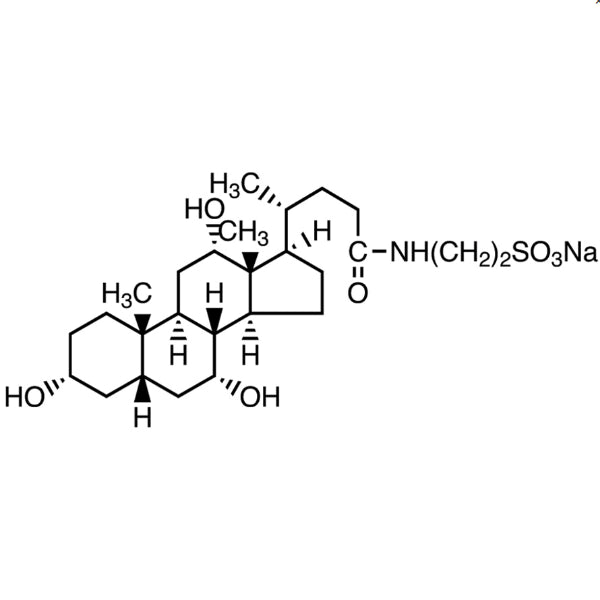
Sodium Taurocholate from Bovine Bile (TCI T0808) is a chemical compound widely utilized in laboratory experiments related to biochemistry and pharmacology. It is derived from bovine bile and serves as a sodium salt of taurocholate, a key component of bile. In laboratory settings, this compound plays a crucial role in various biochemical processes, including lipid metabolism studies and enzyme activity assessments. Its unique chemical properties make it an essential reagent for researchers aiming to understand biological mechanisms and develop new therapeutic approaches.
The compound is valued for its water solubility and ability to interact with lipids, making it highly effective in biomedical research. Its chemical stability under specific conditions further enhances its utility in experimental protocols. Sodium Taurocholate can bind to both proteins and lipids, which is particularly useful in enzyme assays and lipid transport studies. These characteristics ensure its reliability and consistency in laboratory applications, supporting accurate and reproducible results.
In Indonesian laboratories, Sodium Taurocholate is commonly used in academic and research institutions. It is integral to studies involving enzyme activity, lipid metabolism, and toxicity testing. Its availability and reliability make it a preferred choice for scientists working in universities and health-related research organizations. Its versatility and effectiveness contribute to its widespread use in both basic and applied research.
TCI brochures (PDF)
- Steroids 2026-07-28 · p. 7
Related TCI products
- TCI S0596 361-09-1 Sodium Cholate from Bovine Bile [for Biochemical Research]
- TCI U0030 128-13-2 Ursodeoxycholic Acid
- TCI T1567 14605-22-2 Tauroursodeoxycholic Acid Dihydrate
- TCI S0941 2646-38-0 Sodium Chenodeoxycholate
- TCI O0641 459789-99-2 Obeticholic Acid
- TCI O0530 16564-43-5 Sodium Glycochenodeoxycholate
- Enzyme Activity Assays: Sodium Taurocholate is used to study lipase activity due to its ability to interact with lipid molecules.
- Lipid Metabolism Research: It is essential for experiments examining how lipids are processed and transported in biological systems.
- Toxicity Testing: The compound is employed to evaluate the effects of substances on lipid-related pathways in cells and tissues.
- Biochemical Reagent for Chromatography: Its solubility and chemical stability make it suitable for use in analytical techniques like HPLC and TLC.
- Lipid Transport Mechanism Studies: It helps researchers investigate how lipids are transported across cell membranes and within the body.
| Brand | TCI |
|---|---|
| CAS number | 145-42-6 |
| Molecular formula | — |
| Purity | — |
| Category | Life Science > Biochemicals and Reagents > Steroids |
| Pack sizes | Available in various quantities as per standard laboratory reagent packaging |
| Physical form | Solid powder |
| Storage | Store in a cool, dry place away from moisture and direct sunlight |
Sodium Taurocholate should be stored in a cool, dry environment to maintain its chemical stability. It is recommended to keep the compound in a sealed container to prevent moisture absorption. Avoid exposure to direct sunlight and high humidity, as these conditions can affect its solubility and effectiveness. In laboratory settings, it is important to handle the compound with care, using appropriate personal protective equipment when necessary. Proper labeling and storage conditions ensure the compound remains viable for use in experiments. Always follow standard laboratory safety protocols to minimize risks associated with chemical handling.
—
Produk Terkait
-
SodiumCholatefromBovineBile[forBiochemicalResearch] TCI S0596
Regular price From Rp 582.750,00Regular priceRp 423.150,00Sale price From Rp 582.750,00 -
UrsodeoxycholicAcid TCI U0030
Regular price Rp 1.167.600,00Regular priceRp 831.600,00Sale price Rp 1.167.600,00 -
TauroursodeoxycholicAcidDihydrate TCI T1567
Regular price From Rp 1.643.250,00Regular priceRp 1.164.450,00Sale price From Rp 1.643.250,00 -
SodiumChenodeoxycholate TCI S0941
Regular price Rp 1.060.500,00Regular priceRp 757.050,00Sale price Rp 1.060.500,00 -
ObeticholicAcid TCI O0641
Regular price Rp 4.266.150,00Regular priceRp 2.998.800,00Sale price Rp 4.266.150,00 -
SodiumGlycochenodeoxycholate TCI O0530
Regular price From Rp 1.458.450,00Regular priceRp 1.035.300,00Sale price From Rp 1.458.450,00 -
3-Oxo-5beta-cholanoicAcid TCI O0500
Regular price From Rp 5.062.050,00Regular priceRp 3.555.300,00Sale price From Rp 5.062.050,00 -
MethylDesoxycholate TCI M3904
Regular price From Rp 2.942.100,00Regular priceRp 2.072.700,00Sale price From Rp 2.942.100,00


