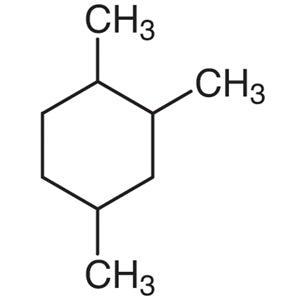
1,2,3-Trimethylcyclohexane is a chemical compound widely used in laboratory settings for constructing complex molecular structures. As a non-heterocyclic building block, it plays a crucial role in organic synthesis by serving as a versatile intermediate. Its ability to form stable bonds with various functional groups makes it an essential component in the development of new chemical compounds. This compound is commonly utilized in research laboratories for its predictable chemical behavior and compatibility with a wide range of synthetic methods.
The compound is known for its stable molecular structure and relatively inert chemical properties under standard laboratory conditions, making it a preferred choice for many synthetic processes. Its well-defined boiling and melting points allow for efficient purification and isolation techniques, which are critical in chemical research. Additionally, its non-toxic nature in normal dosages ensures a safer working environment, reducing potential health risks for laboratory personnel. These properties collectively make it a reliable and dependable material for chemical experimentation.
In Indonesian laboratories, 1,2,3-Trimethylcyclohexane is frequently employed in both fundamental and applied chemical research. It is a staple in academic institutions and research centers, supporting the development of new pharmaceuticals, materials, and industrial chemicals. Its availability and reliability have made it a go-to compound for chemists working on diverse projects across various scientific disciplines.
Related TCI products
- TCI T0827 3073-66-3 1,1,3-Trimethylcyclohexane
- TCI T0825 2234-75-5 1,2,4-Trimethylcyclohexane (mixture of stereoisomers)
- TCI T0664 1839-63-0 1,3,5-Trimethylcyclohexane
- TCI D1715 624-29-3 cis-1,4-Dimethylcyclohexane
- TCI D1055 638-04-0 cis-1,3-Dimethylcyclohexane
- TCI D1054 2207-03-6 trans-1,3-Dimethylcyclohexane
- Organic synthesis is a primary application where 1,2,3-Trimethylcyclohexane is used to build complex molecular frameworks due to its stable structure and compatibility with functional groups.
- Pharmaceutical research benefits from this compound as it serves as a building block for synthesizing new drug molecules with specific biological activities.
- Material science applications rely on its chemical stability to develop new polymers and composite materials with enhanced properties.
- Analytical chemistry utilizes its predictable behavior for calibration and standardization in various analytical techniques.
- Industrial chemistry uses it as a precursor in the production of specialty chemicals and intermediates for diverse manufacturing processes.
| Brand | TCI |
|---|---|
| CAS number | 1678-97-3 |
| Molecular formula | — |
| Purity | — |
| Category | Chemistry > Building Blocks > Non-Heterocyclic Building Blocks |
| Pack sizes | Available in standard laboratory quantities as per supplier specifications |
| Physical form | Liquid |
| Storage | Store in a cool, dry place away from direct sunlight and incompatible materials |
1,2,3-Trimethylcyclohexane should be stored in a cool, dry environment to maintain its chemical stability. It is recommended to keep the compound in a sealed container made of inert material such as glass or stainless steel to prevent contamination. Avoid exposure to direct sunlight and high temperatures to prevent degradation. Laboratory personnel should handle the compound with care, using appropriate personal protective equipment when necessary. Due to its non-toxic nature, it poses minimal health risks, but standard laboratory safety protocols should still be followed. Proper labeling and storage conditions ensure the compound remains safe and effective for use in chemical experiments.
—
Produk Terkait
-
1,1,3-Trimethylcyclohexane TCI T0827
Regular price Rp 5.830.650,00Regular priceRp 4.077.150,00Sale price Rp 5.830.650,00 -
1,2,4-Trimethylcyclohexane(mixtureofstereoisomers) TCI T0825
Regular price From Rp 1.776.600,00Regular priceRp 1.242.150,00Sale price From Rp 1.776.600,00 -
1,3,5-Trimethylcyclohexane TCI T0664
Regular price Rp 2.837.100,00Regular priceRp 1.983.450,00Sale price Rp 2.837.100,00 -
cis-1,4-Dimethylcyclohexane TCI D1715
Regular price From Rp 2.041.200,00Regular priceRp 1.426.950,00Sale price From Rp 2.041.200,00 -
cis-1,3-Dimethylcyclohexane TCI D1055
Regular price From Rp 1.193.850,00Regular priceRp 834.750,00Sale price From Rp 1.193.850,00 -
trans-1,3-Dimethylcyclohexane TCI D1054
Regular price Rp 3.949.050,00Regular priceRp 2.761.500,00Sale price Rp 3.949.050,00 -
1,4-Dimethylcyclohexane(cis-andtrans-mixture) TCI D0700
Regular price From Rp 1.298.850,00Regular priceRp 908.250,00Sale price From Rp 1.298.850,00 -
1,3-Dimethylcyclohexane(cis-andtrans-mixture) TCI D0699
Regular price From Rp 1.458.450,00Regular priceRp 1.019.550,00Sale price From Rp 1.458.450,00