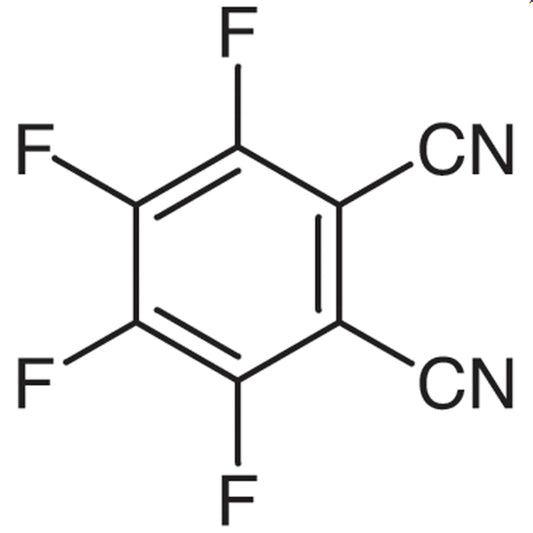
TCI T1050 is Tetrafluoroterephthalonitrile, CAS number 1835-49-0, an aromatic compound that carries two nitrile groups in the para positions and four fluorine atoms on the remaining positions of the benzene ring. It belongs to the family of fluorinated building blocks and is known as a very electron-poor molecule. In the laboratory it serves as a linking unit or monomer in the synthesis of molecules and materials that need a rigid aromatic framework with functional groups that can be replaced step by step.
The combination of four fluorine atoms and two nitrile groups, both strongly electron-withdrawing, makes the ring highly susceptible to nucleophilic attack. The fluorine atoms can be replaced by nucleophiles such as amines, thiols, or alkoxides through nucleophilic aromatic substitution, and the number of substitutions can be controlled through the reaction conditions. This makes the compound attractive as a core for building symmetrical molecules, fluorescent compounds, polymers, and porous frameworks. The nitrile groups can also be converted further, for example into acids, amides, or tetrazoles.
In Indonesia, this material is relevant to organic chemistry, polymer chemistry, and materials research laboratories that are interested in fluorinated aromatic frameworks. Research groups at universities and institutes, as well as industrial R&D teams, can use it as a starting point for exploring substitution chemistry and for designing new functional materials. Supplied under the TCI brand through AMI Scientific, it fits routine synthesis work as well as exploratory projects where a reactive, well-defined aromatic core is needed.
TCI brochures (PDF)
- Covalent Organic Framework (COF) Linkers 2026-05-18 · p. 7
- Fluorination Reagents, Fluorinated Building Blocks 2026-03-18 · p. 34
Related TCI products
- Nucleophilic aromatic substitution studies: the electron-poor ring lets the fluorine atoms be replaced by amines, thiols, or alkoxides, so researchers can examine reactivity and control how many positions are substituted.
- Building symmetrical molecules: the para arrangement of the two nitrile groups gives a rigid, symmetrical core on which matching substituents can be attached to the remaining ring positions.
- Fluorescent compound synthesis: the electron-deficient aromatic core can be combined with electron-donating groups through substitution, making it a useful starting point for designing compounds that emit light.
- Polymer and porous framework research: as a linking unit or monomer, it provides a rigid aromatic backbone with replaceable functional groups, supporting the construction of polymers and framework materials.
- Nitrile group transformations: the two nitrile groups can be converted into acids, amides, or tetrazoles, allowing further functionalization of molecules built on this fluorinated core.
| Brand | TCI |
|---|---|
| CAS number | 1835-49-0 |
| Molecular formula | — |
| Purity | — |
| Category | Chemistry > Building Blocks > Fluorinated Building Blocks |
| Pack sizes | please refer to the options listed on the product page |
| Physical form | — |
| Storage | keep tightly closed in a cool, dry, well-ventilated place, and follow the supplier label and safety data sheet |
- Product code: T1050
Store the container tightly closed in a cool, dry, and well-ventilated place, away from moisture, heat, and incompatible materials, following the conditions stated on the supplier label. Keep the material in its original container or in a suitable tightly sealing chemical-resistant container that is clearly labeled. Because it is a reactive fluorinated nitrile compound, handle it in a fume hood or well-ventilated area and wear gloves, safety glasses, and a laboratory coat. Avoid inhaling dust and avoid contact with skin and eyes. Consult the safety data sheet before use, and dispose of waste according to the laboratory's chemical waste procedures and applicable regulations.
—
Product Categories
Produk Terkait
-
Terephthalonitrile TCI T0016
Regular price From Rp 822.150,00Regular priceRp 590.100,00Sale price From Rp 822.150,00 -
2,5-Bis(trifluoromethyl)terephthalicAcid TCI B6503
Regular price From Rp 3.155.250,00Regular priceRp 2.206.050,00Sale price From Rp 3.155.250,00 -
2,3,5,6-Tetrafluoroterephthalaldehyde TCI T4088
Regular price From Rp 2.068.500,00Regular priceRp 1.445.850,00Sale price From Rp 2.068.500,00 -
Tetrafluorophthalonitrile TCI T1402
Regular price From Rp 1.298.850,00Regular priceRp 924.000,00Sale price From Rp 1.298.850,00 -
Tetrafluoroisophthalonitrile TCI T1728
Regular price From Rp 2.544.150,00Regular priceRp 1.794.450,00Sale price From Rp 2.544.150,00 -
TerephthalicDihydrazide TCI T0758
Regular price From Rp 2.411.850,00Regular priceRp 1.702.050,00Sale price From Rp 2.411.850,00 -
Phthalonitrile TCI P0404
Regular price From Rp 557.550,00Regular priceRp 405.300,00Sale price From Rp 557.550,00 -
TetrafluoroterephthalicAcid TCI T0930
Regular price From Rp 980.700,00Regular priceRp 685.650,00Sale price From Rp 980.700,00