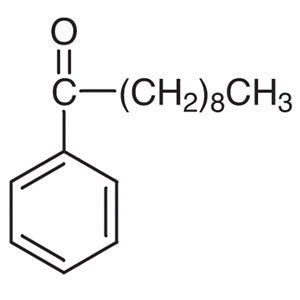
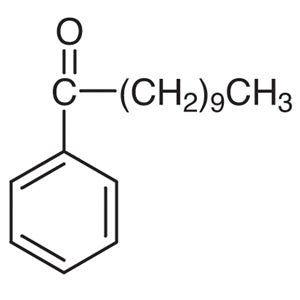
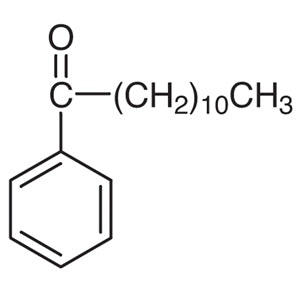
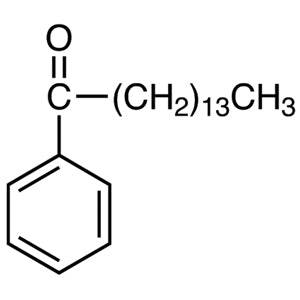
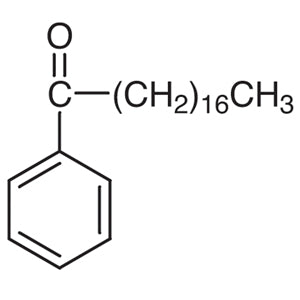
TCI T1087 is Tridecanophenone (CAS 6005-99-8), an aromatic ketone in which a phenyl group is bonded to a carbonyl group that carries a long alkyl chain. The molecule combines a rigid aromatic portion with a flexible, nonpolar hydrocarbon tail. In the laboratory it serves as a non-heterocyclic building block, used to introduce a long alkyl chain into other molecules or as a model compound in studies of aromatic ketones. It is supplied under the TCI brand and belongs to the Building Blocks category of the chemistry range.
The pairing of these two structural features is what makes the compound attractive to researchers. The aromatic carbonyl group can be reduced, alkylated at the alpha position, or condensed with nucleophiles, so it opens several synthetic routes. The long chain, in turn, gives the molecule a strong hydrophobic character. This is useful when a researcher needs an amphiphilic molecule or wants to study how chain length affects physical properties such as solubility and interfacial behavior. The 10 g pack size suits small-scale research and exploratory experiments.
In Indonesian laboratories, Tridecanophenone is a good fit for research groups working in organic chemistry, colloid chemistry, and photochemistry. Graduate students can use it to study the reduction of ketones to alkylbenzenes or alcohols, and materials researchers can use it to examine how a long hydrophobic chain influences molecular behavior. Because it is a single, well-defined compound, it also works as a reference substrate in teaching and method development, where reproducible results across repeated experiments matter.
- Introducing long alkyl chains into target molecules: as a non-heterocyclic building block, Tridecanophenone carries a thirteen-carbon acyl chain on an aromatic ring, which makes it a convenient starting point for adding hydrophobic character to new structures.
- Ketone reduction studies: the aromatic carbonyl group can be reduced to an alcohol or to an alkylbenzene, so the compound is a useful substrate for graduate students learning and comparing reduction methods and their outcomes.
- Alpha-position alkylation and condensation reactions: the carbonyl group lets researchers explore alkylation next to the carbonyl and condensation with nucleophiles, giving a clear substrate for testing reaction conditions and routes.
- Amphiphile and interfacial studies in colloid chemistry: the rigid aromatic head and long nonpolar tail make the molecule suitable for examining how chain length affects solubility and behavior at interfaces.
- Model compound for aromatic ketone and photochemical research: its simple, well-defined structure suits fundamental studies of aromatic ketones, including work in photochemistry, where a consistent reference compound is valuable.
| Brand | TCI |
|---|---|
| CAS number | 6005-99-8 |
| Molecular formula | — |
| Purity | — |
| Category | Chemistry > Building Blocks > Non-Heterocyclic Building Blocks |
| Pack sizes | 10 g |
| Physical form | — |
| Storage | keep tightly closed in a cool, dry place; refer to the supplier label and safety data sheet for exact conditions |
- Product code: T1087
Store Tridecanophenone in its original, tightly closed container in a cool, dry, well-ventilated place, away from direct sunlight, heat sources, and incompatible materials such as strong oxidizing agents. For exact storage conditions, follow the label and the safety data sheet supplied with the product. Wear suitable personal protective equipment, including a laboratory coat, safety glasses, and chemical-resistant gloves, and handle the material in a well-ventilated area or a fume hood. Avoid skin and eye contact and avoid inhaling dust or vapors. Clean up spills promptly, and dispose of waste according to institutional and local regulations.
—
Produk Terkait
-
Decanophenone TCI D0026
Regular price From Rp 1.724.100,00Regular priceRp 1.205.400,00Sale price From Rp 1.724.100,00 -
Undecanophenone TCI U0053
Regular price From Rp 2.597.700,00Regular priceRp 1.816.500,00Sale price From Rp 2.597.700,00 -
Dodecanophenone TCI L0018
Regular price From Rp 1.246.350,00Regular priceRp 871.500,00Sale price From Rp 1.246.350,00 -
Tetradecanophenone TCI T0804
Regular price From Rp 1.538.250,00Regular priceRp 1.075.200,00Sale price From Rp 1.538.250,00 -
Pentadecanophenone TCI P1903
Regular price Rp 3.922.800,00Regular priceRp 2.742.600,00Sale price Rp 3.922.800,00 -
Octadecanophenone TCI O0185
Regular price From Rp 1.510.950,00Regular priceRp 1.056.300,00Sale price From Rp 1.510.950,00 -
Nonadecanophenone TCI N0664
Regular price From Rp 1.590.750,00Regular priceRp 1.111.950,00Sale price From Rp 1.590.750,00 -
Heptadecanophenone TCI H0780
Regular price From Rp 2.174.550,00Regular priceRp 1.520.400,00Sale price From Rp 2.174.550,00