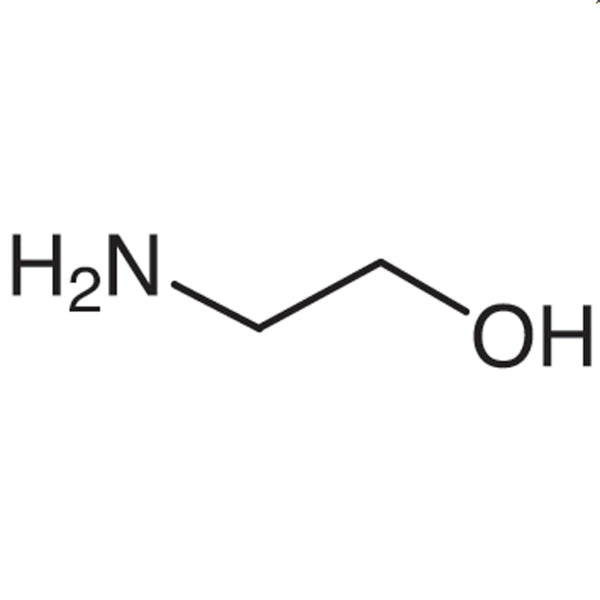
2-Aminoethanol from TCI (product code A0297), also known as ethanolamine or monoethanolamine (MEA), is a simple organic compound that carries both a primary amine group and a hydroxyl group in the same molecule. It is a colorless to slightly yellowish, somewhat viscous liquid with an ammonia-like odor. In the laboratory, 2-aminoethanol is used as an organic base, a starting material for synthesis, a buffer component, an acid gas absorbent, and a standard compound in metabolite analysis. In biology, the molecule is also known as the head group of the phospholipid phosphatidylethanolamine found in cell membranes.
Its bifunctional character is the main reason researchers choose this material. The amine group is basic and nucleophilic, while the hydroxyl group can be esterified or etherified. This allows 2-aminoethanol to serve as a building block for a wide range of derivatives, including amides, oxazolines, and surfactants. The compound is fully miscible with water and with many polar solvents, which makes it easy to work with in aqueous and polar systems. Because it reacts reversibly with carbon dioxide, it is widely used as the reference solution in CO₂ capture research. Users should note that it is hygroscopic and readily absorbs CO₂ from the air, so storage needs care.
In Indonesia, 2-aminoethanol is a common reagent in research and teaching laboratories that work in life science, organic chemistry, and analytical chemistry. Metabolomics and cell biology groups use it as a reference standard when identifying and quantifying metabolites, and as a link to membrane lipid studies. Synthesis laboratories use it as a versatile starting material, and environmental and energy research groups use it as the benchmark absorbent in carbon dioxide capture experiments. Because it comes from TCI, laboratories can rely on a consistent reagent source for routine work.
- Metabolite analysis standard: 2-aminoethanol is a naturally occurring small metabolite, so it serves as a reference compound for identifying and quantifying ethanolamine in metabolomics workflows.
- Organic synthesis starting material: its primary amine and hydroxyl group give two reactive sites, so chemists can build amides, oxazolines, surfactants, and other derivatives from one simple precursor.
- Organic base in reactions: the basic, nucleophilic amine group lets it neutralize acids and promote base-dependent reactions, and its complete water miscibility makes it easy to use in aqueous systems.
- Buffer solution component: its basic amine group and full solubility in water and polar solvents make it a practical ingredient in buffer solutions prepared for laboratory procedures.
- Carbon dioxide capture research: it reacts reversibly with CO₂, so researchers use aqueous 2-aminoethanol as the reference absorbent when they evaluate and compare new acid gas capture materials.
| Brand | TCI (product code A0297) |
|---|---|
| CAS number | 141-43-5 |
| Molecular formula | — |
| Purity | — |
| Category | Life Science > Cell Biology > Metabolomics |
| Pack sizes | as listed in the options on this product page |
| Physical form | colorless to slightly yellowish, somewhat viscous liquid with an ammonia-like odor |
| Storage | hygroscopic and absorbs CO₂ from air; keep the container tightly closed |
2-Aminoethanol is hygroscopic and readily absorbs carbon dioxide from the air. Keep it in its original, tightly sealed container in a cool, dry, well-ventilated area away from acids and oxidizing agents. Close the container promptly after each use to limit moisture uptake and CO₂ absorption, which can change the material's quality over time. Because it is a basic amine with an ammonia-like odor, handle it in a fume hood or a well-ventilated area. Wear chemical-resistant gloves, safety goggles, and a laboratory coat, and avoid contact with skin and eyes and inhalation of vapors. Read the TCI Safety Data Sheet before use, and follow your institution's chemical waste rules when you dispose of residues and contaminated containers.
—
Produk Terkait
-
AcetylcholineChloride TCI A0084
Regular price From Rp 1.405.950,00Regular priceRp 998.550,00Sale price From Rp 1.405.950,00 -
LithiumAcetoacetate TCI A1478
Regular price From Rp 3.232.950,00Regular priceRp 2.276.400,00Sale price From Rp 3.232.950,00 -
Acetyl-L-carnitineHydrochloride TCI A1394
Regular price From Rp 1.140.300,00Regular priceRp 812.700,00Sale price From Rp 1.140.300,00 -
ArachidonicAcid TCI A0781
Regular price From Rp 2.384.550,00Regular priceRp 1.683.150,00Sale price From Rp 2.384.550,00 -
L-Serine TCI S0035
Regular price From Rp 530.250,00Regular priceRp 386.400,00Sale price From Rp 530.250,00 -
Pregnenolone TCI P0786
Regular price From Rp 1.167.600,00Regular priceRp 831.600,00Sale price From Rp 1.167.600,00 -
Progesterone TCI P0478
Regular price From Rp 1.113.000,00Regular priceRp 793.800,00Sale price From Rp 1.113.000,00 -
PhosphocholineChlorideCalciumSaltTetrahydrate TCI P0274
Regular price From Rp 1.801.800,00Regular priceRp 1.275.750,00Sale price From Rp 1.801.800,00