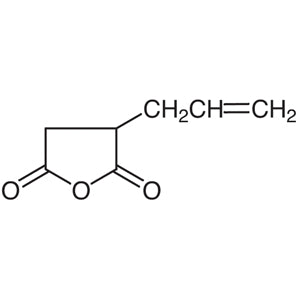
Allylsuccinic Anhydride (CAS 7539-12-0) is a chemical compound widely used in organic synthesis reactions. It serves as a key building block in the development of complex organic molecules, particularly in chemical laboratories. This compound is commonly found in research settings where the synthesis of new compounds is required. As an anhydride, it has the unique ability to react with alcohols and amines to form esters and amides, making it a versatile reagent in synthetic chemistry. Its role in laboratory applications is crucial for the creation of various functional groups and molecular structures.
The chemical properties of Allylsuccinic Anhydride make it a preferred choice for synthetic chemists. It is highly reactive, especially towards water and moisture, which allows it to participate in a wide range of chemical transformations. Its hygroscopic nature means it must be stored carefully to prevent hydrolysis. Despite its reactivity, it remains stable under controlled conditions, ensuring reliability in laboratory experiments. This combination of reactivity and stability makes it a valuable tool for researchers working on complex molecular structures.
In Indonesian laboratories, Allylsuccinic Anhydride is commonly used in organic chemistry research. It plays a significant role in the synthesis of long-chain or alkyl-based compounds. Its application extends to pharmaceutical and industrial chemical development, where the formation of new compounds is essential. Due to its reactivity and effectiveness in chemical reactions, it is a preferred material for researchers aiming to create novel chemical structures. Its use is widespread in both academic and industrial research settings across Indonesia.
TCI brochures (PDF)
- Monomers 2025-05-28 · p. 16
Related TCI products
- TCI B1613 7538-42-3 2-Buten-1-ylsuccinic Anhydride
- TCI H0616 10500-34-2 2-Hexen-1-ylsuccinic Anhydride (cis- and trans- mixture)
- TCI D0976 19780-11-1 2-Dodecen-1-ylsuccinic Anhydride (cis- and trans- mixture)
- TCI A3243 2051-76-5 Acrylic Anhydride (stabilized with MEHQ)
- TCI N0331 826-62-0 5-Norbornene-2,3-dicarboxylic Anhydride
- TCI M3139 760-93-0 Methacrylic Anhydride [stabilized with 1,1,3-Tris(3-tert-butyl-4-hydroxy-6-methylphenyl)butane]
- Organic synthesis of complex molecules due to its reactivity with alcohols and amines to form esters and amides.
- Development of pharmaceutical compounds as it enables the formation of functional groups essential for drug design.
- Preparation of long-chain and alkyl-based compounds for use in material science and polymer chemistry.
- Research in industrial chemical synthesis where efficient formation of new compounds is required.
- Creation of functionalized molecules for use in advanced chemical applications and analytical chemistry.
| Brand | TCI |
|---|---|
| CAS number | 7539-12-0 |
| Molecular formula | — |
| Purity | — |
| Category | Chemistry > Building Blocks > Non-Heterocyclic Building Blocks |
| Pack sizes | — |
| Physical form | — |
| Storage | Must be stored in a dry, cool place to prevent hydrolysis and moisture absorption. |
Allylsuccinic Anhydride should be stored in a dry, cool environment to prevent hydrolysis and moisture absorption. It is hygroscopic and should be kept in a sealed container to minimize exposure to air and humidity. Suitable storage containers include airtight glass or plastic vessels with desiccant to maintain dry conditions. Laboratory personnel should handle the compound with care, using appropriate personal protective equipment to avoid direct contact. Due to its reactivity with water, it should be kept away from moisture sources and stored in a controlled environment to ensure stability and effectiveness in chemical reactions.
—
Produk Terkait
-
2-Buten-1-ylsuccinicAnhydride TCI B1613
Regular price Rp 2.491.650,00Regular priceRp 1.757.700,00Sale price Rp 2.491.650,00 -
2-Hexen-1-ylsuccinicAnhydride(cis-andtrans-mixture) TCI H0616
Regular price Rp 4.266.150,00Regular priceRp 2.998.800,00Sale price Rp 4.266.150,00 -
2-Dodecen-1-ylsuccinicAnhydride(cis-andtrans-mixture) TCI D0976
Regular price Rp 662.550,00Regular priceRp 478.800,00Sale price Rp 662.550,00 -
AcrylicAnhydride(stabilizedwithMEHQ) TCI A3243
Regular price Rp 1.192.800,00Regular priceRp 849.450,00Sale price Rp 1.192.800,00 -
5-Norbornene-2,3-dicarboxylicAnhydride TCI N0331
Regular price Rp 477.750,00Regular priceRp 333.900,00Sale price Rp 477.750,00 -
MethacrylicAnhydride[stabilizedwith1,1,3-Tris(3-tert-butyl-4-hydroxy-6-methylphenyl)butane] TCI M3139
Regular price Rp 1.246.350,00Regular priceRp 887.250,00Sale price Rp 1.246.350,00 -
MaleicAnhydride TCI M0005
Regular price Rp 505.050,00Regular priceRp 368.550,00Sale price Rp 505.050,00 -
4,4'-(Ethyne-1,2-diyl)diphthalicAnhydride(purifiedbysublimation) TCI E1412
Regular price Rp 1.035.300,00Regular priceRp 723.450,00Sale price Rp 1.035.300,00



![760-93-0 Methacrylic Anhydride [stabilized with 1,1,3-Tris(3-tert-butyl-4-hydroxy-6-methylphenyl)butane] - AMI Scientific](http://amiscientific.com/cdn/shop/files/TCI2510M3139.jpg?v=1767127793&width=533)