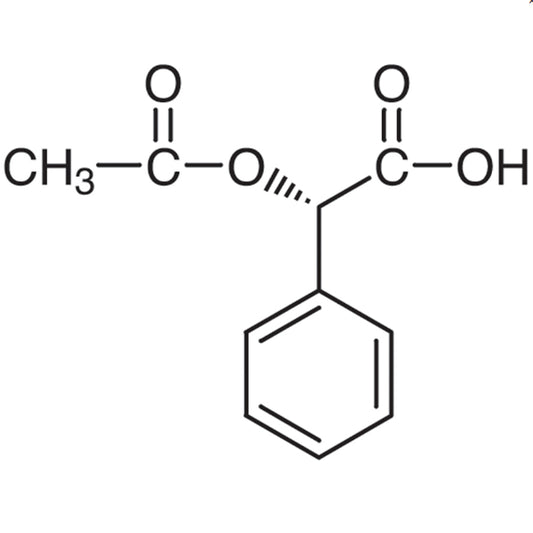
(-)-O-Acetyl-D-mandelic acid is a chiral compound widely used in asymmetric synthesis to construct molecules with specific optical properties. This material plays a crucial role in chemical laboratories, particularly in research focused on chiral compounds. Its unique stereochemistry allows for the selective formation of enantiomers, making it an essential tool in the development of pharmaceuticals and specialty chemicals. Due to its well-defined optical activity, it is highly valued in synthetic pathways that require precise control over molecular structure.
The compound’s chiral nature and reactivity make it a preferred choice for chemists working on complex syntheses. Its ability to participate in various reaction conditions ensures versatility in laboratory applications. The physical and chemical properties of (-)-O-Acetyl-D-mandelic acid contribute to its stability and reactivity, enabling it to be used in a wide range of synthetic processes. This makes it a reliable building block for creating biologically active compounds with specific therapeutic effects.
In Indonesian laboratories, (-)-O-Acetyl-D-mandelic acid is commonly used in scientific research and pharmaceutical development. It is a key component in studies related to asymmetric synthesis and chiral chemistry. Educational and research institutions in Indonesia rely on this compound to advance their understanding of stereochemistry and its applications in drug discovery. With support from AMI Scientific, researchers can access this essential material for their experimental needs.
TCI brochures (PDF)
- Reagents for the Determination of Optical Purity by NMR 2025-01-17 · p. 1
- Chiral Building Blocks 2025-04-14 · p. 13
- Asymmetric synthesis is a key application where (-)-O-Acetyl-D-mandelic acid is used to create enantiomerically pure compounds, which are essential in pharmaceutical research.
- Chiral compound development benefits from this material due to its ability to influence stereochemical outcomes in complex reactions.
- Pharmaceutical research relies on this compound to synthesize active pharmaceutical ingredients with specific biological activities.
- Organic chemistry experiments often incorporate this compound to study stereochemical control and reaction mechanisms.
- Academic research in Indonesian universities uses this material to explore the properties and applications of chiral building blocks in synthetic chemistry.
| Brand | TCI |
|---|---|
| CAS number | 51019-43-3 |
| Molecular formula | — |
| Purity | — |
| Category | Chemistry > Asymmetric Synthesis > Chiral Building Blocks |
| Pack sizes | — |
| Physical form | — |
| Storage | Store in a cool, dry place away from light and moisture |
This compound should be stored in a cool, dry environment to maintain its chemical integrity. It is recommended to keep it in airtight containers to prevent moisture absorption and contamination. Due to its chiral nature, it is important to handle it with care to avoid any unintended stereochemical changes. Laboratory personnel should wear appropriate personal protective equipment when handling the material. The compound should be stored away from incompatible substances to ensure safety. Regular monitoring of storage conditions is advised to maintain its quality and effectiveness in research applications.
—
Produk Terkait
-
(+)-O-Acetyl-L-mandelicAcid TCI A1454
Regular price From Rp 1.378.650,00Regular priceRp 979.650,00Sale price From Rp 1.378.650,00 -
D-(-)-MandelicAcid TCI M0662
Regular price From Rp 928.200,00Regular priceRp 664.650,00Sale price From Rp 928.200,00 -
L-(+)-MandelicAcid TCI M0661
Regular price From Rp 1.140.300,00Regular priceRp 812.700,00Sale price From Rp 1.140.300,00 -
2-Chloro-L-mandelicAcid TCI C2738
Regular price From Rp 2.068.500,00Regular priceRp 1.461.600,00Sale price From Rp 2.068.500,00 -
2-Chloro-D-mandelicAcid TCI C1663
Regular price From Rp 742.350,00Regular priceRp 534.450,00Sale price From Rp 742.350,00 -
(-)-O-Acetyl-L-malicAnhydride TCI A1101
Regular price From Rp 1.192.800,00Regular priceRp 849.450,00Sale price From Rp 1.192.800,00 -
4-Bromo-DL-mandelicAcid TCI B0609
Regular price Rp 2.041.200,00Regular priceRp 1.442.700,00Sale price Rp 2.041.200,00 -
DL-MandelicAcid TCI M0038
Regular price From Rp 610.050,00Regular priceRp 442.050,00Sale price From Rp 610.050,00