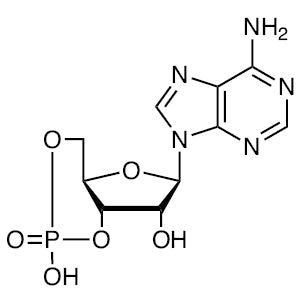
Adenosine 3',5'-Cyclic Monophosphate Sodium Salt (cAMP) is a key biochemical compound widely used in laboratory research. As a cyclic nucleotide, it functions as a secondary messenger in cellular signaling pathways, playing a crucial role in regulating physiological processes such as hormone response and protein kinase activation. In laboratory settings, cAMP is essential for studying signal transduction mechanisms and the activation of biological pathways. Its versatility makes it a fundamental reagent in biochemistry and biomedical research.
This compound is highly valued for its purity and consistency, ensuring reliable results in experimental studies. It exhibits good solubility in organic solvents like acetone and ethanol, making it easy to handle and incorporate into various experimental protocols. Its chemical stability under controlled conditions further enhances its reliability. The availability in small pack sizes, such as 100mg, allows for precise use in controlled experiments, supporting both research and educational applications.
In Indonesian laboratories, cAMP is commonly used in studies related to hormone effects on cells, drug development, and biochemical analysis. Researchers in academic institutions and research centers rely on this compound for its accuracy and reproducibility. Its role in understanding cellular responses and signaling pathways makes it an indispensable tool in modern scientific research.
TCI brochures (PDF)
- Nucleosides, Nucleotides, Nucleic Acids and Related Reagents 2026-03-23 · p. 7
Related TCI products
- TCI A2381 60-92-4 Adenosine 3',5'-Cyclic Monophosphate
- TCI A2117 4578-31-8 Adenosine 5'-Monophosphate Disodium Salt
- TCI A0626 16178-48-6 Adenosine 5'-Diphosphate Disodium Salt
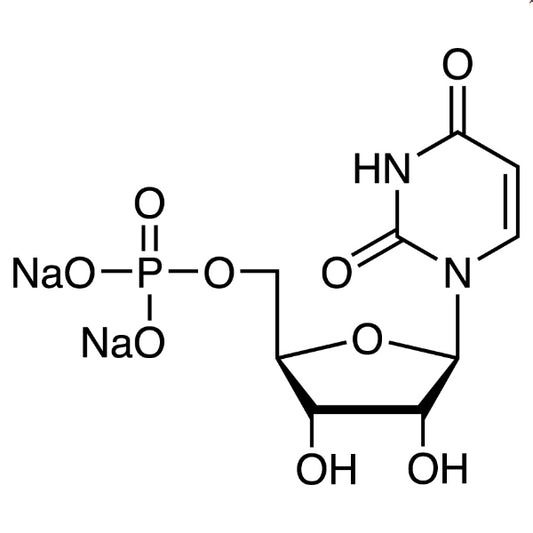
- TCI U0021 3387-36-8 Uridine 5'-Monophosphate Disodium Salt
- TCI T0845 33430-62-5 Thymidine 5'-Monophosphate Disodium Salt
- TCI I0036 352195-40-5 Inosine 5'-Monophosphate Disodium Salt Hydrate
- Signal Transduction Studies: cAMP is used to investigate how cells respond to external signals by activating protein kinase pathways, aiding in understanding cellular communication mechanisms.
- Hormone Research: It serves as a tool to study the effects of hormones on cellular activity, particularly in endocrine system research.
- Drug Development: cAMP is utilized in developing pharmaceuticals that target signaling pathways involved in disease mechanisms.
- Biochemical Analysis: It is employed in assays that measure enzyme activity and metabolic processes, providing insights into cellular function.
- Neurotransmitter Studies: cAMP plays a role in research on neurotransmitter interactions and their impact on neural signaling pathways.
| Brand | TCI |
|---|---|
| CAS number | 37839-81-9 |
| Molecular formula | — |
| Purity | — |
| Category | Life Science > Biochemicals and Reagents > Nucleosides, Nucleotides, Oligonucleotides |
| Pack sizes | 100mg |
| Physical form | Crystalline solid |
| Storage | Store in a cool, dry place away from moisture and light |
This compound should be stored in a cool, dry environment to maintain its chemical stability and prevent degradation. It is recommended to keep it in airtight containers to minimize exposure to moisture and air, which can affect its integrity. Due to its sensitivity, it should be handled in a controlled laboratory setting with appropriate safety measures. Avoid prolonged exposure to light and ensure that storage conditions remain consistent to preserve its quality. Regular monitoring of storage conditions is advised to ensure the compound remains suitable for use in experiments. Proper labeling and documentation of storage conditions are essential for maintaining the reliability of the material in research applications.
—
Produk Terkait
-
Adenosine3',5'-CyclicMonophosphate TCI A2381
Regular price From Rp 2.757.300,00Regular priceRp 1.943.550,00Sale price From Rp 2.757.300,00 -
Adenosine5'-MonophosphateDisodiumSalt TCI A2117
Regular price Rp 1.988.700,00Regular priceRp 1.405.950,00Sale price Rp 1.988.700,00 -
Adenosine5'-DiphosphateDisodiumSalt TCI A0626
Regular price From Rp 822.150,00Regular priceRp 590.100,00Sale price From Rp 822.150,00 -
Uridine5'-MonophosphateDisodiumSalt TCI U0021
Regular price From Rp 2.093.700,00Regular priceRp 1.479.450,00Sale price From Rp 2.093.700,00 -
Thymidine5'-MonophosphateDisodiumSalt TCI T0845
Regular price Rp 2.306.850,00Regular priceRp 1.628.550,00Sale price Rp 2.306.850,00 -
Inosine5'-MonophosphateDisodiumSaltHydrate TCI I0036
Regular price From Rp 505.050,00Regular priceRp 368.550,00Sale price From Rp 505.050,00 -
Guanosine5'-MonophosphateDisodiumSalt TCI G0601
Regular price From Rp 2.068.500,00Regular priceRp 1.461.600,00Sale price From Rp 2.068.500,00 -
2'-Deoxycytidine5'-MonophosphateHydrate TCI D3673
Regular price From Rp 1.192.800,00Regular priceRp 849.450,00Sale price From Rp 1.192.800,00