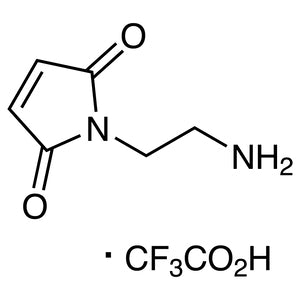
TCI A2914 is a chemical compound used in conjugation chemistry and click chemistry applications within laboratory settings. This reagent plays a crucial role in enabling specific and efficient chemical reactions, particularly in biochemistry research. Its complex structure, featuring an azide group and a trifluoroacetate group, makes it a versatile tool for synthesizing conjugates that can selectively bind to target molecules. The compound's unique chemical properties allow it to be utilized in various experimental workflows, supporting advancements in pharmaceutical and diagnostic research.
The compound's stability under controlled conditions, combined with its reactivity, makes it a preferred choice for researchers. Its ability to participate in click chemistry reactions ensures reliable and reproducible results, which is essential for scientific accuracy. The presence of the azide group enables efficient coupling reactions, while the trifluoroacetate group enhances solubility and reactivity in different solvents. These properties make it suitable for a wide range of applications, from molecular labeling to drug development.
In Indonesian laboratories, TCI A2914 is widely used in scientific research, particularly in academic institutions and research centers. Its role in conjugation chemistry is vital for developing targeted therapies and diagnostic tools. The compound's availability in solid form simplifies storage and handling, making it a practical choice for laboratory use. Its application in both basic and applied research underscores its importance in the Indonesian scientific community.
TCI brochures (PDF)
- Click Chemistry 2026-09-08 · p. 8
Related TCI products
- TCI A2523 875770-34-6 Biotin-PEG3-Azide
- TCI M3978 2415015-21-1 MAUra-Azide
- TCI B5546 1309649-57-7 Biotin-PEG4-Azide
- TCI A3663 146474-00-2 1-(2-Aminoethyl)-1H-pyrrole-2,5-dione Trifluoroacetate
- TCI F1083 849217-48-7 1-[(4-Fluorophenyl)carbamoyl]cyclopropanecarboxylic Acid
- TCI A0304 140-31-8 N-(2-Aminoethyl)piperazine
- Bioconjugation Research – TCI A2914 is ideal for bioconjugation due to its azide functionality, allowing efficient coupling with alkynes for site-specific labeling of biomolecules.
- Drug Development – The compound supports the synthesis of conjugated drug molecules, enabling targeted delivery and improved therapeutic efficacy.
- Diagnostic Reagent – Its reactivity and specificity make it suitable for developing diagnostic tools that require precise molecular recognition.
- Click Chemistry Experiments – TCI A2914 is a key reagent in click chemistry, facilitating rapid and selective reactions between azide and alkyne groups.
- Molecular Imaging Studies – The compound’s ability to form stable conjugates makes it useful in imaging applications where molecular specificity is critical.
| Brand | TCI |
|---|---|
| CAS number | — |
| Molecular formula | — |
| Purity | — |
| Category | Chemistry > Chemical Biology > Conjugation Chemistry/Click Chemistry |
| Pack sizes | — |
| Physical form | Solid |
| Storage | Store in a cool, dark place away from moisture and light |
TCI A2914 should be stored in a cool, dark environment to prevent degradation due to light exposure. It is recommended to keep the compound in a sealed container to minimize moisture contact, as it is sensitive to humidity. The solid form of the compound makes it easier to handle, but care should be taken to avoid contamination during preparation. In laboratory settings, it is advisable to use gloves and appropriate safety equipment when handling the material. Proper storage conditions ensure the compound remains chemically stable and maintains its reactivity for experimental use. Always follow standard laboratory safety protocols to ensure safe handling and storage of this sensitive reagent.
—
Product Categories
Produk Terkait
-
Biotin-PEG3-Azide TCI A2523
Regular price Rp 4.373.250,00Regular priceRp 3.073.350,00Sale price Rp 4.373.250,00 -
MAUra-Azide TCI M3978
Regular price Rp 12.401.550,00Regular priceRp 8.687.700,00Sale price Rp 12.401.550,00 -
Biotin-PEG4-Azide TCI B5546
Regular price Rp 7.949.550,00Regular priceRp 5.574.450,00Sale price Rp 7.949.550,00 -
1-(2-Aminoethyl)-1H-pyrrole-2,5-dioneTrifluoroacetate TCI A3663
Regular price From Rp 2.889.600,00Regular priceRp 2.035.950,00Sale price From Rp 2.889.600,00 -
1-[(4-Fluorophenyl)carbamoyl]cyclopropanecarboxylicAcid TCI F1083
Regular price From Rp 742.350,00Regular priceRp 534.450,00Sale price From Rp 742.350,00 -
N-(2-Aminoethyl)piperazine TCI A0304
Regular price From Rp 557.550,00Regular priceRp 405.300,00Sale price From Rp 557.550,00 -
Yttrium(III)Trifluoroacetate TCI Y0028
Regular price From Rp 2.332.050,00Regular priceRp 1.646.400,00Sale price From Rp 2.332.050,00 -
CesiumTrifluoroacetate TCI T4207
Regular price From Rp 2.677.500,00Regular priceRp 1.887.900,00Sale price From Rp 2.677.500,00