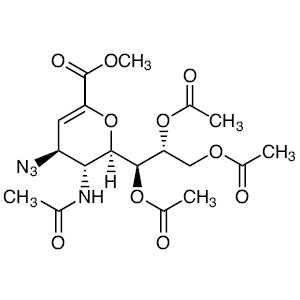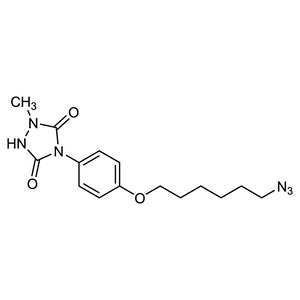
MAUra-Azide from TCI is a probe reagent carrying an azide group that serves as its reaction handle, designed for conjugation chemistry and click chemistry work in chemical biology research. The azide group is one of the most valuable functional groups in bioorthogonal chemistry because it is essentially absent from natural biological systems, which means it does not compete with the biochemical reactions already taking place in a sample. In the laboratory, azide-handled compounds such as this one are used to link the probe portion of the molecule to a wide range of reporters, affinity tags, or solid surfaces through cycloaddition reactions that proceed selectively and efficiently under mild conditions.
The property that makes this reagent a preferred choice is the reliability of its click reaction. The azide group reacts with terminal alkynes through copper-catalysed cycloaddition to form a highly stable triazole ring, or with strained cyclooctynes through a metal-free reaction that is far gentler toward living cells. Both pathways proceed in high yield with almost no side products, and both can be run in aqueous media at either room temperature or physiological temperature. The triazole linkage that forms is robust against hydrolysis, heat, and metabolic conditions, so the conjugate it produces holds together throughout the downstream steps of an experiment.
In Indonesian laboratories, a reagent of this type is typically used in university research groups, chemical biology and biochemistry laboratories, and institutional research centres working on labelling and molecular conjugation. It is normally purchased in small research quantities, handled at the bench by trained researchers, and reserved for method development and experimental work rather than routine analysis. Its role is that of a specialty research reagent supporting studies that require a selective chemical handle for attaching reporters to a molecule of interest.
Related TCI products
- TCI A2914 4-[(2-Aminoethyl)carbamoyl]benzenesulfonyl Azide Trifluoroacetate
- TCI A2523 875770-34-6 Biotin-PEG3-Azide
- TCI B5546 1309649-57-7 Biotin-PEG4-Azide
- TCI U0134 1262975-46-1 ULTROXA(regR) Poly(2-methyl-2-oxazoline) Azide Terminated (n=approx 50)
- TCI U0132 1431850-88-2 ULTROXA(regR) Poly(2-ethyl-2-oxazoline) Azide Terminated (n=approx 50)
- TCI A3442 130525-58-5 Zanamivir Azide Triacetate Methyl Ester
- Bioorthogonal labelling studies, where the azide handle allows attachment of reporters without interfering with the biochemical reactions already running in the biological sample.
- Copper-catalysed azide–alkyne cycloaddition experiments, since the azide group reacts reliably with terminal alkynes to give a highly stable triazole ring in high yield.
- Strain-promoted, copper-free click reactions with cyclooctynes, which are preferred when the experimental system involves living cells that tolerate metal catalysts poorly.
- Conjugation of probe molecules to affinity tags, where the stable triazole linkage keeps the assembled conjugate intact throughout subsequent purification and analysis steps.
- Immobilisation of probe molecules onto solid surfaces, taking advantage of a cycloaddition that proceeds selectively and efficiently under mild aqueous conditions.
| Brand | TCI (Tokyo Chemical Industry) |
|---|---|
| CAS number | 2415015-21-1 |
| Molecular formula | — |
| Purity | — |
| Category | Chemistry > Chemical Biology > Conjugation Chemistry / Click Chemistry |
| Pack sizes | supplied in research-scale pack sizes; please confirm the currently available packaging when ordering |
| Physical form | — |
| Storage | store according to the conditions stated on the manufacturer's label and safety data sheet |
- Product code: M3978
Store this reagent in its original, tightly closed container under the conditions specified by the manufacturer on the product label and safety data sheet, keeping it away from heat, direct sunlight, and sources of ignition. Use chemically compatible containers and close them promptly after each use to limit exposure to moisture and air. Handle the material in a well-ventilated area or fume hood, wearing a laboratory coat, safety glasses, and suitable gloves. Avoid mechanical shock, friction, and strong heating, and do not bring the material into contact with strong acids, strong oxidising agents, or heavy metal salts. Weigh and transfer quantities using clean, dry equipment, and dispose of residues and contaminated materials in accordance with applicable institutional and local chemical waste regulations. Consult the manufacturer's safety data sheet before first use.
—
Product Categories
Produk Terkait
-
AzideTrifluoroacetate TCI A2914
Regular price Rp 2.730.000,00Regular price -
Biotin-PEG3-Azide TCI A2523
Regular price Rp 4.320.750,00Regular price -
Biotin-PEG4-Azide TCI B5546
Regular price Rp 7.897.050,00Regular price -
ULTROXA(regR)Poly(2-methyl-2-oxazoline)AzideTerminated(n=approx50) TCI U0134
Regular price From Rp 2.625.000,00Regular price -
ULTROXA(regR)Poly(2-ethyl-2-oxazoline)AzideTerminated(n=approx50) TCI U0132
Regular price Rp 7.924.350,00Regular price -
ZanamivirAzideTriacetateMethylEster TCI A3442
Regular price Rp 3.472.350,00Regular price -
TetrabutylammoniumAzide TCI T0920
Regular price From Rp 2.466.450,00Regular price -
SodiumAzide TCI S0489
Regular price Rp 875.700,00Regular price
![4-[(2-Aminoethyl)carbamoyl]benzenesulfonyl Azide Trifluoroacetate - AMI Scientific](http://amiscientific.com/cdn/shop/files/TCI2510A2914.jpg?v=1767083536&width=533)