


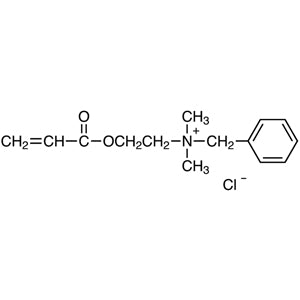
N-(2-Acryloyloxyethyl)-N-benzyl-N,N-dimethylammonium Chloride is a chemical compound widely used in polymerization reactions to produce polymers with specific properties. This material serves as a monomer in the synthesis of ionic polymers, making it an essential component in materials science and chemical research. Its unique structure allows for interactions with other ions during chemical reactions, enabling the creation of functional materials with tailored characteristics. It is commonly found in chemical and material laboratories, supporting a variety of experimental applications.
The compound's properties make it a preferred choice for polymer synthesis due to its high water content of approximately 75%, which enhances its solubility and ease of handling. The addition of MEHQ as a stabilizer ensures its stability under various reaction conditions, making it suitable for controlled polymerization processes. Its ionizable groups allow for the development of materials with specific functional properties, such as conductivity or responsiveness to environmental stimuli. These features make it a versatile reagent in both academic and industrial research settings.
In Indonesian laboratories, this compound is used extensively in research and development projects, particularly in the fields of materials science and chemistry. It supports studies on polymer synthesis, catalyst development, and the creation of advanced materials. Many research institutions and universities in Indonesia rely on this compound to advance their work in polymer chemistry and related disciplines. Its availability and reliability make it a valuable resource for scientific innovation in the region.
Advantages (TCI brochure)
- Stabilized with MEHQ
TCI brochures (PDF)
- Quaternary Ammonium Salts 2025-11-10 · p. 4
- Biomaterials Research Reagents 2025-02-19 · p. 8
- Monomers 2025-05-28 · p. 4
Related TCI products
- TCI M1824 50940-49-3 Mono(2-acryloyloxyethyl) Succinate (stabilized with MEHQ)
- TCI A1493 45021-77-0 (3-Acrylamidopropyl)trimethylammonium Chloride (74-76% in Water) (stabilized with MEHQ)
- TCI M0918 5039-78-1 Methacroylcholine Chloride (ca 80% in Water) (stabilized with MEHQ)
- TCI B2936 13048-33-4 1,6-Bis(acryloyloxy)hexane (stabilized with MEHQ)
- TCI B2935 1070-70-8 1,4-Bis(acryloyloxy)butane (stabilized with MEHQ)
- TCI M3411 126449-41-0 2-Methacryloyloxyethyl Thioctate (stabilized with MEHQ)
- Polymer synthesis for creating ionic polymers with tailored functional properties.
- Development of advanced materials with ion-responsive characteristics for industrial applications.
- Research in catalytic processes where ion interactions are crucial for reaction efficiency.
- Formulation of smart materials that respond to environmental stimuli such as pH or temperature.
- Investigation of polymer behavior in aqueous environments for biomedical and pharmaceutical applications.
| Brand | TCI |
|---|---|
| CAS number | 46830-22-2 |
| Molecular formula | — |
| Purity | — |
| Category | Materials Science > Polymer/Macromolecule Reagents > Monomers |
| Pack sizes | — |
| Physical form | — |
| Storage | Store in a cool, dry place away from direct sunlight |
This compound should be stored in a cool, dry place, away from direct sunlight and sources of heat. It is recommended to use airtight containers to prevent moisture absorption, as its water content can affect its stability. Due to its chemical nature, it should be handled with appropriate personal protective equipment, including gloves and safety goggles. Avoid contact with skin and eyes, and ensure proper ventilation in the workspace. While it is stable under normal storage conditions, it should be kept away from incompatible substances such as strong acids or bases. Regular monitoring of storage conditions is advised to maintain its integrity and effectiveness for laboratory use.
—
Product Categories
Produk Terkait
-
Mono(2-acryloyloxyethyl)Succinate(stabilizedwithMEHQ) TCI M1824
Regular price From Rp 822.150,00Regular priceRp 590.100,00Sale price From Rp 822.150,00 -
(3-Acrylamidopropyl)trimethylammoniumChloride(74-76%inWater)(stabilizedwithMEHQ) TCI A1493
Regular price From Rp 955.500,00Regular priceRp 683.550,00Sale price From Rp 955.500,00 -
MethacroylcholineChloride(ca80%inWater)(stabilizedwithMEHQ) TCI M0918
Regular price From Rp 662.550,00Regular priceRp 478.800,00Sale price From Rp 662.550,00 -
1,6-Bis(acryloyloxy)hexane(stabilizedwithMEHQ) TCI B2936
Regular price From Rp 557.550,00Regular priceRp 405.300,00Sale price From Rp 557.550,00 -
1,4-Bis(acryloyloxy)butane(stabilizedwithMEHQ) TCI B2935
Regular price Rp 637.350,00Regular priceRp 445.200,00Sale price Rp 637.350,00 -
2-MethacryloyloxyethylThioctate(stabilizedwithMEHQ) TCI M3411
Regular price From Rp 4.373.250,00Regular priceRp 3.073.350,00Sale price From Rp 4.373.250,00 -
3-[[2-(Acryloyloxy)ethyl]dimethylammonio]propane-1-sulfonate TCI A3367
Regular price From Rp 4.161.150,00Regular priceRp 2.925.300,00Sale price From Rp 4.161.150,00 -
1-(Acryloyloxy)-3-(methacryloyloxy)-2-propanol(mixtureofisomers)(stabilizedwithMEHQ) TCI A1988
Regular price From Rp 662.550,00Regular priceRp 478.800,00Sale price From Rp 662.550,00


