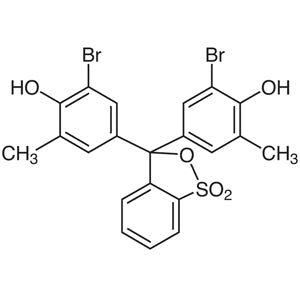
Bromocresol Purple is a widely used pH indicator in laboratories for determining the acidity or alkalinity of a solution. It is commonly employed in analytical chemistry to provide visual feedback on pH changes, making it an essential tool for accurate and efficient pH measurements. This reagent is available in a 0.04% aqueous solution, which ensures consistent performance across various experimental setups. Its role is critical in both qualitative and quantitative analysis, particularly in titration processes where precise endpoint detection is required.
The key properties that make Bromocresol Purple a preferred choice include its sensitivity to pH changes and a well-defined color transition range. It changes color from purple to yellow as the pH increases from 5.2 to 6.8, offering a clear visual indication of pH shifts. This makes it highly reliable for applications requiring accurate and reproducible results. Additionally, its stability under proper storage conditions ensures long-term usability without degradation, maintaining its effectiveness over time.
In Indonesian laboratories, Bromocresol Purple is commonly used in educational and research settings. It is particularly favored for its simplicity and reliability in pH determination, supporting both basic and advanced analytical tasks. Its application is widespread in environmental, industrial, and academic laboratories, where accurate pH measurement is crucial for data integrity and experimental success.
TCI brochures (PDF)
- Titration Reagents and TLC Stains 2026-05-07 · p. 3
Related TCI products
- TCI B0658 76-59-5 Bromothymol Blue (0.04% in Water) [for pH Determination]
- TCI B0579 76-60-8 Bromocresol Green (0.04% in Water) [for pH Determination]
- TCI B0117 Bromophenol Blue (0.04% in Water) [for pH Determination]
- TCI N0161 100-02-7 4-Nitrophenol (0.25% in Water) [for pH Determination]
- TCI C0407 62625-29-0 Cresol Red (0.04% in Water) [for pH Determination]
- TCI B0580 115-40-2 Bromocresol Purple
- pH Titration Analysis: Bromocresol Purple is ideal for acid-base titrations due to its distinct color change range, helping to identify the endpoint accurately.
- Environmental Sample Testing: Used in water and soil analysis to assess pH levels, ensuring compliance with environmental standards.
- Educational Laboratories: Widely adopted in teaching labs for demonstrating pH measurement techniques and colorimetric responses.
- Industrial Quality Control: Applied in manufacturing processes to monitor and maintain optimal pH levels in chemical processes.
- Research and Development: Utilized in R&D settings for pH-sensitive experiments requiring precise and reliable indicators.
| Brand | TCI |
|---|---|
| CAS number | 115-40-2 |
| Molecular formula | — |
| Purity | — |
| Category | Analytical Chemistry > Analytical Reagents > pH Measurement Reagents |
| Pack sizes | 0.04% in Water (various sizes available) |
| Physical form | Aqueous solution |
| Storage | Store in a cool, dark place away from direct sunlight and moisture |
Bromocresol Purple should be stored in a cool, dark place to prevent degradation and maintain its effectiveness. It is recommended to keep the solution in a tightly sealed container to avoid contamination and evaporation. The reagent is sensitive to light and moisture, so exposure to these elements should be minimized. Proper labeling of containers is essential for safe handling and identification. In laboratory settings, it is important to use appropriate personal protective equipment when handling the reagent. Regular inspection of storage conditions ensures the reagent remains stable and suitable for use in analytical processes.
—
Product Categories
Produk Terkait
-
BromothymolBlue(0.04%inWater)[forpHDetermination] TCI B0658
Regular price Rp 795.900,00Regular priceRp 572.250,00Sale price Rp 795.900,00 -
BromocresolGreen(0.04%inWater)[forpHDetermination] TCI B0579
Regular price Rp 822.150,00Regular priceRp 590.100,00Sale price Rp 822.150,00 -
BromophenolBlue(0.04%inWater)[forpHDetermination] TCI B0117
Regular price Rp 1.378.650,00Regular priceRp 979.650,00Sale price Rp 1.378.650,00 -
4-Nitrophenol(0.25%inWater)[forpHDetermination] TCI N0161
Regular price Rp 1.936.200,00Regular priceRp 1.353.450,00Sale price Rp 1.936.200,00 -
CresolRed(0.04%inWater)[forpHDetermination] TCI C0407
Regular price Rp 769.650,00Regular priceRp 553.350,00Sale price Rp 769.650,00 -
BromocresolPurple TCI B0580
Regular price From Rp 557.550,00Regular priceRp 405.300,00Sale price From Rp 557.550,00 -
3,3'-Dimethylnaphthidine[forColorimetricDeterminationofClinWater] TCI D0754
Regular price From Rp 6.651.750,00Regular priceRp 4.667.250,00Sale price From Rp 6.651.750,00 -
MetacresolPurpleSodiumSalt TCI S0045
Regular price From Rp 610.050,00Regular priceRp 442.050,00Sale price From Rp 610.050,00