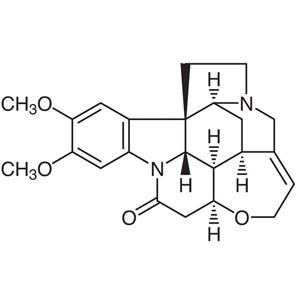
Brucine Hydrate TCI B0670 is a potent alkaloid compound widely utilized in scientific research, particularly in the fields of biochemistry and pharmacology. As a naturally occurring substance found in certain plants, it plays a crucial role in laboratory experiments due to its unique pharmacological properties. This compound is frequently used as a reagent in biological activity assays and as a precursor in the synthesis of other chemical compounds. Its ability to interact with various biological systems makes it an essential tool for researchers aiming to explore its effects on neurological and toxicological processes.
The chemical properties of Brucine Hydrate make it a preferred choice for laboratory use. It exhibits solubility in organic solvents such as ethyl acetate and ethanol, which facilitates its use in a variety of chemical reactions. Its molecular structure allows for specific chemical interactions, making it suitable for targeted experiments. Additionally, the compound demonstrates good stability under appropriate storage conditions, ensuring its reliability and longevity in research settings. These characteristics contribute to its widespread application in both academic and industrial laboratories.
In Indonesian laboratories, Brucine Hydrate is commonly used by researchers in pharmaceutical, biological, and chemical disciplines. Its relevance extends to studies involving drug development, biological activity testing, and toxicological research. The compound’s availability and well-documented properties make it a valuable resource for scientists conducting experiments that require a reliable and effective alkaloid reagent. Its role in advancing scientific understanding in these fields is significant and continuously growing.
TCI brochures (PDF)
- Alkaloids 2025-10-10 · p. 6
- Phytochemicals 2025-12-17 · p. 3
- Reagents for Biological Research 2025-03-11 · p. 52
- Pharmacological research utilizes Brucine Hydrate to study its effects on nerve cells and its potential therapeutic applications.
- Biochemical experiments often incorporate this compound to investigate its role in enzyme interactions and metabolic pathways.
- Toxicological studies benefit from Brucine Hydrate as it helps assess the compound's impact on cellular and organismal health.
- Synthetic chemistry applications use Brucine Hydrate as a building block for creating more complex organic molecules.
- Neurological research employs this alkaloid to explore its influence on brain function and neurotransmitter activity.
| Brand | TCI |
|---|---|
| CAS number | 1638332-73-6 |
| Molecular formula | — |
| Purity | — |
| Category | Life Science > Biochemicals and Reagents > Alkaloids |
| Pack sizes | Available in various quantities as per supplier specifications |
| Physical form | Solid, typically in crystalline or powder form |
| Storage | Store in a cool, dry place away from light and moisture |
Brucine Hydrate should be stored in a cool, dry environment, away from direct sunlight and moisture to maintain its stability and effectiveness. It is recommended to use airtight containers made of glass or high-density polyethylene to prevent contamination and degradation. Due to its chemical nature, it is important to handle the compound with care, using appropriate personal protective equipment such as gloves and safety goggles. It should be kept out of reach of children and not stored near incompatible substances. Regular monitoring of storage conditions ensures the compound remains in optimal condition for use in laboratory experiments. Proper handling and storage practices help preserve the integrity of the material and ensure safe usage in research settings.
—
Produk Terkait
-
BrucineAnhydrous TCI B0946
Regular price Rp 1.538.250,00Regular priceRp 1.090.950,00Sale price Rp 1.538.250,00 -
BrucineHydrochlorideMonohydrate TCI B0671
Regular price Rp 2.068.500,00Regular priceRp 1.461.600,00Sale price Rp 2.068.500,00 -
BrucineSulfateHeptahydrate[forNitrateAnalysis] TCI B0672
Regular price Rp 1.801.800,00Regular priceRp 1.275.750,00Sale price Rp 1.801.800,00 -
YohimbineHydrochloride TCI Y0002
Regular price From Rp 3.392.550,00Regular priceRp 2.387.700,00Sale price From Rp 3.392.550,00 -
Vincamine TCI V0061
Regular price From Rp 2.597.700,00Regular priceRp 1.832.250,00Sale price From Rp 2.597.700,00 -
Tabersonine TCI T3500
Regular price Rp 6.042.750,00Regular priceRp 4.240.950,00Sale price Rp 6.042.750,00 -
StrychnineHydrochloride TCI S0257
Regular price Rp 8.506.050,00Regular priceRp 5.964.000,00Sale price Rp 8.506.050,00 -
Strychnine TCI S0249
Regular price Rp 2.147.250,00Regular priceRp 1.517.250,00Sale price Rp 2.147.250,00