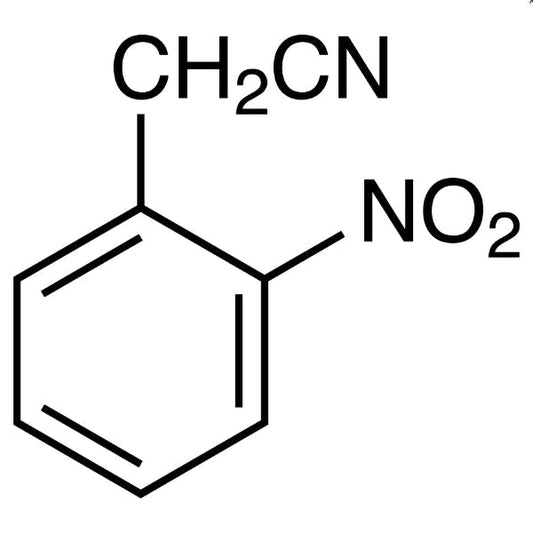
Benzoyl Cyanide (TCI B0835), with CAS number 613-90-1, is a versatile chemical compound widely used in organic laboratory settings. As a key building block in chemical synthesis, it plays a crucial role in the development of complex molecules. Its ability to participate in carbon-carbon and carbon-oxygen bond formations makes it an essential reagent for researchers aiming to create new compounds. This compound is commonly employed in synthetic pathways that require reactive intermediates, supporting a wide range of chemical transformations.
The chemical properties of Benzoyl Cyanide make it a preferred choice for laboratory applications. It exhibits polar characteristics, allowing it to dissolve in organic solvents such as ethyl acetate and chloroform. This solubility facilitates efficient separation and purification processes in analytical and synthetic procedures. Additionally, its stable chemical structure ensures consistent performance in various reaction conditions, making it a reliable material for repeated use. The reactivity of Benzoyl Cyanide also enables it to participate in multiple reaction mechanisms, expanding its utility in diverse chemical applications.
In Indonesian laboratories, Benzoyl Cyanide is frequently utilized in organic chemistry, pharmaceutical, and materials research. Its availability supports the ongoing development of new compounds with potential medical or industrial applications. Researchers in Indonesia rely on this compound for its reliability and effectiveness in both basic and applied research. Its presence in local supply chains further enhances the capacity for scientific innovation and discovery in the region.
Advantages (TCI brochure)
- Fast reaction rate for tracking RNA folding in seconds.
- Rapid inactivation by hydrolysis.
TCI brochures (PDF)
- RNA Structure Analysis Reagent that Sulfonylates the 2'-OH Group of RNA and is Stable in Aqueous Solvents 2024-06-21 · p. 1
- RNA Structure Analysis Reagents 2026-08-20 · p. 1
- Organic synthesis applications benefit from Benzoyl Cyanide's ability to form carbon-carbon and carbon-oxygen bonds, aiding in the creation of complex molecular structures.
- Pharmaceutical research utilizes this compound for the development of new drug compounds, leveraging its reactivity in synthetic pathways.
- Materials science applications rely on Benzoyl Cyanide for the synthesis of functional materials, contributing to the design of advanced chemical structures.
- Analytical chemistry procedures take advantage of its solubility in organic solvents, enabling efficient separation and purification of compounds.
- Industrial chemical processes incorporate Benzoyl Cyanide for the production of specialty chemicals, supporting diverse manufacturing needs.
From the TCI brochure
- Tracking RNA folding in seconds
| Brand | TCI |
|---|---|
| CAS number | 613-90-1 |
| Molecular formula | — |
| Purity | — |
| Category | Chemistry > Building Blocks > Non-Heterocyclic Building Blocks |
| Pack sizes | Available in various quantities as per standard laboratory supply options |
| Physical form | Liquid |
| Storage | Store in a cool, dry place away from direct sunlight and incompatible materials |
Data from the TCI brochure
| Half-life time | 0.25 sec. (Measurement conditions vary according to the reported paper.) |
|---|
Source: TCI brochure LL098 (2026-08-20)
Benzoyl Cyanide should be stored in a cool, dry environment to maintain its chemical stability. It is recommended to keep the compound in a tightly sealed container to prevent exposure to moisture and air. Suitable storage containers include glass or high-density polyethylene vessels that are resistant to chemical degradation. Due to its reactivity, it should be kept away from strong oxidizing agents and incompatible substances. Laboratory personnel should handle the compound with appropriate personal protective equipment, including gloves and safety goggles, to ensure safe handling. Regular inspection of storage conditions is advised to maintain the integrity of the material and ensure compliance with safety protocols.
—
Produk Terkait
-
p-XylylCyanide TCI X0047
Regular price From Rp 1.060.500,00Regular priceRp 757.050,00Sale price From Rp 1.060.500,00 -
m-XylylCyanide TCI X0046
Regular price Rp 2.359.350,00Regular priceRp 1.665.300,00Sale price Rp 2.359.350,00 -
o-XylylCyanide TCI X0045
Regular price From Rp 1.272.600,00Regular priceRp 905.100,00Sale price From Rp 1.272.600,00 -
2,4,6-TrimethylbenzylCyanide TCI T1938
Regular price Rp 1.351.350,00Regular priceRp 960.750,00Sale price Rp 1.351.350,00 -
3-Bromo-4-methoxybenzylCyanide TCI B1455
Regular price From Rp 1.298.850,00Regular priceRp 924.000,00Sale price From Rp 1.298.850,00 -
2-AminobenzylCyanide TCI A2997
Regular price From Rp 557.550,00Regular priceRp 405.300,00Sale price From Rp 557.550,00 -
4-AminobenzylCyanide TCI A1612
Regular price From Rp 1.696.800,00Regular priceRp 1.202.250,00Sale price From Rp 1.696.800,00 -
2-NitrobenzylCyanide TCI N0781
Regular price Rp 1.881.600,00Regular priceRp 1.331.400,00Sale price Rp 1.881.600,00