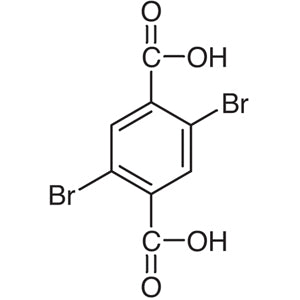
Bromoterephthalic Acid (586-35-6) is an organic compound widely utilized in chemical and materials science experiments. It plays a crucial role in the synthesis of complex compounds, particularly in the development of organic-inorganic hybrid materials. This compound is valued for its ability to form stable and reactive structures, making it a key component in advanced material research. Its unique chemical structure enables it to interact with various metals and other compounds, facilitating the creation of novel materials with specific functional properties.
The compound is known for its chemical stability and controlled reactivity, which are essential for precise chemical reactions in laboratory settings. It exhibits good solubility in organic solvents such as ethyl acetate and acetone, simplifying its handling and application. These properties make it a preferred choice for researchers aiming to produce high-quality materials with tailored characteristics. Additionally, its compatibility with transition metals allows for the formation of porous and crystalline structures, which are vital in the development of Metal Organic Frameworks (MOFs).
In Indonesian laboratories, Bromoterephthalic Acid is commonly used in the synthesis of hybrid materials and MOFs. Its application is widespread in research areas such as catalysis, gas storage, and filtration. Scientists and researchers rely on its consistent performance and predictable behavior to achieve reliable results in their experiments. Its availability and reliability make it an essential reagent in both academic and industrial research settings.
TCI brochures (PDF)
- Organic Linker Molecules for Metal Organic Frameworks (MOFs) 2026-05-11 · p. 3
- Metal Organic Frameworks (MOFs) synthesis due to its ability to form stable and porous structures with transition metals.
- Catalytic reactions where its controlled reactivity and chemical stability enhance reaction efficiency and selectivity.
- Gas storage and separation applications as it contributes to the creation of materials with high surface area and adsorption capacity.
- Organic-inorganic hybrid material development because of its compatibility with various inorganic components and its role in structural formation.
- Filtration processes where its chemical properties enable the creation of materials with specific pore sizes and functional groups.
| Brand | TCI |
|---|---|
| CAS number | 586-35-6 |
| Molecular formula | — |
| Purity | — |
| Category | Materials Science > Organic-Inorganic Hybrid Materials > Metal Organic Frameworks (MOF) and Their Raw Materials |
| Pack sizes | Available in various quantities as per standard laboratory supply |
| Physical form | Solid |
| Storage | Store in a cool, dry place away from direct sunlight and moisture |
Bromoterephthalic Acid should be stored in a cool, dry environment to maintain its chemical stability. It is recommended to keep it in airtight containers to prevent exposure to moisture and air, which could affect its reactivity. The compound is typically handled in a well-ventilated laboratory setting to ensure safe working conditions. Due to its organic nature, it is advisable to use appropriate personal protective equipment, such as gloves and safety goggles, when handling it. Avoid contact with skin and eyes, and ensure proper disposal procedures are followed to maintain laboratory safety standards.
—
Product Categories
- Organic-Inorganic Hybrid MaterialsMetal Organic Frameworks (MOF) and Their Raw MaterialsOrganic Linker Molecules [Metal Organic Frameworks (MOFs) Precursors]
- Polymer/Macromolecule ReagentsMetal Organic Frameworks (MOF) and Their Raw MaterialsOrganic Linker Molecules [Metal Organic Frameworks (MOFs) Precursors]
Produk Terkait
-
TerephthalicAcid TCI T0166
Regular price From Rp 452.550,00Regular priceRp 316.050,00Sale price From Rp 452.550,00 -
2,5-DibromoterephthalicAcid TCI D3994
Regular price From Rp 2.359.350,00Regular priceRp 1.649.550,00Sale price From Rp 2.359.350,00 -
2-AminoterephthalicAcid TCI A1291
Regular price From Rp 980.700,00Regular priceRp 1.686.300,00Sale price From Rp 980.700,00Sale -
TetrafluoroterephthalicAcid TCI T0930
Regular price From Rp 980.700,00Regular priceRp 685.650,00Sale price From Rp 980.700,00 -
NitroterephthalicAcid TCI N0272
Regular price From Rp 1.590.750,00Regular priceRp 1.111.950,00Sale price From Rp 1.590.750,00 -
2,5-DichloroterephthalicAcid TCI D1698
Regular price From Rp 769.650,00Regular priceRp 537.600,00Sale price From Rp 769.650,00 -
2,3,5,6-TetrachloroterephthalicAcid TCI C3862
Regular price From Rp 2.571.450,00Regular priceRp 1.797.600,00Sale price From Rp 2.571.450,00 -
2-MethylterephthalicAcid TCI M3640
Regular price Rp 3.419.850,00Regular priceRp 2.390.850,00Sale price Rp 3.419.850,00