


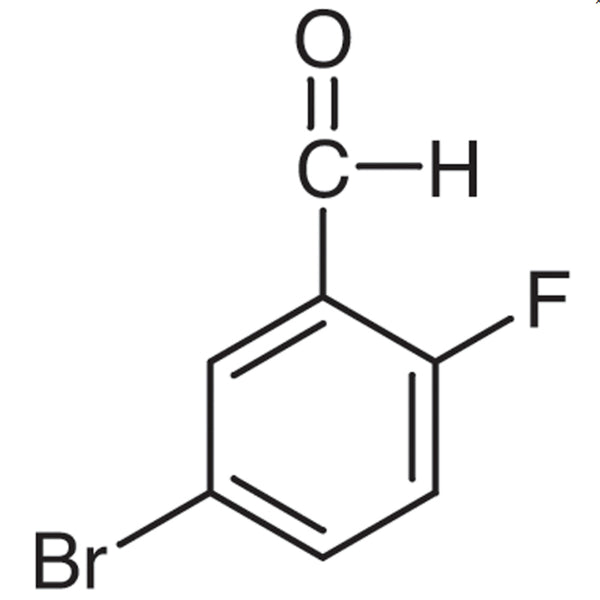
5-Bromo-2-fluorobenzaldehyde is a chemical compound widely used as a building block in the synthesis of complex organic molecules. This compound contains both bromo and fluoro functional groups, which contribute to its unique reactivity and specificity in chemical reactions. In laboratory settings, it serves as a versatile intermediate for the development of new compounds with tailored properties. Its structural features make it an essential tool for chemists working on advanced synthetic pathways.
The presence of bromo and fluoro groups significantly influences the compound’s reactivity, making it ideal for substitution and electrophilic reactions. Its solubility in organic solvents further enhances its utility in various synthetic processes. These properties allow researchers to manipulate its structure efficiently, leading to the creation of a wide range of derivatives. The compound’s stability and reactivity make it a preferred choice for both academic and industrial research.
In Indonesian laboratories, 5-Bromo-2-fluorobenzaldehyde is commonly used in organic chemistry research, particularly in the development of pharmaceutical compounds and novel materials. Its reactivity and structural versatility make it a go-to reagent for researchers seeking to explore new synthetic routes. The compound is especially valuable in studies involving drug discovery and material science, where precise molecular design is crucial.
TCI brochures (PDF)
- Fluorination Reagents, Fluorinated Building Blocks 2026-03-18 · p. 17
Related TCI products
- Organic Synthesis: This compound is ideal for creating complex organic molecules due to its reactive bromo and fluoro groups.
- Pharmaceutical Research: Its structural versatility makes it suitable for the development of new drug compounds and therapeutic agents.
- Material Science: The compound’s reactivity supports the synthesis of advanced materials with specific functional properties.
- Analytical Chemistry: It is used in the preparation of standards and reagents for analytical testing and spectroscopic analysis.
- Teaching and Training: It serves as an essential reagent for educational purposes, helping students understand synthetic chemistry techniques.
| Brand | TCI |
|---|---|
| CAS number | 93777-26-5 |
| Molecular formula | — |
| Purity | — |
| Category | Chemistry > Building Blocks > Fluorinated Building Blocks |
| Pack sizes | Available in various quantities as per standard laboratory supply |
| Physical form | Solid or liquid, depending on the specific formulation |
| Storage | Store in a cool, dry place away from direct sunlight and moisture |
This compound should be stored in a cool, dry environment to maintain its stability and prevent degradation. It is recommended to use airtight containers to minimize exposure to moisture and air, which can affect its reactivity. Due to its bromo and fluoro groups, it may be sensitive to light and heat, so storage in a dark, temperature-controlled area is advisable. Always handle with care, using appropriate personal protective equipment such as gloves and goggles. Ensure proper ventilation in the laboratory when working with this compound to avoid inhalation of vapors. Regular monitoring of storage conditions is essential to maintain the compound’s integrity and ensure safe usage in laboratory settings.
—
Produk Terkait
-
3-Bromo-2-fluorobenzaldehyde TCI B5363
Regular price From Rp 1.590.750,00Regular priceRp 1.111.950,00Sale price From Rp 1.590.750,00 -
4-Bromo-3-fluorobenzaldehyde TCI B4319
Regular price From Rp 1.644.300,00Regular priceRp 1.149.750,00Sale price From Rp 1.644.300,00 -
2-Bromo-4-fluorobenzaldehyde TCI B3498
Regular price Rp 1.035.300,00Regular priceRp 723.450,00Sale price Rp 1.035.300,00 -
2-Bromo-5-fluorobenzaldehyde TCI B2353
Regular price From Rp 664.650,00Regular priceRp 464.100,00Sale price From Rp 664.650,00 -
3-Bromo-4-fluorobenzaldehyde TCI B2143
Regular price From Rp 477.750,00Regular priceRp 333.900,00Sale price From Rp 477.750,00 -
4-Bromo-2-fluorobenzaldehyde TCI B2002
Regular price From Rp 1.035.300,00Regular priceRp 723.450,00Sale price From Rp 1.035.300,00 -
4-FluorobenzaldehydeOxime TCI F1367
Regular price From Rp 1.696.800,00Regular priceRp 1.202.250,00Sale price From Rp 1.696.800,00 -
4-Fluorobenzaldehyde TCI F0191
Regular price From Rp 1.035.300,00Regular priceRp 723.450,00Sale price From Rp 1.035.300,00


