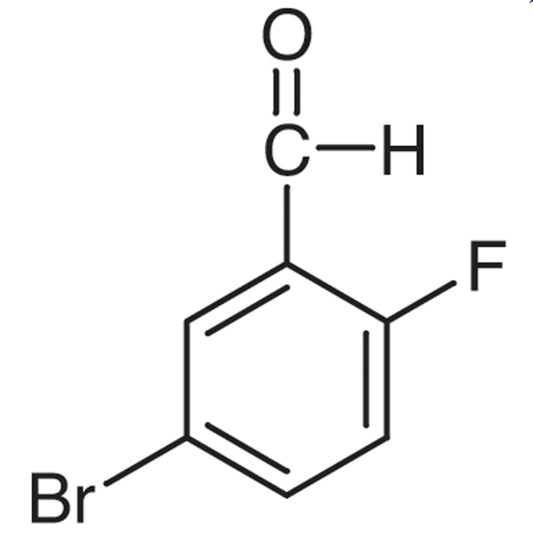
2-Bromo-5-fluorobenzaldehyde is a chemical compound widely used as a building block in the synthesis of complex organic molecules. Its presence in various chemical reactions involving halogen substitution and aromatic reactions makes it a valuable tool in laboratory settings. This compound plays a crucial role in the development of new substances, particularly in the fields of pharmacology and chemical materials. Due to its reactivity and ability to form bonds with different functional groups, it is a preferred choice for numerous chemical experiments.
The unique properties of 2-Bromo-5-fluorobenzaldehyde, including its molecular structure with bromine and fluorine atoms, contribute to its high reactivity. These atoms provide the compound with distinct chemical behavior, making it suitable for substitution reactions and aromatic reactions. The presence of both halogen atoms enhances its versatility in synthetic pathways, allowing chemists to design and produce compounds with specific biological activities. This reactivity, combined with its structural complexity, makes it a sought-after material in organic chemistry research.
In Indonesian laboratories, 2-Bromo-5-fluorobenzaldehyde is commonly used for research purposes in higher education institutions and research organizations. Its application spans across various scientific disciplines, supporting the development of new materials and pharmaceutical compounds. The compound’s stability under certain conditions also facilitates its storage and use, making it a reliable choice for ongoing chemical investigations in the region.
TCI brochures (PDF)
- Fluorination Reagents, Fluorinated Building Blocks 2026-03-18 · p. 24
Related TCI products
- Organic synthesis: This compound is ideal for creating complex organic molecules due to its reactivity and functional group versatility.
- Pharmaceutical research: It is used in the development of new drugs because of its ability to participate in various chemical transformations.
- Material science studies: Its unique molecular structure makes it suitable for synthesizing advanced chemical materials.
- Halogen substitution reactions: The presence of bromine and fluorine allows it to be a key reagent in substitution processes.
- Aromatic reaction experiments: Its aromatic nature enables it to be involved in a wide range of aromatic chemical reactions.
| Brand | TCI |
|---|---|
| CAS number | 94569-84-3 |
| Molecular formula | — |
| Purity | — |
| Category | Chemistry > Building Blocks > Fluorinated Building Blocks |
| Pack sizes | — |
| Physical form | — |
| Storage | Store in a cool, dry place away from light and incompatible materials |
This compound should be stored in a cool, dry environment, away from direct sunlight and sources of heat. It is recommended to use airtight containers to prevent exposure to moisture and air, which can affect its stability. Due to its reactivity, it should be handled in a well-ventilated area, preferably with appropriate personal protective equipment. Avoid contact with incompatible substances such as strong oxidizers or bases. Proper labeling and storage conditions ensure the safety and effectiveness of the compound during laboratory use.
—
Produk Terkait
-
3-Bromo-2-fluorobenzaldehyde TCI B5363
Regular price From Rp 1.590.750,00Regular priceRp 1.111.950,00Sale price From Rp 1.590.750,00 -
4-Bromo-3-fluorobenzaldehyde TCI B4319
Regular price From Rp 1.644.300,00Regular priceRp 1.149.750,00Sale price From Rp 1.644.300,00 -
2-Bromo-4-fluorobenzaldehyde TCI B3498
Regular price Rp 1.035.300,00Regular priceRp 723.450,00Sale price Rp 1.035.300,00 -
3-Bromo-4-fluorobenzaldehyde TCI B2143
Regular price From Rp 477.750,00Regular priceRp 333.900,00Sale price From Rp 477.750,00 -
4-Bromo-2-fluorobenzaldehyde TCI B2002
Regular price From Rp 1.035.300,00Regular priceRp 723.450,00Sale price From Rp 1.035.300,00 -
5-Bromo-2-fluorobenzaldehyde TCI B1789
Regular price From Rp 848.400,00Regular priceRp 593.250,00Sale price From Rp 848.400,00 -
4-FluorobenzaldehydeOxime TCI F1367
Regular price From Rp 1.696.800,00Regular priceRp 1.202.250,00Sale price From Rp 1.696.800,00 -
4-Fluorobenzaldehyde TCI F0191
Regular price From Rp 1.035.300,00Regular priceRp 723.450,00Sale price From Rp 1.035.300,00