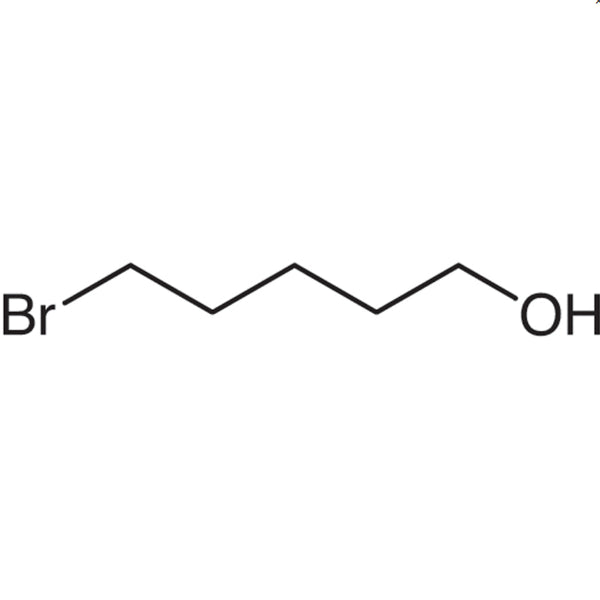
5-Bromo-1-pentanol is a chemical compound widely used as a building block in the synthesis of complex organic compounds. It plays a crucial role in laboratory settings by serving as a versatile intermediate in various chemical reactions. Its simple molecular structure allows for easy modification, making it an essential tool for chemists working on the development of new materials, pharmaceuticals, and industrial chemicals. This compound is particularly valuable in the field of organic chemistry due to its ability to participate in multiple reaction types, including substitution and elimination reactions.
The chemical properties of 5-Bromo-1-pentanol make it a preferred choice for laboratory applications. It exhibits good stability under a range of reaction conditions and demonstrates sufficient reactivity to engage in diverse chemical transformations. Its solubility in organic solvents such as ethyl acetate and acetone further enhances its utility, as it simplifies the process of handling and incorporating the compound into experimental workflows. These characteristics ensure that it remains a reliable and efficient reagent in both academic and industrial research environments.
In Indonesian laboratories, 5-Bromo-1-pentanol is commonly used in organic chemistry research, especially in educational and research programs at academic institutions. It is a fundamental component of the basic chemical supply chain, supporting more advanced experiments and contributing to the development of new chemical compounds. Its availability and reliability make it a standard item in many laboratory inventories, ensuring consistent use across various research projects.
- Organic synthesis applications benefit from 5-Bromo-1-pentanol due to its reactivity and versatility in forming complex molecules.
- It is ideal for substitution reactions where bromine can be replaced with other functional groups, facilitating the creation of new compounds.
- In elimination reactions, the compound serves as a key intermediate, allowing for the formation of alkenes and other functional groups.
- Educational institutions use it to teach fundamental organic chemistry principles, providing students with hands-on experience.
- Industrial research labs rely on it for the development of new pharmaceuticals and specialty chemicals due to its chemical adaptability.
| Brand | TCI |
|---|---|
| CAS number | 34626-51-2 |
| Molecular formula | — |
| Purity | — |
| Category | Chemistry > Building Blocks > Non-Heterocyclic Building Blocks |
| Pack sizes | Available in various quantities as per standard laboratory requirements |
| Physical form | Liquid |
| Storage | Store in a cool, dry place away from direct sunlight |
5-Bromo-1-pentanol should be stored in a cool, dry environment to maintain its chemical stability. It is recommended to keep the compound in a tightly sealed container to prevent exposure to air and moisture. Suitable storage containers include glass or high-quality plastic vessels that are resistant to chemical reactions. In laboratory settings, it is important to handle the compound with appropriate safety measures, such as using gloves and working in a well-ventilated area. Avoid contact with incompatible materials and ensure proper disposal methods are followed to maintain a safe working environment.
—
Produk Terkait
-
2,4,4-Trimethyl-2-pentanol TCI T1962
Regular price From Rp 2.571.450,00Regular priceRp 1.797.600,00Sale price From Rp 2.571.450,00 -
5-Phenyl-1-pentanol TCI P1325
Regular price From Rp 3.658.200,00Regular priceRp 2.557.800,00Sale price From Rp 3.658.200,00 -
1-Phenyl-1-pentanol TCI P1086
Regular price From Rp 1.298.850,00Regular priceRp 908.250,00Sale price From Rp 1.298.850,00 -
4-Methyl-1-phenyl-2-pentanol TCI M2012
Regular price From Rp 848.400,00Regular priceRp 593.250,00Sale price From Rp 848.400,00 -
3-Methyl-1-phenyl-3-pentanol TCI M2011
Regular price From Rp 505.050,00Regular priceRp 352.800,00Sale price From Rp 505.050,00 -
3-Ethyl-2-methyl-3-pentanol TCI E0481
Regular price Rp 4.320.750,00Regular priceRp 3.020.850,00Sale price Rp 4.320.750,00 -
2,3,4-Trimethyl-3-pentanol TCI D2436
Regular price From Rp 4.108.650,00Regular priceRp 2.872.800,00Sale price From Rp 4.108.650,00 -
1-Cyclohexyl-1-pentanol TCI C1569
Regular price Rp 1.060.500,00Regular priceRp 757.050,00Sale price Rp 1.060.500,00