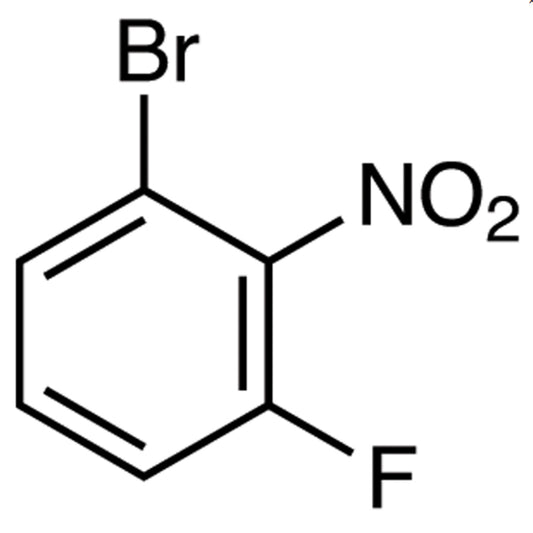
4-Bromo-1-fluoro-2-nitrobenzene is a versatile organic compound widely used in laboratory settings as a building block for the synthesis of complex organic molecules. This compound plays a crucial role in chemical research, particularly in the development of aromatic compounds with multiple functional groups. Its presence in various chemical reactions makes it an essential reagent for chemists working on advanced synthetic pathways. Due to its structural complexity and reactivity, it is frequently utilized in both academic and industrial research environments.
The compound's unique combination of bromo, fluoro, and nitro functional groups contributes to its high reactivity and broad applicability in chemical transformations. These substituents allow it to participate in a variety of reactions, including electrophilic substitution, reduction, and coupling reactions. Its stability under controlled conditions ensures that it remains a reliable and effective reagent for a wide range of experimental applications. The presence of multiple reactive groups also enhances its utility in the design of new pharmaceutical and industrial compounds.
In Indonesian laboratories, 4-Bromo-1-fluoro-2-nitrobenzene is commonly used in organic chemistry research, especially in the synthesis of pharmaceutical compounds and industrial chemicals. Its availability in various packaging formats makes it easily accessible to researchers and educational institutions. The compound's role in creating complex aromatic structures is vital for advancing chemical innovation in the region.
TCI brochures (PDF)
- Fluorination Reagents, Fluorinated Building Blocks 2026-03-18 · p. 18
Related TCI products
- TCI B4842 886762-70-5 1-Bromo-3-fluoro-2-nitrobenzene
- TCI B3062 321-23-3 4-Bromo-2-fluoro-1-nitrobenzene
- TCI B3061 700-36-7 2-Bromo-4-fluoro-1-nitrobenzene
- TCI B3060 185331-69-5 1-Bromo-2-fluoro-4-nitrobenzene
- TCI B2958 701-45-1 2-Bromo-1-fluoro-4-nitrobenzene
- TCI B2339 446-09-3 1-Bromo-4-fluoro-2-nitrobenzene
- Synthesis of complex aromatic compounds for pharmaceutical research due to its multiple reactive functional groups.
- Electrophilic substitution reactions in the development of new organic molecules because of its bromo and nitro groups.
- Coupling reactions in the creation of diverse chemical structures for industrial applications.
- Organic chemistry research in Indonesian laboratories for the design of novel chemical entities.
- Industrial chemical synthesis for the production of specialty compounds requiring precise functional group manipulation.
| Brand | TCI |
|---|---|
| CAS number | 364-73-8 |
| Molecular formula | — |
| Purity | — |
| Category | Chemistry > Building Blocks > Fluorinated Building Blocks |
| Pack sizes | Available in various sizes to suit different laboratory needs |
| Physical form | Liquid |
| Storage | Store in a cool, dry place away from light and incompatible materials |
4-Bromo-1-fluoro-2-nitrobenzene should be stored in a cool, dry place away from direct sunlight and sources of heat. It is recommended to keep the compound in a tightly sealed container to prevent exposure to air and moisture. Due to its reactive nature, it should be stored separately from strong bases, reducing agents, and other incompatible substances. Proper ventilation is essential when handling this material to minimize inhalation risks. Laboratory personnel should wear appropriate personal protective equipment, including gloves and safety goggles, to ensure safe handling and prevent accidental contact. Regular monitoring of storage conditions is advised to maintain the compound's integrity and ensure safe usage in research settings.
—
Produk Terkait
-
1-Bromo-3-fluoro-2-nitrobenzene TCI B4842
Regular price From Rp 1.273.650,00Regular priceRp 890.400,00Sale price From Rp 1.273.650,00 -
4-Bromo-2-fluoro-1-nitrobenzene TCI B3062
Regular price From Rp 1.538.250,00Regular priceRp 1.075.200,00Sale price From Rp 1.538.250,00 -
2-Bromo-4-fluoro-1-nitrobenzene TCI B3061
Regular price Rp 1.988.700,00Regular priceRp 1.390.200,00Sale price Rp 1.988.700,00 -
1-Bromo-2-fluoro-4-nitrobenzene TCI B3060
Regular price From Rp 1.431.150,00Regular priceRp 1.000.650,00Sale price From Rp 1.431.150,00 -
2-Bromo-1-fluoro-4-nitrobenzene TCI B2958
Regular price Rp 664.650,00Regular priceRp 464.100,00Sale price Rp 664.650,00 -
1-Bromo-4-fluoro-2-nitrobenzene TCI B2339
Regular price From Rp 980.700,00Regular priceRp 685.650,00Sale price From Rp 980.700,00 -
2-Fluoro-4-methoxy-1-nitrobenzene TCI F1291
Regular price From Rp 769.650,00Regular priceRp 537.600,00Sale price From Rp 769.650,00 -
4-Fluoro-2-iodo-1-nitrobenzene TCI F1178
Regular price From Rp 1.485.750,00Regular priceRp 1.038.450,00Sale price From Rp 1.485.750,00