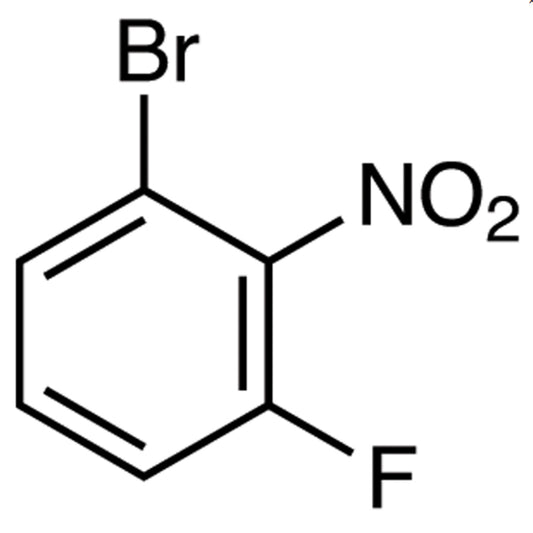
1-Bromo-4-fluoro-2-nitrobenzene is a versatile chemical compound widely used in laboratory settings as a building block for the synthesis of complex organic molecules. It plays a crucial role in the development of new compounds, including pharmaceuticals, industrial chemicals, and functional materials. This compound is particularly valuable in organic chemistry due to its ability to participate in various reaction mechanisms, such as electrophilic substitution and nucleophilic attack. Its presence in research laboratories across Indonesia makes it an essential tool for chemists and researchers working on advanced chemical synthesis projects.
The unique combination of bromo, fluoro, and nitro functional groups gives 1-Bromo-4-fluoro-2-nitrobenzene distinct chemical properties that make it a preferred choice in synthetic chemistry. The fluoro group increases molecular polarity, while the bromo and nitro groups contribute to its reactivity and electronic characteristics. These features allow it to be a key intermediate in the design of novel compounds with specific functional properties. Its stability under controlled conditions also ensures reliable performance in a wide range of chemical reactions.
In Indonesian laboratories, 1-Bromo-4-fluoro-2-nitrobenzene is commonly used in organic chemistry research, complex molecule synthesis, and the development of new chemical products. It is particularly relevant for academic and industrial research, supporting the creation of advanced materials and pharmaceutical compounds. Its availability and chemical versatility make it a standard component in many research laboratories across the country.
TCI brochures (PDF)
- Fluorination Reagents, Fluorinated Building Blocks 2026-03-18 · p. 24
Related TCI products
- TCI B4842 886762-70-5 1-Bromo-3-fluoro-2-nitrobenzene
- TCI B3062 321-23-3 4-Bromo-2-fluoro-1-nitrobenzene
- TCI B3061 700-36-7 2-Bromo-4-fluoro-1-nitrobenzene
- TCI B3060 185331-69-5 1-Bromo-2-fluoro-4-nitrobenzene
- TCI B2958 701-45-1 2-Bromo-1-fluoro-4-nitrobenzene
- TCI B2075 364-73-8 4-Bromo-1-fluoro-2-nitrobenzene
- Organic synthesis research utilizes 1-Bromo-4-fluoro-2-nitrobenzene as a starting material for the creation of complex aromatic compounds due to its reactive functional groups.
- Pharmaceutical development projects often incorporate this compound as a building block for the synthesis of drug molecules, leveraging its electronic and structural properties.
- Industrial chemical production benefits from its use in the manufacture of specialty chemicals, where its reactivity supports efficient synthetic pathways.
- Academic research in fluorinated compounds frequently employs this material to explore new chemical transformations and reaction mechanisms.
- Environmental chemistry studies may use it to investigate the behavior of halogenated aromatic compounds in various chemical environments.
| Brand | TCI |
|---|---|
| CAS number | 446-09-3 |
| Molecular formula | — |
| Purity | — |
| Category | Chemistry > Building Blocks > Fluorinated Building Blocks |
| Pack sizes | Available in standard laboratory quantities |
| Physical form | Solid or liquid, depending on the specific product variant |
| Storage | — |
This compound should be stored in a cool, dry, and well-ventilated area away from direct sunlight and sources of heat. It is recommended to use sealed containers made of inert materials such as glass or polyethylene to prevent contamination and maintain chemical integrity. Due to its reactive nature, it should be handled with appropriate personal protective equipment, including gloves, goggles, and a lab coat. Storage should be in a location that is inaccessible to children and unauthorized personnel. Regular monitoring of storage conditions is advised to ensure long-term stability and safety in the laboratory environment.
—
Produk Terkait
-
1-Bromo-3-fluoro-2-nitrobenzene TCI B4842
Regular price From Rp 1.273.650,00Regular priceRp 890.400,00Sale price From Rp 1.273.650,00 -
4-Bromo-2-fluoro-1-nitrobenzene TCI B3062
Regular price From Rp 1.538.250,00Regular priceRp 1.075.200,00Sale price From Rp 1.538.250,00 -
2-Bromo-4-fluoro-1-nitrobenzene TCI B3061
Regular price Rp 1.988.700,00Regular priceRp 1.390.200,00Sale price Rp 1.988.700,00 -
1-Bromo-2-fluoro-4-nitrobenzene TCI B3060
Regular price From Rp 1.431.150,00Regular priceRp 1.000.650,00Sale price From Rp 1.431.150,00 -
2-Bromo-1-fluoro-4-nitrobenzene TCI B2958
Regular price Rp 664.650,00Regular priceRp 464.100,00Sale price Rp 664.650,00 -
4-Bromo-1-fluoro-2-nitrobenzene TCI B2075
Regular price From Rp 477.750,00Regular priceRp 333.900,00Sale price From Rp 477.750,00 -
2-Fluoro-4-methoxy-1-nitrobenzene TCI F1291
Regular price From Rp 769.650,00Regular priceRp 537.600,00Sale price From Rp 769.650,00 -
4-Fluoro-2-iodo-1-nitrobenzene TCI F1178
Regular price From Rp 1.485.750,00Regular priceRp 1.038.450,00Sale price From Rp 1.485.750,00