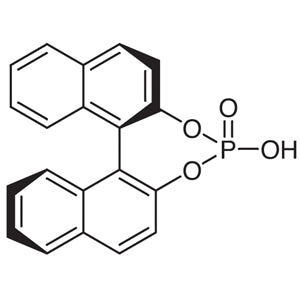
(+/-)-1,1'-Binaphthyl-2,2'-diyl Hydrogenphosphate is a chemical compound widely used in catalytic reactions and organic synthesis within laboratory settings. This compound is a key reagent in asymmetric catalysis, where it plays a crucial role in promoting selective chemical transformations. Its unique structure, consisting of two naphthalene rings connected by a phosphorus-containing group, allows it to act as a versatile catalyst in various synthetic pathways. The compound's ability to facilitate both electrophilic and nucleophilic activation makes it highly valuable in modern chemical research.
The compound is preferred for its high chemical stability and efficient catalytic performance across a range of reaction conditions. Its symmetric molecular structure enables the formation of stable complexes with substrates, enhancing reaction efficiency and selectivity. Additionally, it exhibits relatively low toxicity compared to other catalysts, making it a safer option for laboratory use. These properties contribute to its widespread adoption in both academic and industrial research environments.
In Indonesian laboratories, (+/-)-1,1'-Binaphthyl-2,2'-diyl Hydrogenphosphate is commonly used in organic chemistry research, particularly in the development of asymmetric synthesis and enzymatic catalysis. Its reliability and effectiveness make it a preferred choice for researchers working on complex chemical transformations and process optimization. The compound's consistent performance supports the advancement of chemical innovation in the region.
Related TCI products
- TCI B6250 791616-63-2 (R)-3,3'-Bis(2,4,6-triisopropylphenyl)-1,1'-binaphthyl-2,2'-diyl Hydrogenphosphate
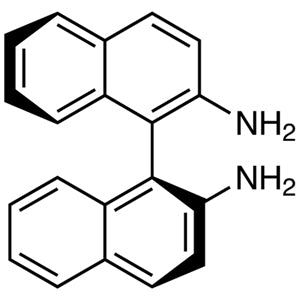
- TCI B3923 4488-22-6 1,1'-Binaphthyl-2,2'-diamine
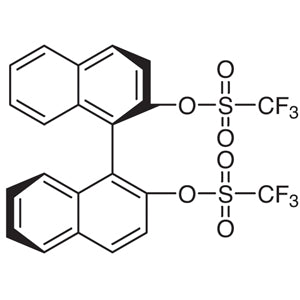
- TCI B2231 128544-05-8 (S)-(+)-1,1'-Binaphthyl-2,2'-diyl Bis(trifluoromethanesulfonate)
- TCI B2230 126613-06-7 (R)-(-)-1,1'-Binaphthyl-2,2'-diyl Bis(trifluoromethanesulfonate)
- TCI B1144 35193-64-7 (S)-(+)-1,1'-Binaphthyl-2,2'-diyl Hydrogen Phosphate
- TCI B1143 39648-67-4 (R)-(-)-1,1'-Binaphthyl-2,2'-diyl Hydrogen Phosphate
- Asymmetric Catalysis: This compound is ideal for asymmetric reactions due to its ability to promote high enantioselectivity in complex organic transformations.
- Organic Synthesis: It is widely used in the synthesis of chiral compounds, where precise control over reaction outcomes is essential.
- Enzymatic Catalysis: Its compatibility with biological systems makes it suitable for applications involving enzyme-based reactions and biocatalysis.
- Reaction Optimization: The compound's stability and efficiency make it a preferred choice for optimizing reaction conditions in both academic and industrial settings.
- Green Chemistry Initiatives: Its relatively low toxicity and high reusability align with sustainable chemical practices, supporting environmentally friendly laboratory protocols.
| Brand | TCI |
|---|---|
| CAS number | 35193-63-6 |
| Molecular formula | — |
| Purity | — |
| Category | Chemistry > Catalysis and Inorganic Chemistry > Phosphorous Compounds |
| Pack sizes | Available in various quantities as per standard laboratory requirements |
| Physical form | Solid powder |
| Storage | Store in a cool, dry place away from moisture and direct sunlight |
This compound should be stored in a cool, dry environment to maintain its chemical stability and catalytic activity. It is recommended to keep it in a sealed container to prevent exposure to moisture and air, which could affect its performance. Suitable storage containers include glass or high-density polyethylene vessels that are resistant to chemical degradation. Laboratory personnel should handle the compound with care, using appropriate personal protective equipment such as gloves and safety goggles. Regular monitoring of storage conditions is advised to ensure the compound remains in optimal condition for use. Proper labeling of containers is essential to prevent accidental misuse or contamination.
—
Produk Terkait
-
(R)-3,3'-Bis(2,4,6-triisopropylphenyl)-1,1'-binaphthyl-2,2'-diylHydrogenphosphate TCI B6250
Regular price From Rp 7.023.450,00Regular priceRp 4.926.600,00Sale price From Rp 7.023.450,00 -
1,1'-Binaphthyl-2,2'-diamine TCI B3923
Regular price Rp 3.949.050,00Regular priceRp 2.777.250,00Sale price Rp 3.949.050,00 -
(S)-(+)-1,1'-Binaphthyl-2,2'-diylBis(trifluoromethanesulfonate) TCI B2231
Regular price Rp 1.565.550,00Regular priceRp 1.094.100,00Sale price Rp 1.565.550,00 -
(R)-(-)-1,1'-Binaphthyl-2,2'-diylBis(trifluoromethanesulfonate) TCI B2230
Regular price Rp 1.829.100,00Regular priceRp 1.278.900,00Sale price Rp 1.829.100,00 -
(S)-(+)-1,1'-Binaphthyl-2,2'-diylHydrogenPhosphate TCI B1144
Regular price From Rp 557.550,00Regular priceRp 405.300,00Sale price From Rp 557.550,00 -
(R)-(-)-1,1'-Binaphthyl-2,2'-diylHydrogenPhosphate TCI B1143
Regular price From Rp 530.250,00Regular priceRp 386.400,00Sale price From Rp 530.250,00 -
1,1'-Binaphthyl TCI B0805
Regular price From Rp 1.405.950,00Regular priceRp 982.800,00Sale price From Rp 1.405.950,00 -
(S)-(-)-1,1'-Binaphthyl-2,2'-diamine TCI D3208
Regular price Rp 1.776.600,00Regular priceRp 1.257.900,00Sale price Rp 1.776.600,00