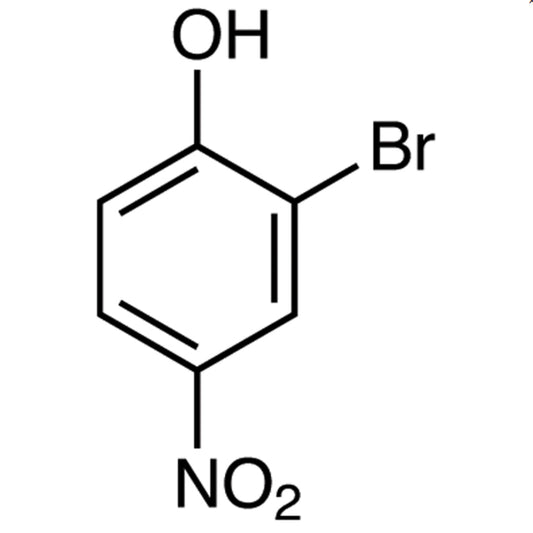
2-Bromo-6-nitrophenol is a chemical compound widely used as a foundational material in various chemical reactions, particularly in the synthesis of aromatic and heterocyclic compounds. It plays a crucial role in organic chemistry laboratories by serving as a versatile building block for the creation of complex organic molecules. Its presence in chemical research is essential for advancing the development of new compounds and understanding reaction mechanisms. This compound is commonly found in both academic and industrial laboratories, where it supports a wide range of synthetic processes.
The compound’s chemical properties make it a preferred choice for researchers. Its molecular structure contains both bromo and nitro groups, which contribute to its high polarity and reactivity. These characteristics allow it to participate effectively in substitution and electrophilic reactions, making it a valuable reagent in synthetic pathways. The stability of 2-bromo-6-nitrophenol under controlled conditions, such as in basic environments or with organic solvents, further enhances its utility. Its ability to undergo various chemical transformations makes it an essential component in organic synthesis.
In Indonesian laboratories, 2-bromo-6-nitrophenol is extensively used in organic chemistry research, especially in the synthesis of new compounds and the modification of aromatic structures. It is also commonly utilized in higher-level chemistry education to train students in synthesis techniques and reactivity concepts. Its widespread application highlights its importance in both research and teaching environments within the chemical sciences.
- Organic synthesis is a key application where 2-bromo-6-nitrophenol is used to create complex aromatic and heterocyclic compounds through substitution and electrophilic reactions.
- Drug development benefits from this compound as it serves as a precursor in the synthesis of pharmaceutical intermediates with specific functional groups.
- Analytical chemistry utilizes this material for the preparation of standard solutions and as a reference compound in spectroscopic and chromatographic analyses.
- Teaching laboratories use it to demonstrate chemical reactivity and synthesis techniques to undergraduate and graduate students.
- Environmental research incorporates this compound in the study of persistent organic pollutants and their behavior in different chemical environments.
| Brand | TCI |
|---|---|
| CAS number | 13073-25-1 |
| Molecular formula | — |
| Purity | — |
| Category | Chemistry > Building Blocks > Non-Heterocyclic Building Blocks |
| Pack sizes | Available in various quantities as per supplier specifications |
| Physical form | Solid, typically in crystalline form |
| Storage | Store in a cool, dry place away from light and incompatible materials |
2-Bromo-6-nitrophenol should be stored in a cool, dry environment to maintain its chemical stability. It is recommended to keep it in a tightly sealed container to prevent exposure to moisture and air. The compound should be stored away from incompatible substances such as strong oxidizers and acids to avoid potential chemical reactions. Suitable containers for storage include glass or high-density polyethylene vessels that are resistant to chemical degradation. In laboratory settings, it is important to handle this compound with appropriate personal protective equipment, including gloves and safety goggles, to ensure safety during handling and use. Proper ventilation should also be maintained when working with this material to minimize inhalation risks.
—
Produk Terkait
-
2-Bromo-4-methoxy-6-nitrophenol TCI B4723
Regular price From Rp 557.550,00Regular priceRp 405.300,00Sale price From Rp 557.550,00 -
2-Bromo-4-nitrophenol TCI B3918
Regular price From Rp 2.625.000,00Regular priceRp 1.835.400,00Sale price From Rp 2.625.000,00 -
4-Bromo-2-nitrophenol TCI B2363
Regular price From Rp 1.035.300,00Regular priceRp 723.450,00Sale price From Rp 1.035.300,00 -
5-Bromo-2-nitrophenol TCI B5788
Regular price From Rp 2.545.200,00Regular priceRp 1.779.750,00Sale price From Rp 2.545.200,00 -
4-tert-Butyl-2-nitrophenol TCI B1812
Regular price From Rp 1.008.000,00Regular priceRp 704.550,00Sale price From Rp 1.008.000,00 -
4-tert-Butyl-2,6-dinitrophenol TCI B1803
Regular price Rp 2.016.000,00Regular priceRp 1.409.100,00Sale price Rp 2.016.000,00 -
2-NitrophenolSodiumSalt TCI N0222
Regular price From Rp 1.220.100,00Regular priceRp 852.600,00Sale price From Rp 1.220.100,00 -
4-Nitrophenol TCI N0220
Regular price From Rp 505.050,00Regular priceRp 352.800,00Sale price From Rp 505.050,00