


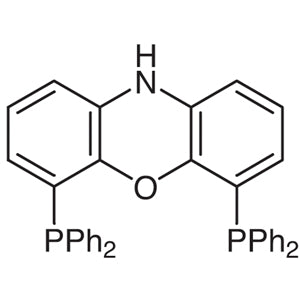
4,6-Bis(diphenylphosphino)phenoxazine is a chemical compound widely used as a catalyst in various chemical reactions, particularly in organic synthesis. Its role in the laboratory is critical for accelerating reaction rates while maintaining the integrity of the chemical substrates. This compound belongs to the category of phosphorus-based compounds and is commonly found in catalysis and inorganic chemistry. Its complex structure enables efficient catalytic interactions with a wide range of substrates, making it a valuable tool for researchers.
One of the key properties that make this compound a preferred choice is its stability under extreme reaction conditions, such as high temperatures and oxidative environments. It also exhibits strong affinity for transition metals, making it highly suitable for heterogeneous catalytic applications. Additionally, its resistance to moisture and oxidation ensures long-term usability and reliability in laboratory settings. These characteristics contribute to its widespread use in both academic and industrial research environments.
In Indonesian laboratories, 4,6-Bis(diphenylphosphino)phenoxazine is extensively used in organic and inorganic chemistry research. It is a common component in the synthesis of complex compounds and is relied upon by research institutions and universities to expedite chemical processes. Its versatility and performance make it an essential material for advanced chemical studies and development.
TCI brochures (PDF)
- C-H Bond Activation Reaction 2025-06-20 · p. 9
- Ligands 2025-12-01 · p. 7
Related TCI products
- TCI B2064 95464-05-4 [1,1'-Bis(diphenylphosphino)ferrocene]palladium(II) Dichloride Dichloromethane Adduct
- TCI B2042 14588-08-0 Bis(triphenylphosphine)palladium(II) Diacetate
- TCI B1667 13965-03-2 Bis(triphenylphosphine)palladium(II) Dichloride
- TCI B3235 903592-98-3 [1,3-Bis(2,6-diisopropylphenyl)imidazol-2-ylidene]triphenylphosphine Nickel(II) Dichloride
- TCI B4908 1395881-55-6 7,7'-Bi[1,4]benzoxazino[2,3,4-kl]phenoxazine
- TCI B4907 1395881-58-9 3,3'-Bi[1,4]benzoxazino[2,3,4-kl]phenoxazine
- Organic synthesis reactions benefit from this compound's ability to facilitate efficient catalytic processes without degrading the substrates.
- Heterogeneous catalysis applications leverage its strong interaction with transition metals, enhancing reaction efficiency in industrial settings.
- Inorganic chemistry experiments utilize its stability under extreme conditions, allowing for reliable results in high-temperature or oxidative environments.
- Research institutions use it to accelerate the synthesis of complex molecules, supporting advancements in chemical science and technology.
- It is commonly employed in academic laboratories for teaching and experimental purposes, providing students with hands-on experience in catalytic processes.
| Brand | TCI |
|---|---|
| CAS number | 261733-18-0 |
| Molecular formula | — |
| Purity | — |
| Category | Chemistry > Catalysis and Inorganic Chemistry > Phosphorous Compounds |
| Pack sizes | Available in various quantities as per standard laboratory supply |
| Physical form | Solid |
| Storage | Store in a cool, dry place away from light and moisture |
This compound should be stored in a cool, dry place, away from direct light and moisture to maintain its stability and effectiveness. It is recommended to use airtight containers to prevent exposure to humidity and potential oxidation. Due to its chemical nature, it should be handled with appropriate personal protective equipment, including gloves and safety goggles, to ensure laboratory safety. Proper ventilation is also essential when working with this material to minimize inhalation risks. Regular inspection of storage conditions is advised to ensure the compound remains in optimal condition for use in chemical experiments.
—
Produk Terkait
-
[1,1'-Bis(diphenylphosphino)ferrocene]palladium(II)DichlorideDichloromethaneAdduct TCI B2064
Regular price From Rp 2.121.000,00Regular priceRp 1.498.350,00Sale price From Rp 2.121.000,00 -
Bis(triphenylphosphine)palladium(II)Diacetate TCI B2042
Regular price From Rp 2.942.100,00Regular priceRp 2.072.700,00Sale price From Rp 2.942.100,00 -
Bis(triphenylphosphine)palladium(II)Dichloride TCI B1667
Regular price From Rp 1.618.050,00Regular priceRp 1.146.600,00Sale price From Rp 1.618.050,00 -
[1,3-Bis(2,6-diisopropylphenyl)imidazol-2-ylidene]triphenylphosphineNickel(II)Dichloride TCI B3235
Regular price From Rp 2.518.950,00Regular priceRp 1.776.600,00Sale price From Rp 2.518.950,00 -
7,7'-Bi[1,4]benzoxazino[2,3,4-kl]phenoxazine TCI B4908
Regular price From Rp 5.062.050,00Regular priceRp 3.555.300,00Sale price From Rp 5.062.050,00 -
3,3'-Bi[1,4]benzoxazino[2,3,4-kl]phenoxazine TCI B4907
Regular price From Rp 4.771.200,00Regular priceRp 3.351.600,00Sale price From Rp 4.771.200,00


