


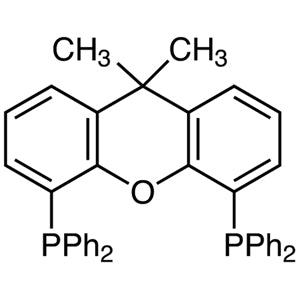
4,5-Bis(diphenylphosphino)-9,9-dimethylxanthene is a chemical compound widely used as a catalyst in various organic reactions, particularly in cross-coupling processes. This compound plays a crucial role in accelerating chemical reactions without being consumed in the final product. Its unique molecular structure enables it to interact effectively with transition metals, making it a valuable tool in synthetic chemistry. In laboratory settings, it is essential for promoting reactions that require precise control over reaction conditions and efficiency.
The compound’s stability and effectiveness make it a preferred choice for researchers and chemists. Its molecular structure, featuring two diphenylphosphino groups, enhances its catalytic properties and allows it to function efficiently in a range of reaction environments. The compound’s ability to maintain its activity under various reaction conditions ensures consistent results, which is critical in both academic and industrial research. Its high stability also reduces the risk of degradation during storage and use, making it a reliable option for long-term experiments.
In Indonesian laboratories, 4,5-Bis(diphenylphosphino)-9,9-dimethylxanthene is commonly used in organic chemistry research and molecular synthesis. It is particularly favored for its role in facilitating complex reactions such as Suzuki-Miyaura and Heck reactions. Its application in these contexts highlights its importance in advancing chemical synthesis and innovation within the scientific community in Indonesia.
TCI brochures (PDF)
- Carbon Monoxide (CO) Surrogate Reagents for Carbonylation 2024-11-07 · p. 2
- C-H Bond Activation Reaction 2025-06-20 · p. 9
- Ligands 2025-12-01 · p. 7
- Suzuki-Miyaura Cross Coupling Reaction 2025-12-01 · p. 26
- Biomaterials Research Reagents 2025-02-19 · p. 28
Related TCI products
- TCI B5239 940934-47-4 4,5-Bis(dicyclohexylphosphino)-9,9-dimethylxanthene
- TCI D3834 628333-86-8 1-[2-(Di-tert-butylphosphino)phenyl]-3,5-diphenyl-1H-pyrazole
- TCI B2064 95464-05-4 [1,1'-Bis(diphenylphosphino)ferrocene]palladium(II) Dichloride Dichloromethane Adduct
- TCI M2103 1229444-44-3 1-Methyl-1-[4-(diphenylphosphino)benzyl]pyrrolidinium Bromide
- TCI B2042 14588-08-0 Bis(triphenylphosphine)palladium(II) Diacetate
- TCI B2717 261733-18-0 4,6-Bis(diphenylphosphino)phenoxazine
- Cross-Coupling Reactions: This compound is ideal for cross-coupling reactions due to its ability to activate transition metals, enhancing reaction efficiency and selectivity.
- Organic Synthesis: It is widely used in organic synthesis to facilitate the formation of complex molecules with high precision and control.
- Catalytic Processes: Its catalytic properties make it suitable for various catalytic processes that require stable and efficient catalysts.
- Transition Metal Complex Formation: The compound's structure allows it to form stable complexes with transition metals, which is essential for many catalytic mechanisms.
- Research and Development: It is a key component in R&D settings where consistent and reliable catalytic performance is required.
From the TCI brochure
- Ligand used with Pd(OAc)2 in the T3121 carbonylation scheme
| Brand | TCI |
|---|---|
| CAS number | 161265-03-8 |
| Molecular formula | — |
| Purity | — |
| Category | Chemistry > Catalysis and Inorganic Chemistry > Cross-Coupling [Catalysis] |
| Pack sizes | Available in various quantities as per supplier specifications |
| Physical form | Solid, typically in powder or crystalline form |
| Storage | Store in a cool, dry place away from moisture and direct sunlight |
This compound should be stored in a cool, dry environment to maintain its stability and effectiveness. It is recommended to use airtight containers to prevent exposure to moisture and air, which can degrade its properties. Proper labeling of containers is essential to ensure safe handling and prevent accidental use. Due to its chemical nature, it should be kept away from incompatible substances such as strong oxidizers. Laboratory personnel should wear appropriate personal protective equipment when handling the compound. Regular monitoring of storage conditions is advised to ensure optimal performance and safety in the laboratory setting.
References cited in the TCI brochure
- Tsuyoshi Ueda. Trichlorophenyl Formate: Highly Reactive and Easily Accessible Crystalline CO Surrogate for Palladium-Catalyzed Carbonylation of Aryl/Alkenyl Halides and Triflates Organic Letters, 2012. doi:10.1021/ol302593z
- . Pd-Catalyzed External-CO-Free Carbonylation: Preparation of 2,4,6-Trichlorophenyl 3,4-Dihydronaphthalene-2-Carboxylate Organic Syntheses, 2014. doi:10.15227/orgsyn.091.0039
Product Categories
- Catalysis and Inorganic ChemistryCross-Coupling [Catalysis]Phosphine Ligands (for Cross-Coupling) [Catalysis]
- Catalysis and Inorganic ChemistryCross-coupling Reaction using Transition Metal Catalysts [C-C Bond Formation]Phosphine Ligands [Cross-coupling Reaction using Transition Metal Catalysts]
- Catalysis and Inorganic ChemistryPhosphorous Compounds [Catalysis and Inorganic Chemistry]Polydentate Phosphine Ligands [Catalysis]
- Synthetic ReagentsC-C Bond Formation [Synthetic Reagents]Cross-coupling Reaction using Transition Metal Catalysts [C-C Bond Formation]
- Synthetic ReagentsC-X(Non-Halogen) Bond Formation [Synthetic Reagents]C-H Bond Activation Reaction [Synthetic Reagents]
- Polymer/Macromolecule ReagentsPolymerization ReagentsControlled Radical Polymerization Reagents
- Biomaterials/Biocompatible Materials Research ReagentsPolymerization Reagents (Initiators, Catalysts, Ligands) [Biomaterials/Biocompatible Materials Research Reagents]Atom Transfer Radical Polymerization (ATRP) Reagents
Produk Terkait
-
4,5-Bis(dicyclohexylphosphino)-9,9-dimethylxanthene TCI B5239
Regular price From Rp 1.431.150,00Regular priceRp 1.016.400,00Sale price From Rp 1.431.150,00 -
1-[2-(Di-tert-butylphosphino)phenyl]-3,5-diphenyl-1H-pyrazole TCI D3834
Regular price From Rp 1.510.950,00Regular priceRp 1.072.050,00Sale price From Rp 1.510.950,00 -
[1,1'-Bis(diphenylphosphino)ferrocene]palladium(II)DichlorideDichloromethaneAdduct TCI B2064
Regular price From Rp 2.121.000,00Regular priceRp 1.498.350,00Sale price From Rp 2.121.000,00 -
1-Methyl-1-[4-(diphenylphosphino)benzyl]pyrrolidiniumBromide TCI M2103
Regular price Rp 6.943.650,00Regular priceRp 4.870.950,00Sale price Rp 6.943.650,00 -
Bis(triphenylphosphine)palladium(II)Diacetate TCI B2042
Regular price From Rp 2.942.100,00Regular priceRp 2.072.700,00Sale price From Rp 2.942.100,00 -
4,6-Bis(diphenylphosphino)phenoxazine TCI B2717
Regular price From Rp 610.050,00Regular priceRp 442.050,00Sale price From Rp 610.050,00 -
Bis(triphenylphosphine)palladium(II)Dichloride TCI B1667
Regular price From Rp 1.618.050,00Regular priceRp 1.146.600,00Sale price From Rp 1.618.050,00 -
Copper(I)Iodide TCI C2163
Regular price From Rp 582.750,00Regular priceRp 423.150,00Sale price From Rp 582.750,00


