


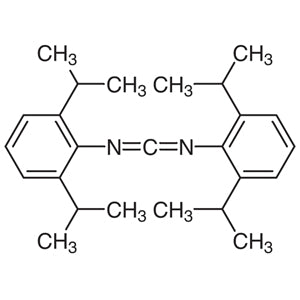
Bis(2,6-diisopropylphenyl)carbodiimide is a chemical compound widely used in organic chemistry reactions, particularly in the formation of amide bonds. This reagent plays a crucial role in activating carboxylic acid groups, which is essential for the synthesis of complex organic molecules. Its high reactivity enables efficient and rapid reactions, making it a valuable tool in laboratory settings. Due to its ability to facilitate amide bond formation, it is commonly used in research involving pharmaceuticals, organic chemistry, and material science.
One of the key properties that make this compound a preferred choice is its high reactivity towards water and polar compounds. This reactivity allows it to efficiently activate carboxylic acid groups without the interference of water, which is often a challenge in synthetic processes. Additionally, its stable molecular structure ensures that it remains effective under controlled laboratory conditions. The compound’s ability to enhance reaction efficiency and speed makes it a reliable option for various chemical applications.
In Indonesian laboratories, Bis(2,6-diisopropylphenyl)carbodiimide is frequently used in organic chemistry research, especially in the synthesis of amide compounds. Its reliability and effectiveness in activating carboxylic acid groups make it a popular choice among researchers. It is also used in the development of new pharmaceutical compounds and in the production of advanced materials. Its stability and reactivity ensure consistent results in chemical synthesis processes.
Related TCI products
- TCI C0793 2491-17-0 1-Cyclohexyl-3-(2-morpholinoethyl)carbodiimide Metho-p-toluenesulfonate [for Peptide Synthesis]
- TCI P1037 88038-94-2 4-(4-Propylphenyl)benzoic Acid
- TCI F1415 125109-85-5 3-(3-Isopropylphenyl)butanal
- TCI D5347 691-24-7 N,N'-Di-tert-butylcarbodiimide
- TCI B3465 244187-81-3 1,3-Bis(2,6-diisopropylphenyl)imidazol-2-ylidene
- TCI P2210 499793-84-9 1-(4-Propylphenyl)-2,5-di(2-thienyl)-1H-pyrrole
- Organic synthesis applications benefit from this compound's ability to efficiently activate carboxylic acid groups, enabling the formation of amide bonds in complex molecule synthesis.
- Pharmaceutical research utilizes this reagent to facilitate the creation of amide linkages, which are essential in drug molecule development and modification.
- Material science applications rely on its reactivity to form stable amide bonds, contributing to the development of advanced polymer and composite materials.
- Analytical chemistry experiments use this compound as a reagent to activate functional groups, enhancing the accuracy and efficiency of chemical analyses.
- Industrial chemical processes incorporate this compound for its high reactivity, ensuring rapid and efficient synthesis of target compounds in production settings.
| Brand | TCI |
|---|---|
| CAS number | 2162-74-5 |
| Molecular formula | — |
| Purity | — |
| Category | Chemistry > Building Blocks > Non-Heterocyclic Building Blocks |
| Pack sizes | Available in various quantities as per standard laboratory supply formats |
| Physical form | Solid |
| Storage | Store in a cool, dry place away from moisture and light |
This compound should be stored in a cool, dry environment to maintain its stability and reactivity. It is recommended to keep it in a sealed container to prevent exposure to moisture, which can affect its effectiveness. Due to its reactivity with water and polar substances, it should be handled in a well-ventilated area and stored away from incompatible materials. Laboratory personnel should wear appropriate personal protective equipment, such as gloves and safety goggles, when handling this compound. Proper labeling of storage containers is essential to ensure safe handling and prevent accidental exposure. Regular inspection of storage conditions is advised to maintain the integrity of the compound and ensure its continued use in research applications.
—
Produk Terkait
-
1-Cyclohexyl-3-(2-morpholinoethyl)carbodiimideMetho-p-toluenesulfonate[forPeptideSynthesis] TCI C0793
Regular price From Rp 6.281.100,00Regular priceRp 4.407.900,00Sale price From Rp 6.281.100,00 -
4-(4-Propylphenyl)benzoicAcid TCI P1037
Regular price Rp 2.464.350,00Regular priceRp 1.738.800,00Sale price Rp 2.464.350,00 -
3-(3-Isopropylphenyl)butanal TCI F1415
Regular price Rp 3.100.650,00Regular priceRp 2.168.250,00Sale price Rp 3.100.650,00 -
N,N'-Di-tert-butylcarbodiimide TCI D5347
Regular price From Rp 1.246.350,00Regular priceRp 887.250,00Sale price From Rp 1.246.350,00 -
1,3-Bis(2,6-diisopropylphenyl)imidazol-2-ylidene TCI B3465
Regular price From Rp 3.630.900,00Regular priceRp 2.554.650,00Sale price From Rp 3.630.900,00 -
1-(4-Propylphenyl)-2,5-di(2-thienyl)-1H-pyrrole TCI P2210
Regular price Rp 3.949.050,00Regular priceRp 2.777.250,00Sale price Rp 3.949.050,00 -
1-(2,6-Diisopropylphenyl)imidazole TCI D4948
Regular price From Rp 4.001.550,00Regular priceRp 2.814.000,00Sale price From Rp 4.001.550,00 -
1,3-Bis(2,6-diisopropylphenyl)imidazoliumChloride TCI D3611
Regular price From Rp 1.060.500,00Regular priceRp 757.050,00Sale price From Rp 1.060.500,00


