N,N'-Bis(tert-butoxycarbonyl)-1H-pyrazole-1-carboxamidine is a synthetic chemical compound widely used in laboratory settings for its role in forming C-X (non-halogen) bonds during complex molecule synthesis. This reagent is essential in organic chemistry and pharmacology for its ability to participate in various chemical reactions, including nucleophilic substitution and coupling reactions. Its unique molecular structure enables it to serve as a versatile building block in the synthesis of heterocyclic compounds and their derivatives, making it a key component in advanced chemical research.
The compound's preferred status stems from its stable yet reactive nature, which allows for controlled chemical transformations under specific conditions. The presence of tert-butoxycarbonyl groups provides structural stability while maintaining reactivity, enabling precise manipulation in synthetic pathways. Its molecular complexity and functional groups make it suitable for applications requiring high specificity and selectivity, such as in drug development and molecular modification processes. These properties ensure its reliability and effectiveness in a wide range of chemical reactions.
In Indonesian laboratories, this compound is commonly used in scientific research, pharmaceutical development, and industrial chemical synthesis. It supports the creation of complex molecules for medicinal and chemical applications, contributing to advancements in both academic and industrial sectors. Its role in high-precision chemical synthesis makes it an essential tool for researchers and chemists working in diverse fields.
TCI brochures (PDF)
- Guanidinylation Reagents 2025-11-07 · p. 1
- C-N Bond Formation Reactions 2025-08-07 · p. 4
Related TCI products
- TCI B4028 152120-61-1 N-(tert-Butoxycarbonyl)-1H-pyrazole-1-carboxamidine
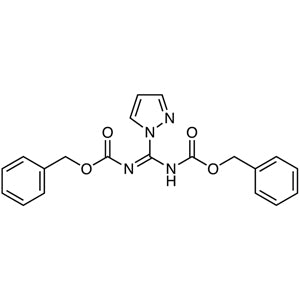
- TCI B3605 152120-55-3 N,N'-Bis(carbobenzoxy)-1H-pyrazole-1-carboxamidine
- TCI C2709 152120-62-2 N-(Carbobenzoxy)-1H-pyrazole-1-carboxamidine
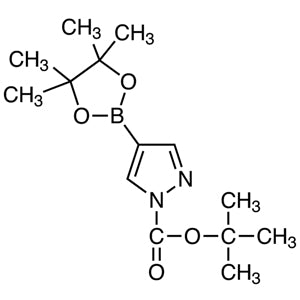
- TCI B5203 552846-17-0 1-(tert-Butoxycarbonyl)-4-(4,4,5,5-tetramethyl-1,3,2-dioxaborolan-2-yl)pyrazole
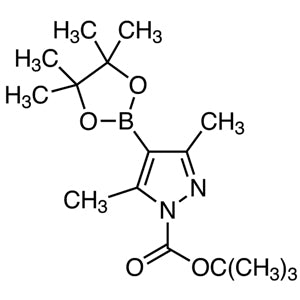
- TCI B6026 1073354-70-7 1-(tert-Butoxycarbonyl)-3,5-dimethyl-4-(4,4,5,5-tetramethyl-1,3,2-dioxaborolan-2-yl)pyrazole
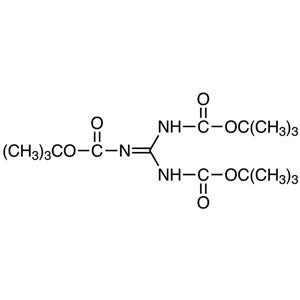
- TCI T2964 216584-22-4 1,2,3-Tris(tert-butoxycarbonyl)guanidine
- Used in pharmaceutical research for the synthesis of complex heterocyclic compounds due to its reactivity and structural versatility.
- Applied in organic chemistry for nucleophilic substitution and coupling reactions, offering controlled chemical transformations.
- Utilized in drug development for the modification of molecular structures, enabling the creation of bioactive compounds.
- Employed in synthetic chemistry for the preparation of derivatives with specific functional groups, enhancing molecular functionality.
- Integrated into academic research projects for the study of molecular reactivity and synthetic pathway optimization.
From the TCI brochure
- Guanidinylation of a primary amine (R-NH2) with Et3N in CH2Cl2 at rt, giving the Boc-protected guanidine; subsequent TFA treatment in CH2Cl2 at rt gives the free guanidine
| Brand | TCI |
|---|---|
| CAS number | 152120-54-2 |
| Molecular formula | — |
| Purity | — |
| Category | Chemistry > Synthetic Reagents > C-X(Non-Halogen) Bond Formation [Synthetic Reagents] |
| Pack sizes | Available in standard laboratory quantities as per supplier specifications |
| Physical form | Solid, crystalline powder |
| Storage | Store in a cool, dry place away from direct sunlight and moisture |
This compound should be stored in a cool, dry environment to maintain its chemical stability. It is recommended to keep it in a tightly sealed container to prevent exposure to moisture and air. Due to its reactivity, it should be handled in a well-ventilated area, ideally under a fume hood, to minimize inhalation risks. Avoid contact with incompatible substances such as strong acids or bases. Proper personal protective equipment, including gloves and safety goggles, should be worn during handling. Regular monitoring of storage conditions ensures the compound remains effective for its intended applications.
References cited in the TCI brochure
- Takao Noguchi. Emergent Molecular Recognition through Self‐Assembly: Unexpected Selectivity for Hyaluronic Acid among Glycosaminoglycans Angewandte Chemie International Edition, 2016. doi:10.1002/anie.201511564
Produk Terkait
-
N-(tert-Butoxycarbonyl)-1H-pyrazole-1-carboxamidine TCI B4028
Regular price Rp 2.384.550,00Regular priceRp 1.683.150,00Sale price Rp 2.384.550,00 -
N,N'-Bis(carbobenzoxy)-1H-pyrazole-1-carboxamidine TCI B3605
Regular price From Rp 1.246.350,00Regular priceRp 887.250,00Sale price From Rp 1.246.350,00 -
N-(Carbobenzoxy)-1H-pyrazole-1-carboxamidine TCI C2709
Regular price From Rp 875.700,00Regular priceRp 627.900,00Sale price From Rp 875.700,00 -
1-(tert-Butoxycarbonyl)-4-(4,4,5,5-tetramethyl-1,3,2-dioxaborolan-2-yl)pyrazole TCI B5203
Regular price From Rp 1.326.150,00Regular priceRp 942.900,00Sale price From Rp 1.326.150,00 -
1-(tert-Butoxycarbonyl)-3,5-dimethyl-4-(4,4,5,5-tetramethyl-1,3,2-dioxaborolan-2-yl)pyrazole TCI B6026
Regular price From Rp 1.272.600,00Regular priceRp 905.100,00Sale price From Rp 1.272.600,00 -
1,2,3-Tris(tert-butoxycarbonyl)guanidine TCI T2964
Regular price From Rp 1.590.750,00Regular priceRp 1.127.700,00Sale price From Rp 1.590.750,00 -
1,3-Bis(tert-butoxycarbonyl)-2-(trifluoromethanesulfonyl)guanidine TCI B3625
Regular price From Rp 4.345.950,00Regular priceRp 3.054.450,00Sale price From Rp 4.345.950,00 -
N,N'-Dicyclohexyl-4-morpholinecarboxamidine TCI D3792
Regular price From Rp 875.700,00Regular priceRp 627.900,00Sale price From Rp 875.700,00